AI Policies Fail When Nobody Owns Enforcement

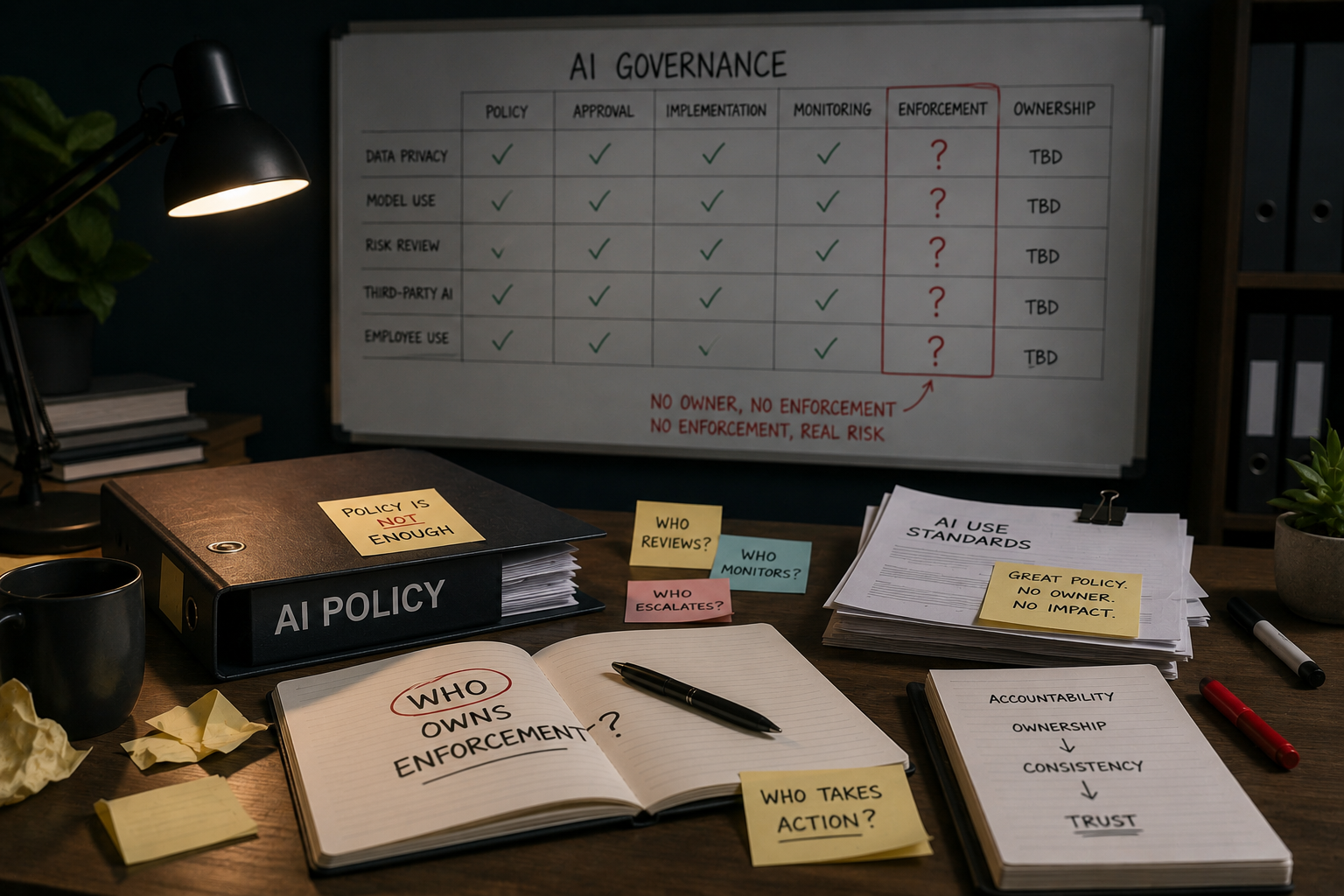
A lot of organizations already have an AI policy. The document exists, leadership signed off on it, legal reviewed it, and people nodded along to it during onboarding. On paper, the box is checked. Then a manager asks a simple question, something like “who actually approves this tool, and who’s checking that we follow the policy day to day,” and the room goes quiet. The policy exists. The ownership doesn’t.
That gap matters more than it first appears. AI governance rarely breaks down because the policy language was wrong. It breaks down because, once the document is published, nobody is clearly responsible for it in practice. A policy describes intent. It doesn’t enforce itself.
Why governance feels clearer on paper than in practice
Early on, governance conversations are mostly about writing rules: which tools are approved, what acceptable use looks like, how data should be handled, what the review process is. Those are real and necessary foundations. The problem is that they’re easier to write than to run.
As AI use spreads across teams, operational complexity climbs fast. Different departments adopt tools their own way. People experiment on their own. Product moves faster than the review cycle. And almost everyone quietly assumes ownership lives somewhere else, with legal, or security, or “leadership.” Eventually the organization realizes it has governance documentation without governance operations, which is a very different thing from being ungoverned, but it produces a lot of the same symptoms.
Why accountability gets blurry so quickly
AI governance naturally sits across several functions at once. Legal owns part of it, security owns part, product drives implementation, operations runs the workflows, HR handles training, leadership sets the posture. That shared involvement is healthy. It’s also exactly how ownership goes fuzzy, because when everyone is a little responsible, no one is clearly accountable.
When ownership is unclear, the symptoms are recognizable: enforcement that’s inconsistent from team to team, the same risk getting reviewed twice by people who don’t know about each other, unclear escalation paths, shadow usage running ahead of the official picture, and decisions that stall because nobody is sure whose call it is. None of this means the organization is failing. Most of the time it just means governance maturity is still catching up to how fast AI got adopted, which is normal.
A policy document rarely changes behavior on its own if teams still don’t know who owns the decisions day to day.
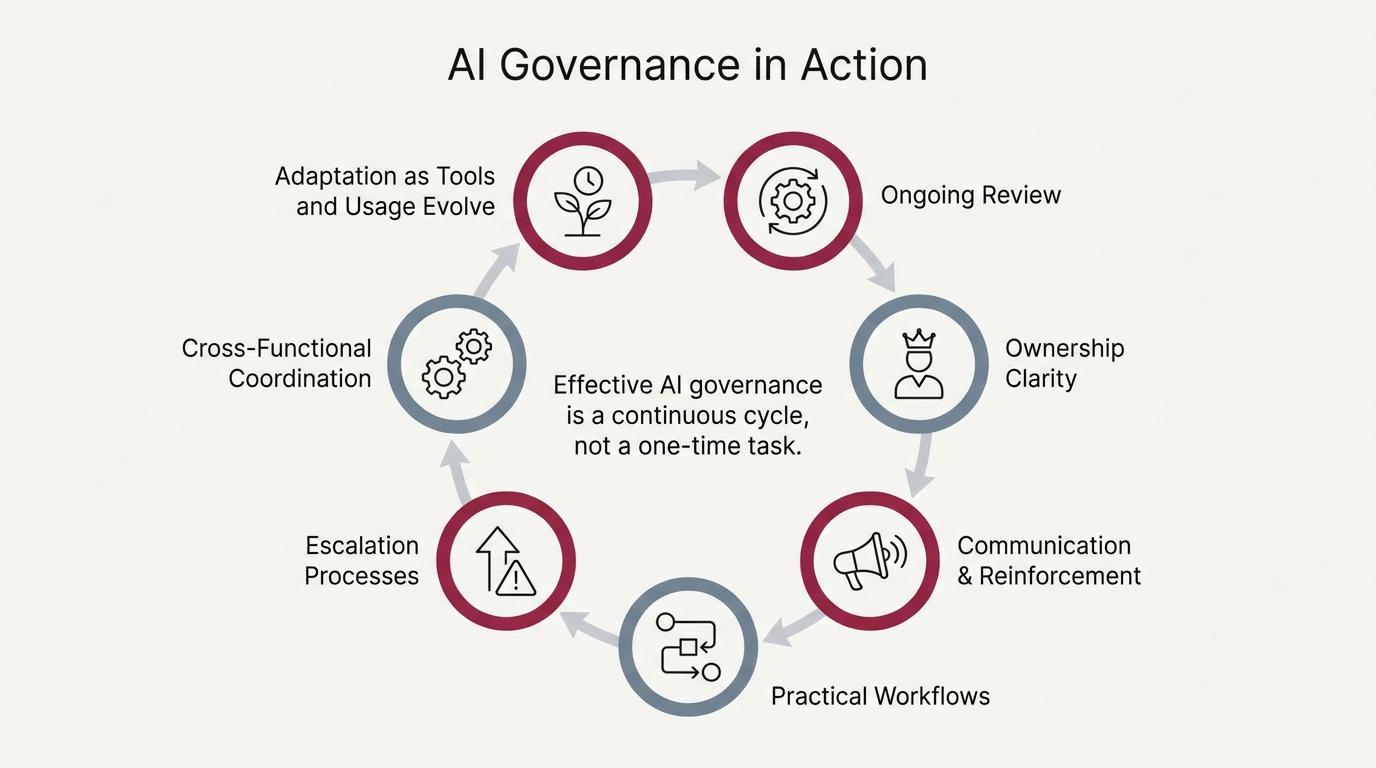
What effective ownership actually looks like
Strong ownership doesn’t mean one department controls everything. It means accountability is clear at a few different levels, so decisions don’t fall through the cracks between teams.
At the executive level, leadership sets the governance expectations, the organization’s risk posture, and the priorities, which keeps functions aligned. At the operational level, specific teams or people become responsible for actually maintaining the workflows, reviews, and approvals, and this is usually the layer organizations are missing. Then at the functional level, each group understands its own piece: security handling risk reviews, product documenting how it implements, legal watching regulatory questions, operations tracking adoption. The goal isn’t to centralize every decision. It’s to make ownership visible enough that things don’t quietly slip between functions.
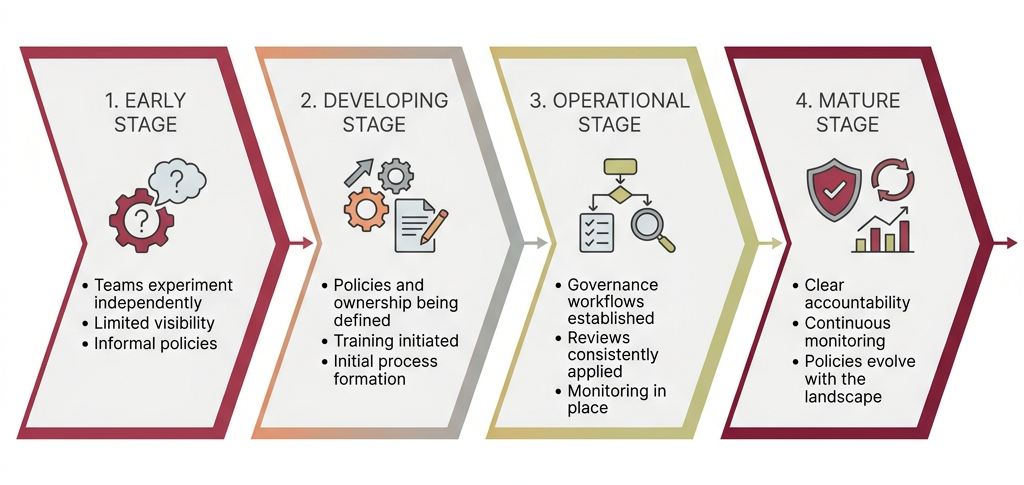
Governance maturity usually arrives in stages
Most organizations don’t start with a mature governance model, and they don’t need to. The progression tends to be gradual, from informal experimentation, to documenting policies and defining ownership, to integrating governance into everyday operations, to a mature state with clear accountability and continuous monitoring. The useful reframe is that you don’t need perfect governance immediately. You need governance mature enough to match the level of AI adoption already happening in your organization.
The questions that reveal readiness
As governance matures, a handful of operational questions tell you more about your readiness than the policy document ever will:
Who owns AI governance operationally across the organization, not just on paper?
How are AI approval or review decisions actually documented?
Do employees know where to go with a governance question?
Are responsibilities clearly divided across legal, security, product, operations, and leadership?
Are the processes practical enough that people will realistically follow them?
The goal is clarity, not bureaucracy
Organizations sometimes hold back from formalizing ownership because they worry it will slow things down. In practice it usually does the opposite. When teams understand how decisions get made, where approvals happen, who owns escalation, and what the standards are, they move more confidently, not less. Clear governance reduces friction rather than adding it.
Sustainable governance is built through consistent operational behavior, not through a stronger document. The organizations that handle this well tend to treat it calmly and operationally, as a living practice that adapts as tools and usage change. AI governance becomes achievable the moment you treat it as an iterative operating practice instead of a one-time compliance task.
* * *
If you’re assigning ownership and turning policy into practice, the AI Governance Experts inside Compass can help you map who owns what and where the gaps are before they become real risk.


