AI Productivity: Working Smarter in the Age of AI

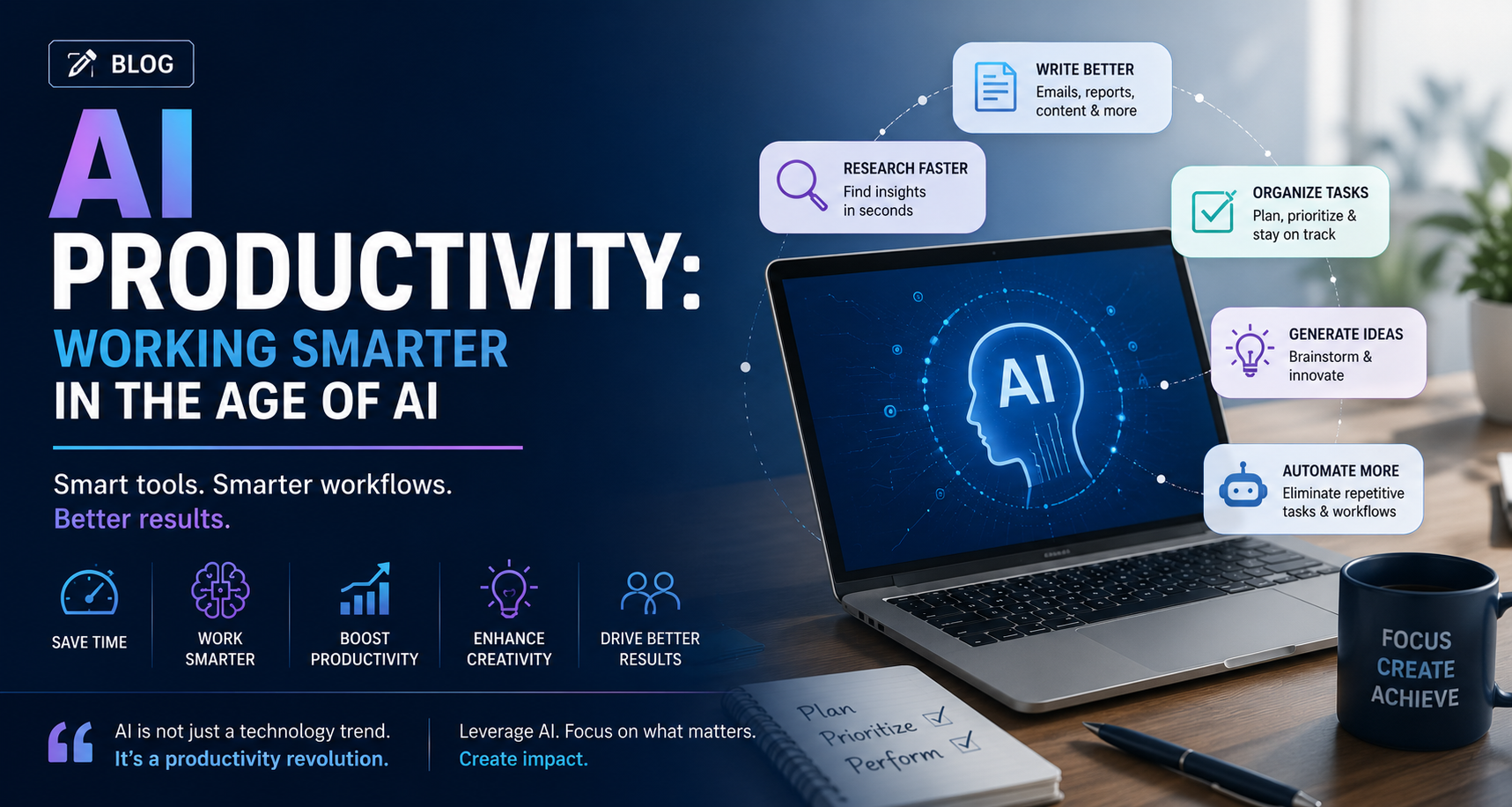
AI won't replace you. But professionals who learn to work with AI will have a clear advantage."
A few years ago, AI felt like something reserved for researchers and tech companies. Today, it's part of everyday work. Whether you're writing emails, preparing presentations, analyzing data, planning projects, or brainstorming ideas, AI is becoming a trusted companion for millions of professionals.
But despite all the excitement, one question keeps coming up:
"How can AI actually make me more productive?"
The answer is simpler than many people think.
AI isn't here to replace your thinking. It's here to enhance it.
The biggest productivity gains don't come from letting AI do your job. They come from using AI to eliminate routine work so you can spend more time on work that truly requires your expertise.
Productivity Looks Different Today
For decades, productivity was measured by how much work we could squeeze into a day.
Today, the definition is changing.
Real productivity is about creating better outcomes with less unnecessary effort.
The most effective professionals aren't always the busiest. They're the ones who know where to invest their time and where to let technology handle repetitive tasks.
Think of AI as a highly capable assistant. It can prepare the first draft, organize information, summarize research, and generate ideas, but you're still the one making the important decisions.
That's where the real value lies.
Where AI Makes an Immediate Difference
Research Without Information Overload
We've all experienced spending hours jumping between websites, articles, and reports looking for answers.
AI can dramatically reduce that effort by summarizing information, comparing sources, identifying key insights, and helping you understand complex topics in minutes instead of hours.
You're still responsible for validating the information, but AI helps you get to the important parts much faster.
Writing Faster Without Sacrificing Quality
Whether you're writing emails, reports, proposals, presentations, or LinkedIn posts, getting started is often the hardest part.
AI removes the pressure of the blank page.
It can help you:
- Draft content quickly
- Improve grammar and clarity
- Adjust tone for different audiences
- Simplify technical information
- Generate multiple versions of the same message
The first draft doesn't need to be perfect. It just needs to exist.
Your experience and judgment transform that draft into something valuable.
Turning Meetings into Action
Many meetings end with pages of notes and little follow-through.
AI can summarize conversations, capture decisions, identify action items, assign responsibilities, and even draft follow-up emails.
Instead of spending valuable time documenting discussions, you can focus on executing them.
Brainstorming Without Limits
Every creative process starts with ideas.
Sometimes they come naturally. Sometimes they don't.
AI is an excellent brainstorming partner. It can generate alternative perspectives, challenge assumptions, suggest creative approaches, and help overcome mental blocks.
Whether you're designing a workshop, launching a product, planning a campaign, or solving a business problem, AI helps expand your thinking.
It doesn't replace creativity.
It fuels it.
Learning at Your Own Pace
The pace of change today is overwhelming.
New tools, new technologies, and new skills appear almost every week.
AI makes learning easier by explaining complex concepts in simple language, summarizing books and articles, creating learning plans, and answering questions instantly.
Instead of searching endlessly for information, you can have a conversation with it.
The Human Skills That Matter More Than Ever
One common misconception is that AI makes human skills less important.
The opposite is true.
As AI becomes better at generating information, human judgment becomes even more valuable.
AI can generate dozens of solutions.
You decide which one fits the situation.
AI can write content.
You decide whether it's accurate and meaningful.
AI can suggest strategies.
You decide whether they're ethical, practical, and aligned with business goals.
Skills like critical thinking, empathy, communication, creativity, leadership, and decision-making aren't disappearing.
They're becoming even more valuable.
Common Mistakes Professionals Make
Many people expect AI to deliver perfect answers immediately.
That's rarely how it works.
Some of the most common mistakes include:
- Accepting AI responses without checking the facts
- Asking vague questions and expecting detailed answers
- Using AI for every task instead of the right tasks
- Sharing confidential information without considering privacy
- Assuming AI knows the context of your business
The quality of AI's output depends largely on the quality of your input.
Better prompts produce better results.
More importantly, better thinking produces better prompts.
Habits of AI-Productive Professionals
People who consistently benefit from AI tend to follow a few simple habits.
They use AI to automate repetitive work instead of replacing meaningful work.
They spend more time thinking strategically and less time doing administrative tasks.
They verify AI-generated information before using it.
They experiment with new tools and workflows instead of sticking to old habits.
And perhaps most importantly, they focus on solving problems, not just completing tasks.
Over time, these small habits create a significant competitive advantage.
The Future of Work Is Human + AI
The future isn't about humans competing with machines.
It's about humans working alongside them.
The organizations that embrace this partnership will innovate faster, respond more quickly to change, and create better experiences for customers.
The professionals who thrive won't necessarily be those who know every AI tool available.
They'll be the ones who know how to ask thoughtful questions, think critically, solve meaningful problems, and use AI with intention.
Technology will continue to evolve.
Human judgment will continue to matter.
The combination of both is where the greatest opportunities lie.
Final Thoughts
AI isn't a shortcut to success.
It's a productivity multiplier.
Used wisely, it helps us spend less time on repetitive work and more time on creative thinking, problem solving, innovation, and building meaningful relationships.
The future belongs to professionals who know when to rely on AI and when to rely on their own experience.
After all, AI can generate answers.
Only humans can decide which answers truly matter.
How are you using AI to work smarter? I'd love to hear what's working for you and what challenges you're still trying to solve.


