Blind Trust in AI Outputs Is Becoming a Business Risk


Someone on a finance team pasted an AI-written summary of a contract into an email, added “looks fine to me,” and sent it up for sign-off. The summary was clean, confident, and well organized. It also left out a renewal clause that changed the numbers in a way that mattered. Nobody had lied. The model had done roughly what it was asked. The trouble was that four people in a row read a fluent paragraph and treated the fluency as if it were verification.
This is not a story about a bad tool. The tool was fine. It is a story about how people read.
Everyone knows AI gets things wrong sometimes. That is not really the risk. The risk is that it gets things wrong in a calm, confident, nicely formatted way, and confidence is exactly the cue humans use to decide when to stop checking. The better the output looks, the less we tend to verify it. The polish does the persuading.
Why this is creeping in now
A couple of years ago, AI output had visible seams. It was useful but a little off, and the roughness kept you alert. You read it the way you read a first draft from someone new, with one eyebrow up. That friction quietly did a job. It reminded you to check.
The outputs got smoother. The eyebrow came down. Now a generated summary reads like something a competent colleague wrote, and we extend it the same trust we would extend a competent colleague, without noticing that we never actually earned that trust with this particular paragraph.
We started trusting the writing instead of the work. They are not the same thing, and the gap is where the risk lives.
What blind trust actually costs
The costs are rarely dramatic, which is part of why they accumulate. A slightly wrong number flows into a forecast. A missed clause shapes a negotiation. A summary that quietly dropped the inconvenient detail becomes the basis for a decision, and three meetings later nobody can remember that the detail ever existed.
There is a second cost that is easy to miss. When an AI output is wrong and a decision follows from it, accountability gets slippery. “The model said so” starts doing work it should never do, as if the tool were a person who could be held responsible. It cannot. The responsibility stayed with the humans the whole time. It just got harder to see.
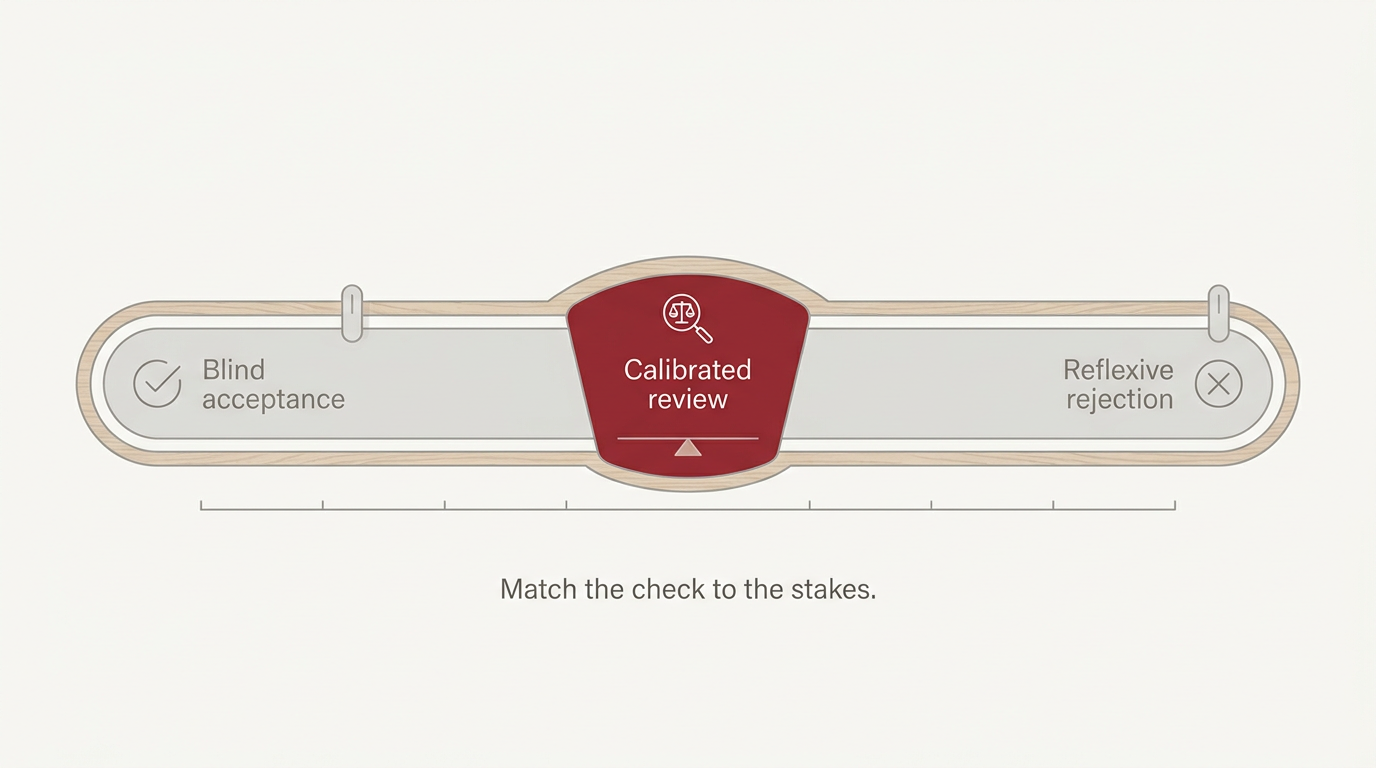
The healthy position is not suspicion of everything, which is its own kind of waste. It is calibration, knowing which outputs deserve a real check and which genuinely do not.
Where teams slip
The most common slip is treating fluency as accuracy, which we have covered. Two more are worth naming. One is that nobody actually owns the output. It came from a tool, it got forwarded, and responsibility evaporated somewhere in the chain. The other is checking the wrong things: teams scrutinize the dramatic, visible uses and wave through the routine ones, when it is usually the routine, trusted-by-default outputs that quietly carry the error.
What helps, in practice
None of this requires a heavy review regime. A few habits do most of the work:
• Decide in advance which kinds of output get a human check and which are low enough stakes to trust. Make it a deliberate choice, not a mood.
• Check the inputs, not only the output. A confident answer built on the wrong source document is still wrong, just persuasively so.
• Keep a named human owner for any output that feeds a real decision. “The model” cannot own anything.
• Spot-check the routine, trusted uses occasionally, since those are the ones nobody is watching.
It also helps to remember that the goal is not to slow down. It is to keep your judgment in the loop while still moving quickly, which is the same balance behind Strategies to Navigate AI’s Dual Promise of Opportunity and Risk.
Worth sitting with
When was the last time we accepted an AI output mainly because it sounded confident and well-written?
Which of our AI-assisted outputs feed real decisions, and who actually owns checking them?
Are we scrutinizing the dramatic uses while waving through the routine ones that carry more quiet risk?
If a decision we made on an AI output turned out to be wrong, could we trace how it happened?
You do not need to distrust the tools to use them well. You need to keep noticing that a fluent answer and a verified one are different things, and to spend your checking where the stakes actually are. If you want more on building that habit across a team, our other writing on responsible AI use is a good place to keep reading.


