EXECUTIVE PRESENCE : The Missing Skill That Could Be Costing You Your Next Promotion
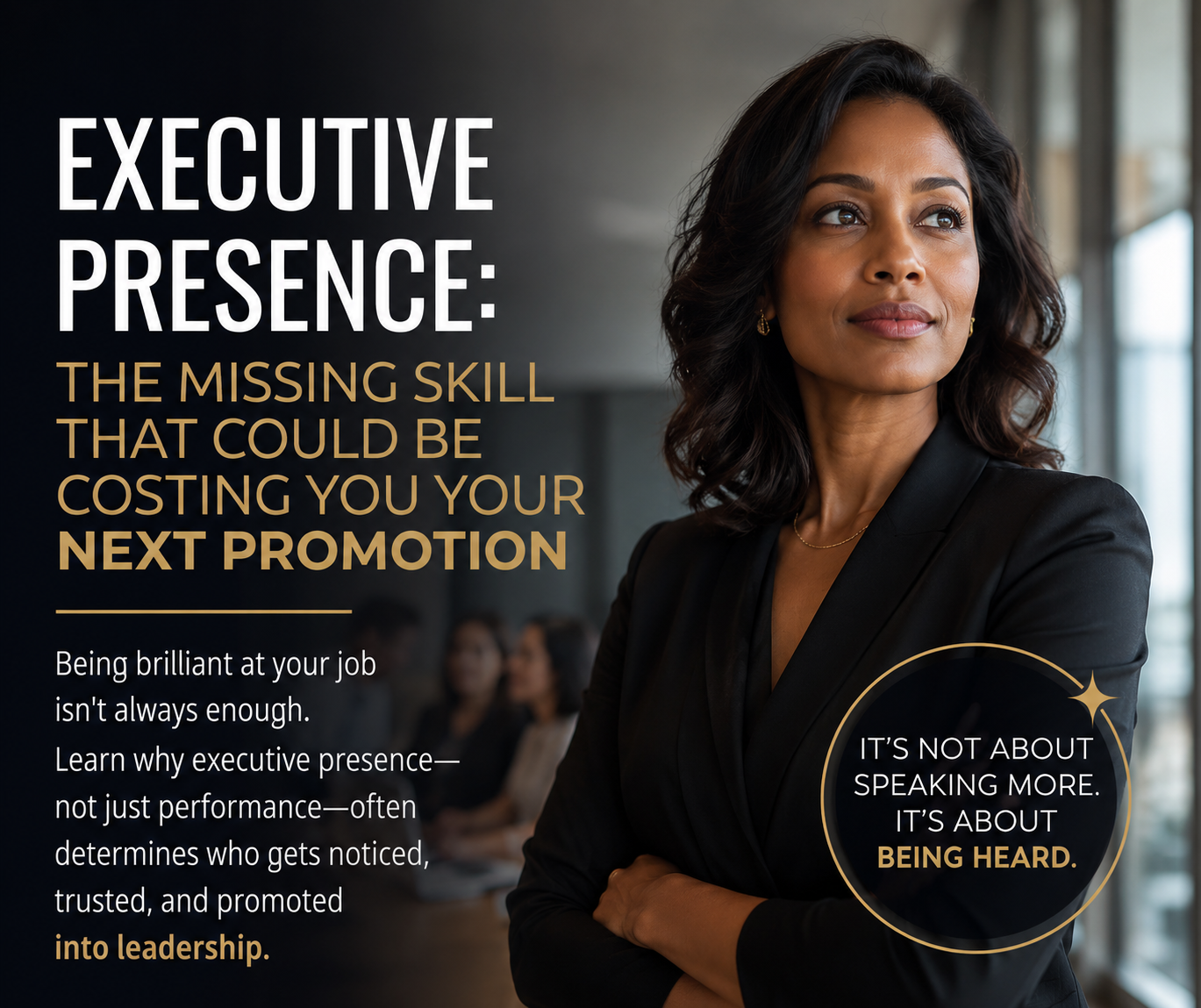
Generated by AI
Why do some highly capable people get promoted, while others who are equally talented do not?
This was the question that my coaching client, Brenda, wanted to explore during coaching.
Brenda was exceptionally good at her job. She was reliable, consistently delivered high quality work as was well respected for her expertise. Despite her strong performance she wasn't progressing into senior leadership roles. During team meetings Brenda asked a lot of questions, explained her thinking at length and spoke frequently to demonstrate engagement and value.
Feedback from her VP, suggested that she lacked Executive Presence.
Most clients think that Executive Presence is about putting your voice in the room, delivering polished speeches or displaying charisma.
from my experience, Executive Presence is felt by others and shown in the confidence they have in how you think communicate and show up.
The Power of Slowing Down
During our coaching session, I shared my observation. At times she spoke very fast and I struggled to understand her every word.
Brenda smiles and said that when she was excited or felt passionately about a subject she spoke quickly. She also shared that at meetings she only had a few minutes to get her contributions in.
When I asked, "How much of you message may be lost?"
She paused and replied, "I never thought of it like that."
In sessions, Brenda practiced slowing down her speech. She realised that this gave her more thinking time and she could choose her words more carefully.
Concise Creates Confidence
Brenda believed that providing more explanations demonstrated her expertise and added value to meetings.
"How does your VP speak?"
She replied that he was brief and spoke with clarity and precision. In a few well chosen sentences he spoke about what matters, and what doesn't.
She realised that her speech patter contrasted with the way in which her VP communicated.
From Asking Questions to Adding Perspective
As Brenda reflected on her communication style she had another "Ah Ha."
Her peers often complimented her for asking "great questions."
She admitted that she often knew the answers and asked open ended questions to help others think.
"What may someone else think of someone who asks questions?"
She realised that she was may be perceived as as someone who was seeking answers instead of someone providing direction.
"How else can you add value?"
She replied that she could add value by summarising a discussion, highlighting a risk, identifying a missing perspective or making a recommendation.
With this in mind Breda began experimenting with "I" statements such as:
"I notice that", My recommendations would be, I believe that xyz is missing, I believe that.
Small Changes, Big Difference
By out third coaching session, Brenda reported that she was noticing a shift.
Her colleagues appeared to be listening more attentively and she felt more confident contributing. She was asking less questions and sharing more or her thoughts and ideas. Her VP even complimented her after one of her meetings.
She was planning to demonstrate her Executive Presence, that she was intentionally developing, at an upcoming leadership meeting.
Executive Presence is a Practice
During our time together, Brenda shifted her belief system.
Before she viewed Executive Presence as a personality trait reserved for a few.
Now she knows that Executive Presence is a leadership capability that can be developed through intentional practice.
For her it meant speaking less, observing more, making thoughtful contributions and slowing down enough for other to see the quality of her thinking.
What does Executive Presence mean to you?


