How to Name a Fireside Chat People Actually Join

"Marketing session with Jane" doesn't fill a room. "The First-10-Clients Sprint for Freelance Designers" does.
Same expert. Same knowledge. Different name. Different result.
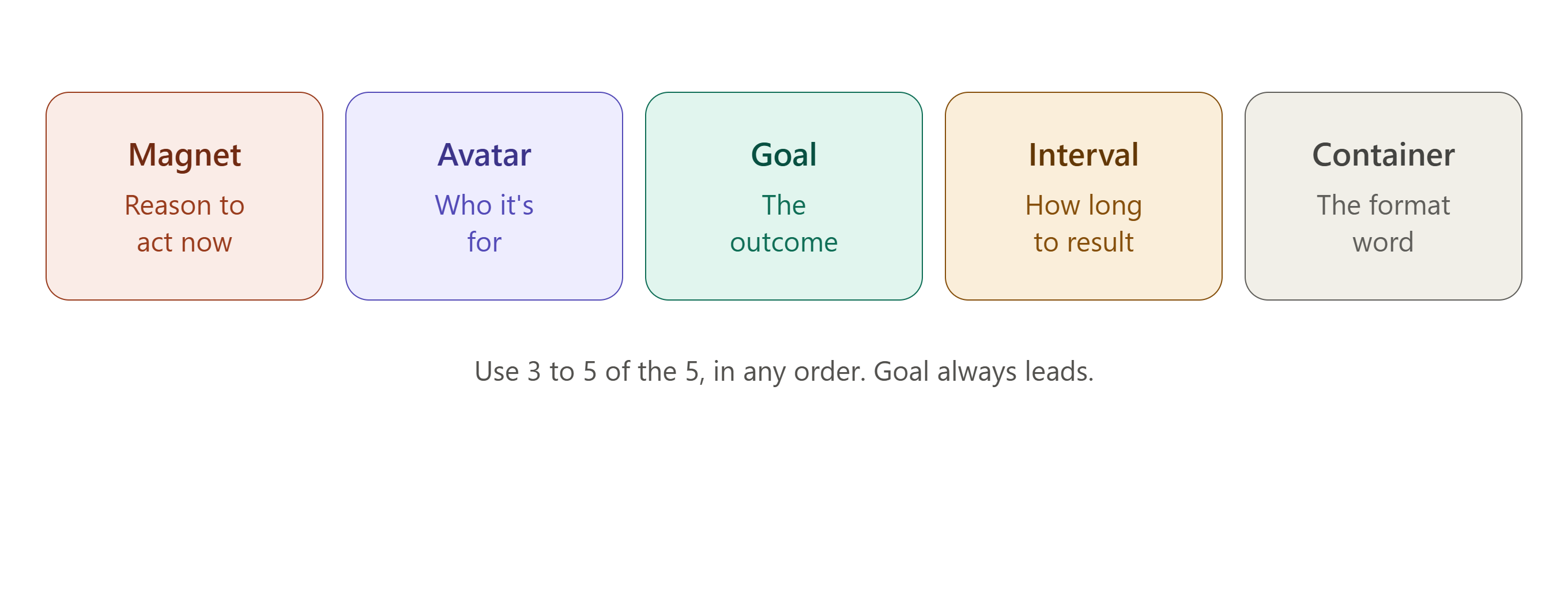
A weak title describes a topic. A strong title names a destination someone wants to reach, for someone specific, with a reason to show up now. Everything below is just that idea, broken into parts you can actually use.
The five parts, use 3 to 5
Goal. The outcome, first. "Land your first 10 clients" beats "marketing fundamentals," every time, no exceptions. This is the one part nobody skips, because it's the one part that's obvious once you see it missing.
Avatar. Name the exact person. "For freelance designers" instead of nobody. This single word is what lets the same knowledge sell for 5 to 10 times more, because a specific person reads it and thinks "that's me" instead of scrolling past.
Container. A word that turns a session into a product: Sprint, Blueprint, Bootcamp, Intensive, Masterclass. "Marketing session" is a meeting you can skip. "Marketing sprint" is a thing you join.
Interval. How long to the result. Short signals low effort. Long signals depth. Promise what you can actually deliver, don't slap "30 days" on something that takes one call.
Magnet. The reason to act right now: a date, a cohort, a season. Skip it if there's nothing true to say. Use it on a recurring session and "July cohort" does work a static title never will.
What weak looks like next to strong
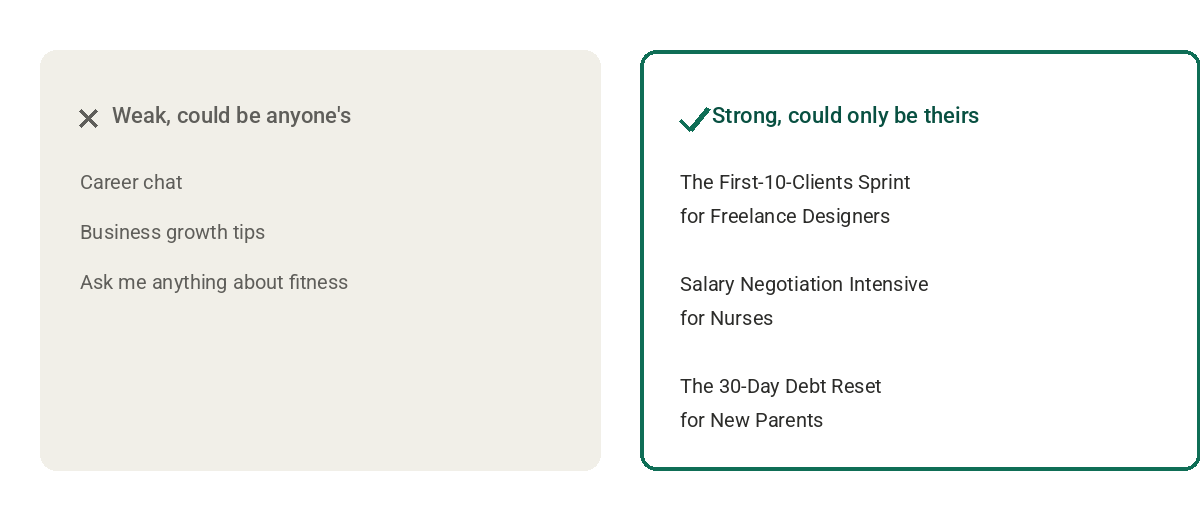
Read both lists out loud. The weak ones could be anyone's session. The strong ones could only be that one. That's the entire test.
What to actually do this week
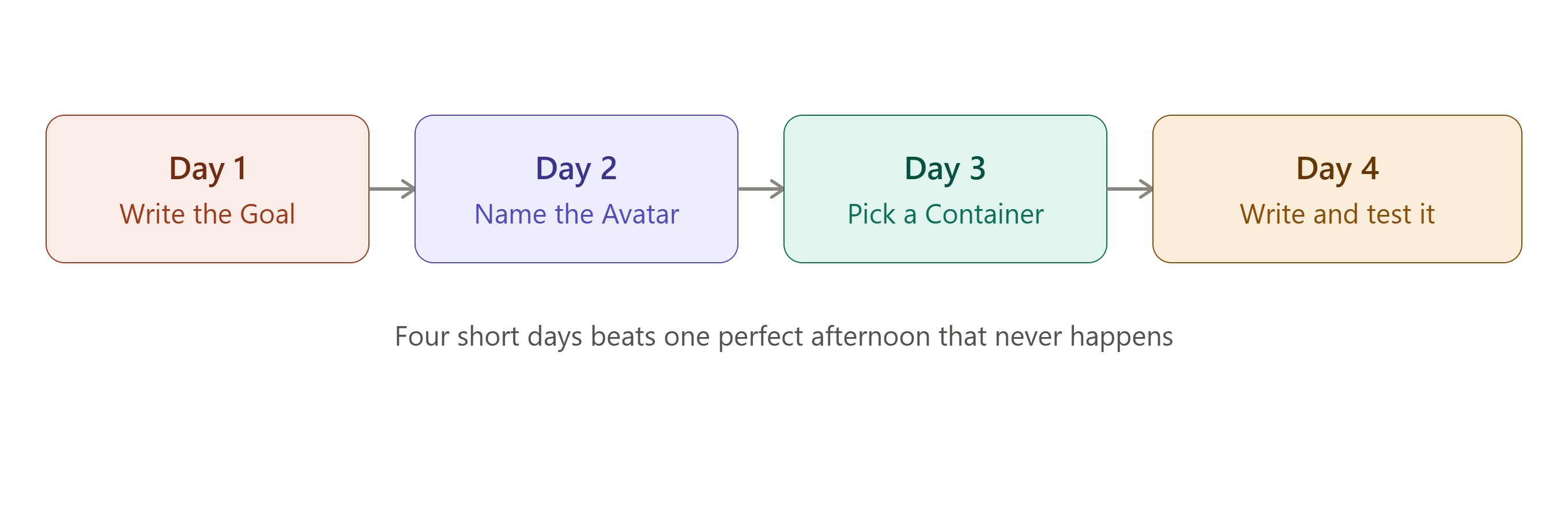
Day 1: Write your Goal first, one sentence, the destination not the topic.
Day 2: Name your Avatar. If "everyone" is the answer, name the type of person who actually books you most instead.
Day 3: Pick one Container word. Say it out loud. Product or meeting, you'll hear the difference immediately.
Day 4: Write 2 to 3 full variations, mixing in Interval and Magnet where they're true. Read each one to someone who's never heard your pitch. The one they remember is the one you use.
Want AI's help scoring your own draft against this exact formula? [Steal this prompt to fix your title.]
You're helping me write a free-tier blog post for Accomplishr's Writer's Hub. This post is activation-tier content, teaching experts how to set up and succeed on the platform (Fireside Chat, BookNow, or Blog/Subscription), not strategy-tier content, that's reserved for my paid subscription.
VOICE: Sam Ovens / Hormozi register. Short sentences that build to a payoff. No dashes in body copy. Sentence case, no corporate polish, no fear-based urgency, no banned words (journey, unlock, empower, game-changer, supercharge). Address the reader directly with "you."
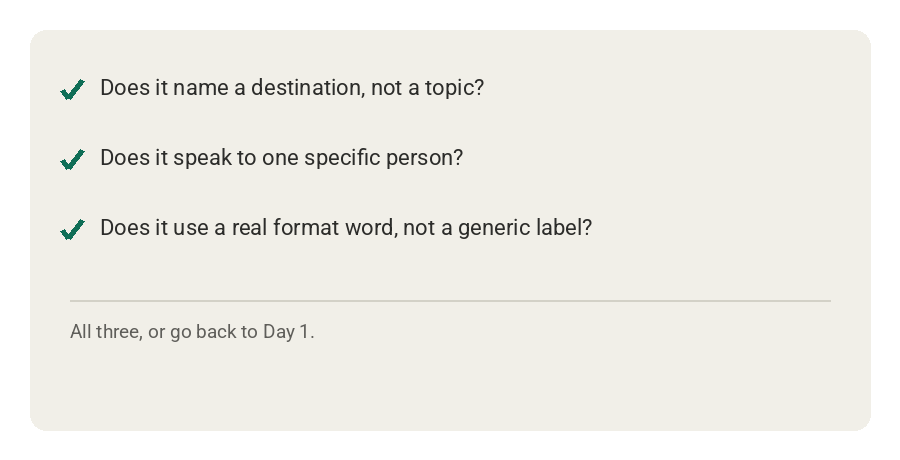
TITLE RULE: Every title must pass this check before it ships. Does it name a destination, not a topic? Does it speak to one specific person? Does it use a real format word (Sprint, Blueprint, Bootcamp, Intensive, Masterclass) instead of a generic label? If any of the three is missing, it's a topic label, not a title, rewrite it. This is the Goal + Avatar + Container formula, and it applies to blog titles the same as it applies to Fireside Chat names.
POST STRUCTURE, in this order:
1. Hook: a real contrast or gap, stated in 2 sentences max, no throat-clearing.
2. An instant action: something the reader does in the next 60 seconds, before reading further. A fill-in-the-blank or a 1-line test.
3. The core teaching, broken into named parts (not paragraphs of prose), each part 2-3 sentences, specific over abstract.
4. A weak vs strong (or before/after) comparison making the stakes concrete.
5. A short numbered action plan, 3-5 steps, doable this week, each step 1 sentence.
6. A self-check: 2-3 yes/no questions the reader runs before they consider the task done.
7. A soft CTA that asks for something small first (a comment, a reply, a draft they share), not straight to booking a call.
8. If relevant, one cross-link to another piece of free content that deepens the same topic.
VISUALS: Mark 3-4 points in the post where a visual should sit, using [Diagram: description] placeholders. Prioritize: a formula/framework breakdown, a weak-vs-strong or before/after comparison, a timeline for the action steps, and a checklist for the self-check. These get built separately as PNGs in a light theme (white background, muted gray cards, teal/coral/purple/amber accents) to match the blog body, not the dark thumbnail cover.
COVER PHOTO: Separately, write 1 punchy headline for the cover thumbnail, under 6 words, using the Negative Frame or Parallel Contrast hook pattern (highest virality ceiling for this kind of teaching content). Test it against the first-3-words rule: do the first 3 words alone create curiosity or contrast without needing the rest of the sentence.
Topic for this post: [fill in]
Drop your title attempt in the comments. I'll tell you straight if it's a Goal, Avatar, and Container away from filling a room.


