How To Start An Online Agency


If you are considering starting an online agency, there has never been a better time. The online service market has experienced significant growth since 2020. You may be wondering what type of agency to start. Honestly, any online service can be transformed into an agency, so how can you start an online agency?
What Is An Agency
We hear a lot about agencies today, but does that really mean? As you know, I love defining terms.
Defining Agency
“The agency business model falls squarely in the service category. Typically, it involves bringing together a team of specialized experts within a specific niche to deliver a set of services.”
As mentioned, nearly any type of online service can be turned into an agency. Whether you provide virtual assistant services, social media management, email marketing, or any other online service makes a great agency if you are ready to put a little work into it. It is especially important to prepare to set it up properly.
Step One: Deciding On The Agency Type
The first step is to decide on the type of online agency you want to create. This boils down to the type of service(s) you want to provide for your clients, if not already providing them.
“There are several types of online agencies, but they can be broadly categorized into three main types: Creative Agencies, Marketing Agencies, and Advertising Agencies.”
“There are several types of online agencies, but they can be broadly categorized into three main types:
- Creative Agencies
- Marketing Agencies
- Advertising Agencies”
According to Google Search AI
According to UpCity, there are seven types of digital agencies alone.
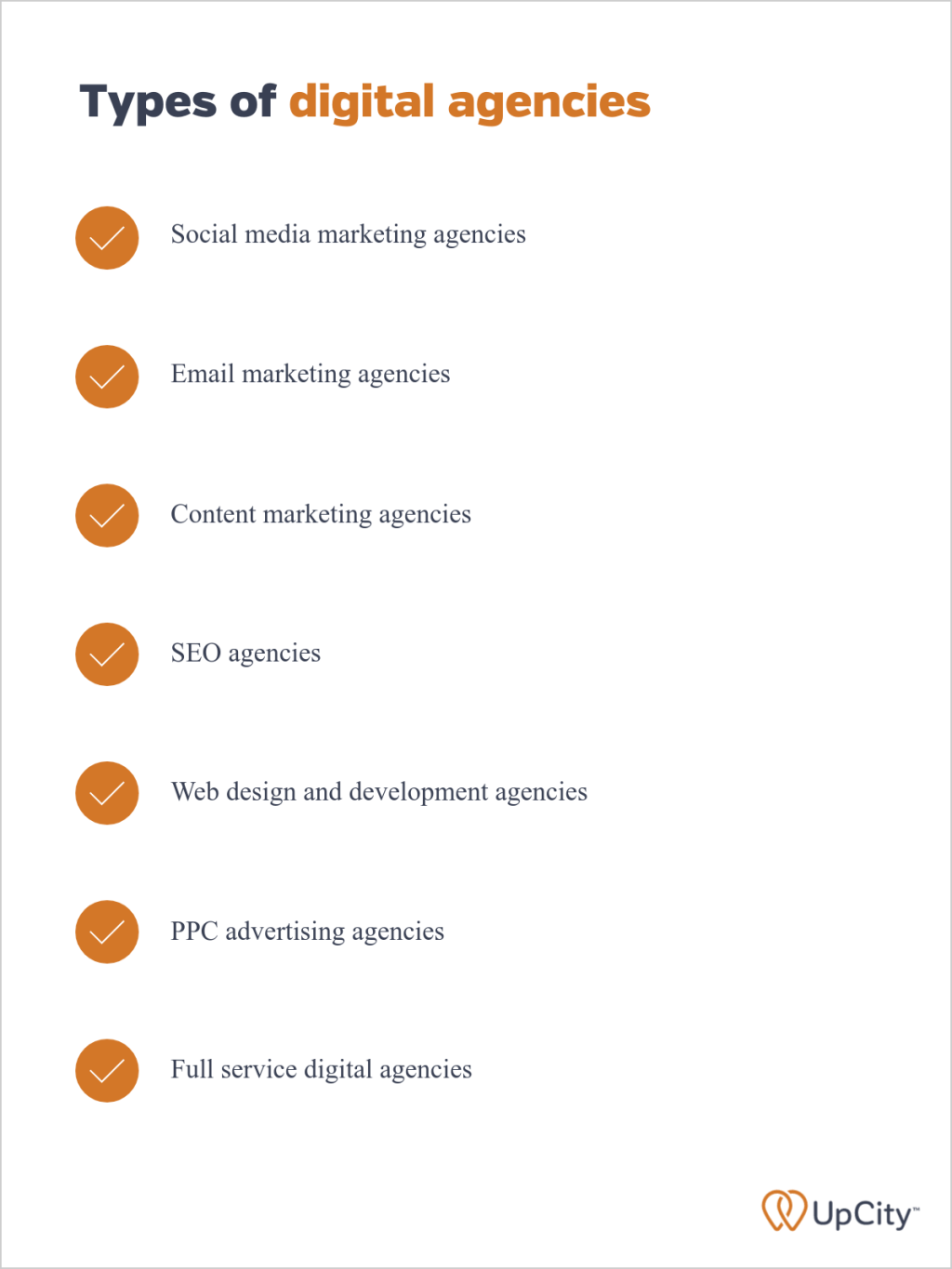 Image via UpCity article about Digital Agencies
Niche and Online Client Services
The online services you provide to clients are the services you deliver to them on a regular basis. This may or may not also include your niche area.
What is a Niche
Related to marketing or e-commerce, a niche is defined as:
“an opportunity for a business to offer a product or service that is not offered by other businesses” –Dictionary|Cambridge
Types of Agencies
There are many different types of agencies. I will try to name most types, but there are always new ones being created.
- Digital Marketing
- Digital Research
- Email Marketing
- Freelance Digital
- Graphic Design
- Social Media Management
Niche market – A niche can also mean the type of industry you provide these services to.
Therefore, you can offer online niche services to your clients, or you can also offer online services to your niche market.
If I haven’t lost you yet, please hang in as we work through the remaining steps to start an online agency.
Step Two: Preparing Your Processes
I consider this one of the most important steps before starting the agency if you already provide online services. As a solopreneur, it’s easy to simply do your day-to-day tasks out of routine.
If, however, you want to build an agency, you must document each one of these steps in a secure, easily accessible place, so that the team you build can get to them.
This involves going through each service step-by-step, from opening the front door and turning on your computer to shutting it down later that day. All the steps in between are crucial for the team you will build. So, list each task activity, then each step you take to achieve that task.
EXAMPLE: Email Marketing (example only and not necessarily all the steps involved in completing this type of task).
- Turn on the computer
- Obtain the email copy from the client
- Log in to the client’s email marketing account
- Duplicate the previous email campaign (if allowed in the program)
- Go into the duplicated campaign
- Change the Title of the campaign
- Change the Reason (recipient will see)
- Change the Copy Preview with personalized content (this should be able to be achieved in the software)
- Choose the email lists that should receive this email campaign
- Go into the email editor
- Provide a personalized greeting
- Add in the email copy that was provided by the client
- Send a test copy to yourself first
- Add any graphics, photos, videos, and/or CTA buttons
- Proofread the copy in your email system
- Make any changes needed within the editor of the software
- Send a test copy to your client (if needed) for approval
- Receive approval or make appropriate changes and resend for approval
- Once all approvals are given, schedule the campaign for the appropriate date that the client desires it to be sent on
- On the scheduled day, confirm that the campaign was sent out
- A day or two after, go into the client email marketing system and view the analytics on this specific campaign
- Record the specifics in the report template (if given one) or send a report to the client (if needed) – may only need to send monthly, depending on the contract
This is one example of one type of online service task that may be provided to clients by service providers. This may initially be done by a solopreneur and then turned into an email marketing agency.
The processes and systems are crucial BEFORE you think of hiring your first subcontractor.
Step Three: Setting Up Officially*
When I work with my clients to help them set up their agency, I always recommend setting up an LLC (Limited Liability Corporation) in the U.S. In other countries, it can be called by another name, so please look at your legal requirements. I also recommend going to a lawyer and your accountant to have them review it all first.
Setting up your agency as an LLC can help limit your liability against personal property (I am not a lawyer, so please refer to your attorney). In the United States, if you do not have any employees, you are also considered a Sole Proprietor; however, I still recommend filing for the LLC.
You will also need to set up your Articles of Incorporation at this time. A great place to begin if you are uncertain is at the U.S. Small Business Administration. On this site, you can also register your business under your State.
EXPERT TIP ON SETTING UP A BUSINESS: Before deciding on your business name, check this website to be sure it is not already taken. Check on your State’s page and then check on domain registries like GoDaddy, NameCheap, or other similar registries. Once you find both are available, purchase them right away.]
Business License
Most states also require that you file for a business license in the state and sometimes also within the county you reside in (or the office resides if outside of your home).
Filing for an EIN
Once you have registered your name and filed for your LLC, you will need to file for an EIN (Employer Identification Number). Filing is very easy and can be done by going to the IRS website.
Costs Involved In Starting Your Online Agency
You must also consider the costs involved before starting an online agency. Doing a business plan ahead of time is a must. Within the plan, you will also be required to create a budget.
“The cost of starting a traditional or digital marketing agency depends on multiple factors, including size, services offered, and location. Even solopreneurs must factor in expenses like website development, business tools, legal fees, and marketing costs. According to estimates, startup costs can range anywhere between $1,000 to $30,000 and much higher, depending on the size of your venture. While there’s no one-size-fits-all figure for starting an agency, you can keep costs down by working remotely and outsourcing business tasks like payroll and benefits administration.”
Step Four: Vetting and Interviewing
Your next step is to bring on subcontractors who will work on your client’s tasks. These are not employees (they are considered 1099 employees in the U.S.). I suggest reviewing the IRS** website under ‘contractor’ to be sure you pass the test to consider them subcontractors.
Then you will want to have a vetting process. Part of this process is knowing where to find good team members. Then you should have pre-interview questions to discern the skills they have and whether these match your needs.
Once you have a subcontractor who has passed the pre-interview process, it is time to meet in person or via Zoom. Always break the ice first with general questions and then get into the specific questions you need to find out. Keeping in mind that you also want to get a feeling of their character.
I always say character over skill because you can teach skill, but probably cannot teach character at their age.
Step Five: Onboarding Your Team
After you choose the subcontractor(s) you want to work with, your clients or oncoming clients, you should onboard your new team member.
The onboarding process involves:
- Sending a welcome email that may also include the following
- Invite them to your Project Management System
- Invite them to your Processes (if not in the PM System)
- Create an email address with your company and send it to them to use
These are some of the basics you will need to onboard your new team member.
Step Six: Delegating and Assigning
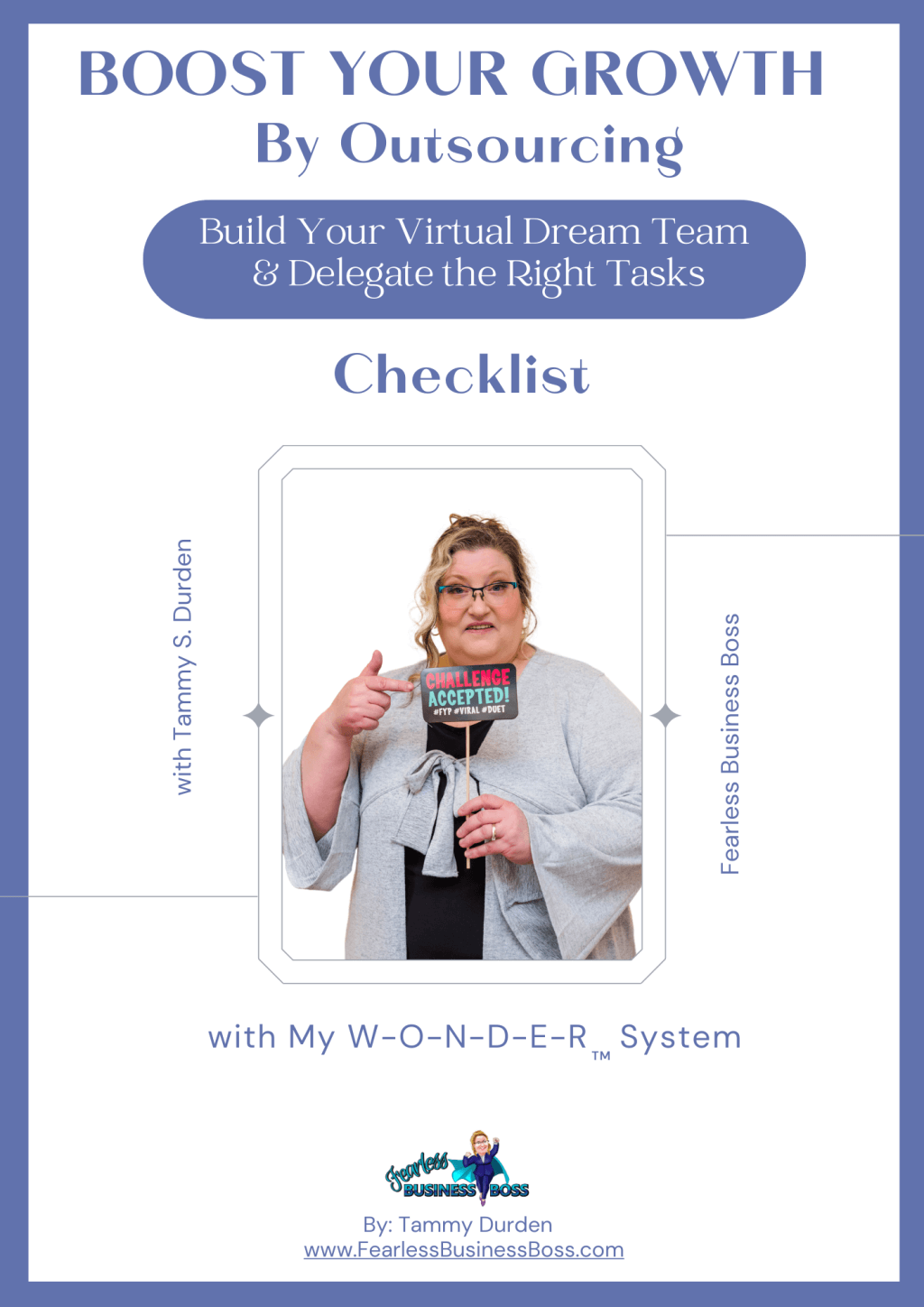 Image via https://FearlessBusinessBoss.com/free-offers
You should know before onboarding which tasks you will delegate and assign to which subcontractor (team member). If you have not decided or feel stuck at this stage, there is a great resource to help you discern.
Within this checklist, it guides you through choosing the tasks that you will outsource and in what order to do it.
Learn to delegate build your team checklist
Step Seven: Managing Your Team
Managing your team can take different roles at different times. I began by hovering and only allowing my subcontractor to filter their work through me, not directly with the client. Many start this way, but as you learn to trust them more, you should release more and more to them.
Eventually, I was able to simply introduce my team member to my client and allow them to work together without my involvement unless a problem arose. I still met monthly for strategy meetings with my clients. This helped me be able to be the face of the company still. Yet gave me the freedom to work on other needs in the business. It was a freeing time.
Final Thoughts
We all have different styles, so lean into yours. You eventually find that groove that fits and will help you feel free to do what you love without having to do the other tasks that weigh you down.
Building a virtual team is a great way to grow while earning more and working less.
 Book a Free Mini-Coaching Session
Tammy S. Durden is an award-winning business coach who specializes in helping women online service providers grow a business to fit their lifestyle rather than squeeze a life around their business.
She is also a thought leader, course creator, and speaker in the online service industry.
Tammy has established herself as an authority figure over the last 17 years while creating and growing several online service businesses.
*Always consult an Attorney and your Accountant as you begin a new business.
**Other countries should check with your country’s rules about contractors


