Leadership and Mentorship Are Different Skills


An engineering director I respect was, by every measure, an excellent leader. Her teams shipped, her attrition was low, people wanted to work for her. So when a promising senior engineer asked her to be his mentor, she said yes without thinking twice. She was good at developing people, after all. A few months in, the engineer quietly stopped booking their sessions. When she asked why, he said the meetings felt like smaller versions of their one-on-ones. Useful, but not what he’d been hoping for.
She’d been managing him the whole time. She just hadn’t noticed, because managing was the skill she’d spent fifteen years sharpening, and it was the one her hands reached for by default.
This is one of the more common traps for experienced leaders. The better you get at leading, the easier it is to assume that mentoring is just leadership pointed at one person. It isn’t. They draw on overlapping instincts, but they answer to different goals, and at a certain stage of your career the difference between them stops being academic and starts shaping how much influence you actually have.
Why this distinction matters more as you advance
Early on, your impact comes mostly from your own output and from running your team well. The leadership skills you build, setting direction, making decisions, holding standards, are oriented around results that belong to the organization. That orientation is correct, and it’s most of the job for a long time.
Then the nature of your influence shifts. Past a certain point, the highest-leverage thing you do is no longer the work in front of you or even the team under you. It’s the people you shape who go on to do things you’ll never directly touch. That kind of influence doesn’t run through authority, and it doesn’t show up in your team’s metrics. It runs through relationships where you have no formal stake in the outcome, and that is mentoring territory, not management territory.
The leaders who plateau in influence at this stage are often the ones who keep doing the thing that got them here, only harder. They manage more people, more tightly. The ones who keep growing tend to have added a different gear.
Management scales your team. Mentorship scales the people who will outgrow your team, and that’s the influence that lasts.
Three modes that get blurred together
It helps to separate three things that experienced leaders often collapse into one. Managing, coaching, and mentoring sit on a spectrum of who owns the agenda and what the conversation is ultimately for. The diagram below lays them side by side.
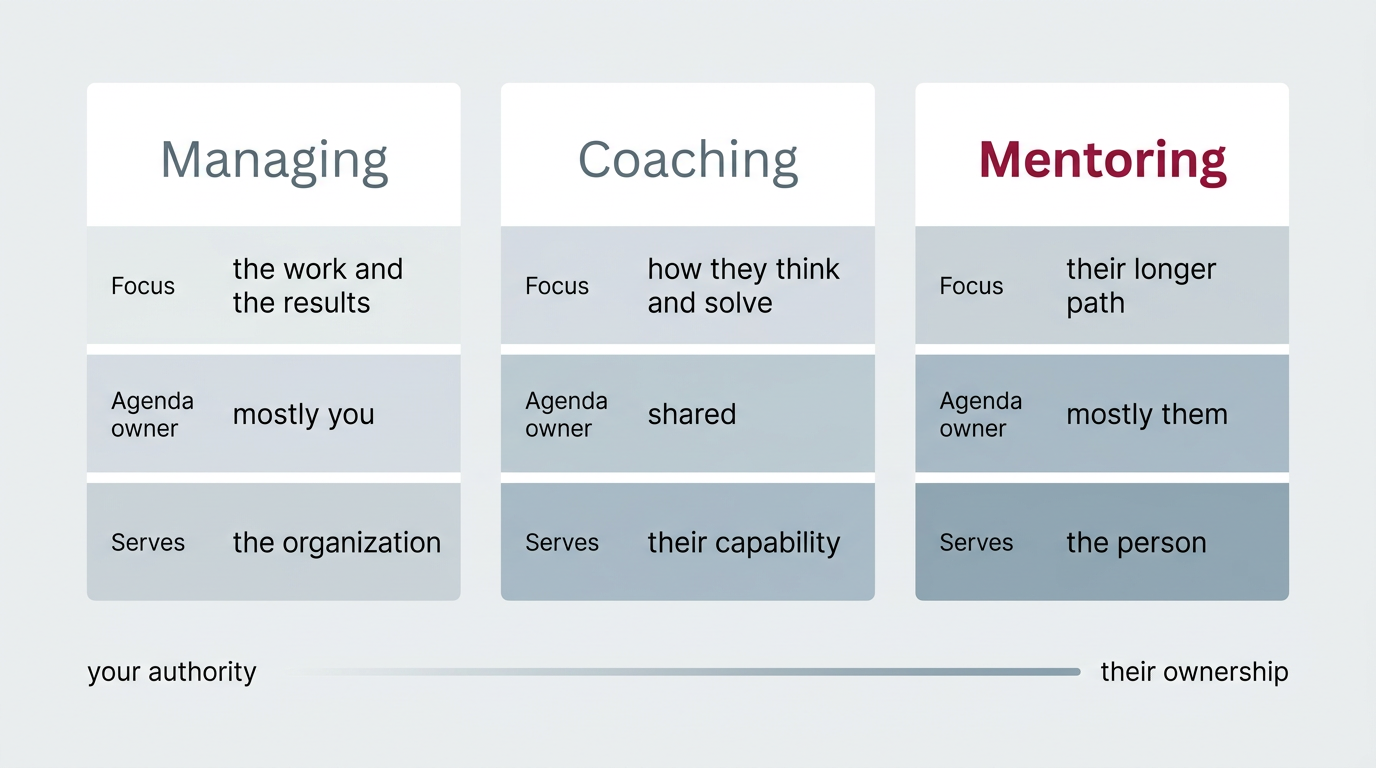
Coaching sits in the middle on purpose. It’s the bridge skill, more developmental than managing, more grounded in the person’s own thinking than instruction. A lot of leaders are decent at managing and have never deliberately practiced the other two.
What changes when you actually mentor
The hardest adjustment is giving up the agenda. In management you set it, that’s the role. In mentoring, the agenda belongs to the other person, and your job is to bring perspective to their questions, not redirect them to yours. The first time you notice yourself steering a mentee toward what would be useful for your team, you’ve slipped back into managing without meaning to.
A few shifts make the move concrete:
• Let them set the topic. A mentoring session that opens with “What’s on your mind?” and follows their answer is in a different posture than one where you arrive with points to cover.
• Share your experience as one data point, not a directive. “Here’s what I did and what I’d weigh differently now” leaves room for them to choose. “Here’s what you should do” quietly takes it back.
• Detach your ego from their decisions. They will sometimes ignore your advice and do fine, or take it and struggle. If that lands as a referendum on you, you’re still holding the outcome that should be theirs.
• Protect the relationship from your org chart. The moment a mentee suspects you’re mentoring them toward what your team needs, the candor that makes mentoring valuable evaporates.
Coaching has its own version of this shift, slightly less far along the spectrum. You’re still oriented toward their development, but usually anchored to a real situation in front of them. If you want to get good at mentoring, getting good at coaching first is the natural on-ramp, because both ask you to resist the pull to simply solve things.
The strategic cost of conflating them
When a leader treats every developmental relationship as an extension of management, a few things happen at the level the organization actually feels.
Your best people stop coming to you for the conversations that would keep them. Ambitious employees often want a mentor more than another manager, and if every interaction with you carries the weight of evaluation and direction, they go find that relationship elsewhere, sometimes at another company. You also lose a clear-eyed read on your own people, because someone being managed tells you what they think you want to hear, while someone being mentored tells you what they actually think.
There’s an organizational cost too. Companies that develop leaders well usually have people at the top who can move fluidly between these modes and who model that range for the next layer down. Where the senior bench only knows how to manage, the whole place tends to over-rely on authority and under-invest in the slower work of growing judgment. That shows up years later as a thin leadership pipeline that nobody can quite explain.
Worth sitting with
When I’m developing someone, whose agenda is the conversation really serving, theirs or my team’s?
Which of the three modes do I default to, and which one have I genuinely never practiced on purpose?
Is there someone I’m “mentoring” who is actually just being managed in a quieter room?
If my influence had to outlive my title, what am I doing now that would carry it?
Where to start
You don’t need to overhaul how you lead to begin building the other gears. Pick one person you’re trying to develop and, in your next conversation, deliberately hand them the agenda, then practice staying with their question instead of routing it back to what your team needs. It will feel less efficient and probably more valuable. For a wider view of how mentoring shapes thinking well beyond reporting lines, Mentorship Beyond Titles: How Sharing Knowledge Shapes Product Thinking is worth your time.
Leadership got you to a place where people want your guidance. What you do with that, whether you keep managing or learn to genuinely mentor, is a different skill, and it’s the one that decides how far your influence travels once you’re no longer in the room.


