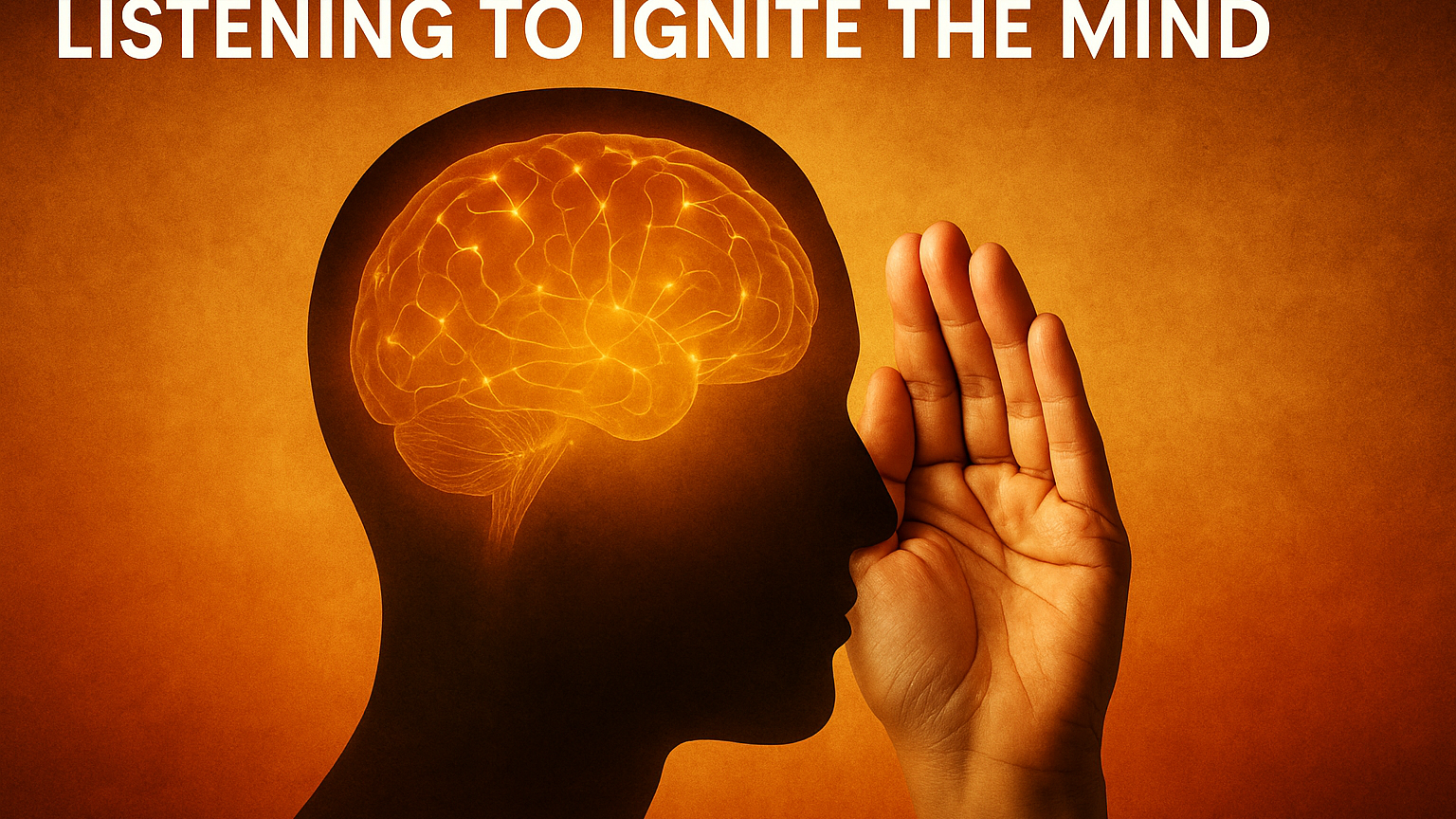
Listening to Ignite the Mind: The NeuroCARE™ Approach to Transformational Presence

By Dr. Steven L. Jordan, Sr., Ph.D., Ed.D., PCC
“Listening is the sacred act of seeing with the heart what the mind cannot yet name.”
In a world overwhelmed by noise, distraction, and competing pressures, the greatest gift a leader—or a coach—can offer is the power of deep, attentive listening. Listening is not simply absorbing words. It is perceiving the world within them. When done skillfully and ethically, listening becomes a revolutionary act that awakens clarity, courage, and transformation.
Chapter 7 of the NeuroCARE™ Framework explores how listening activates the mind, regulates the body, and honors the spirit. It draws on neuroscience, coaching science, and faith-informed wisdom to show how listening ignites change at every level of human experience.
But before we explore that power, it is essential to understand a foundational truth:
Coaching is a neurological experience.It physically changes how the brain processes stress, insight, identity, and possibility.
This is why the NeuroCARE™ model is described as neurological care and transformative coaching for every generation. Whether speaking to high school students or senior executives, the goal is the same—help the brain think more clearly, feel more safely, and grow more intentionally.
A Simple Student-Friendly Framework for How the Brain Works in Coaching
To help students understand why listening matters, we begin with a quick overview of three major brain systems involved in every coaching conversation:
1. The Thinking Brain (Prefrontal Cortex)
This part of the brain handles decision-making, planning, and clarity.Coaching strengthens the thinking brain by:
- Slowing reactive impulses
- Increasing reflection
- Supporting clear thought and future-focused reasoning
2. The Feeling Brain (Limbic System)
This system manages emotions, connection, and memory.When a coach listens deeply:
- Emotional pressure decreases
- Safety increases
- Insight becomes easier
3. The Survival Brain (Amygdala + Brainstem)
This part reacts to threat—real or perceived.If a client feels judged or rushed, this system activates, shutting down clarity.
Deep listening disarms the survival brain, making transformation possible.
When students grasp these three systems, they understand why listening is not passive—it is a neurological tool for growth and healing.
The Transformative Power of Listening
Great coaching does not begin with powerful questions—it begins with powerful presence. When a coach listens deeply, the client begins to think more freely, speak more authentically, and explore more courageously. Listening creates a safe, resonant space where the mind can open and the soul can breathe.
In NeuroCARE™, listening is both neural and spiritual. Research shows that deep listening activates regions in the brain responsible for empathy, emotional regulation, and reflective thinking (Siegel, 2020). At the same time, silence and presence invite sacred awareness—a moment where insight becomes revelation.
ICF Alignment: Listening as an Ethical and Professional Practice
According to ICF Core Competency 6 – Listens Actively (ICF, 2025), coaches must focus on what the client is saying and not saying. This includes:
- Understanding the client’s identity, context, and values
- Recognizing emotion and energy beneath the language
- Reflecting and clarifying without judgment
- Integrating verbal and nonverbal communication
Deep listening also supports ICF Core Competency 1 (Ethical Practice) and Core Competency 4 (Cultivates Trust and Safety). Listening is therefore not just a technique—it is ethical presence in action.
The Neuroscience of Listening
Listening is a whole-brain event.
- The temporal lobes process language
- The prefrontal cortex interprets meaning, intention, and emotion
- Mirror neurons reflect the emotional state of the speaker, creating empathy and resonance
This neural synchrony builds trust and reduces tension, allowing clients to move from cognitive dissonance to clarity (Cozolino, 2017). Interruptions or distractions disrupt this harmony. But attuned listening restores coherence between mind and body.
The brain listens best when the heart is quiet.
Listening and Emotional Regulation
A dysregulated coach cannot listen deeply.
NeuroCARE™ emphasizes somatic listening—tuning into the body as an instrument of awareness. Tightened breath, clenched jaw, or rising tension signals the coach to self-regulate and return to presence.
When regulation is embodied, listening becomes:
- Clearer
- Calmer
- More compassionate
- More connected
Listening is both mirror and mindfulness.
The Faith Dimension: Listening with Spirit
Listening is a sacred responsibility. In the Christian tradition, James 1:19 reminds us:
“Be quick to listen, slow to speak…”
In faith-informed coaching, listening becomes an act of reverence—an echo of divine attentiveness. The coach holds space with compassion, discernment, and unconditional regard. Silence becomes ministry. Presence becomes prayer.
This is where NeuroCARE™ integrates neuroscience and spirituality to elevate listening into sacred dialogue.
Levels of Listening in NeuroCARE™
Drawing from Nancy Kline, Stephen Covey, and ICF standards, NeuroCARE™ teaches four levels:
LevelDescriptionExample1. Internal ListeningHearing through personal filters“What should I ask next?”2. Focused ListeningAttending to words“You mentioned feeling overwhelmed…”3. Global ListeningReading energy, tone, emotion“Your voice softens when you talk about this.”4. Transformational ListeningPresence beyond words; listening to potentialSilence, intuition, deeper resonance
Transformational listening is where breakthroughs occur. It is the essence of the NeuroCARE™ approach.
Case Example: The Power of Silence
During a coaching session, a CEO named Darnell spoke rapidly about burnout. The coach listened quietly… then remained silent for 20 full seconds.
Eventually Darnell exhaled:
“I just realized I’ve been talking to avoid feeling how tired I am.”
Silence was not absence—it was presence.
Coherence emerged. Truth surfaced. Transformation began.
Why Listening Ignites the Mind
Deep listening:
- Awakens awareness
- Expands emotional clarity
- Strengthens neural pathways of trust
- Honors ethical practice
- Creates space for spiritual insight
Listening is not passive reception—it is active revelation. It ignites the neural, emotional, and spiritual circuits of change.
When we listen deeply, we awaken the mind—and the miracle within it.
APA References
Cozolino, L. (2017). The neuroscience of psychotherapy: Healing the social brain (2nd ed.). W. W. Norton.International Coaching Federation. (2025). ICF Code of Ethics. ICF Professional Standards.International Coaching Federation. (2021). ICF Core Competencies.Kline, N. (2021). Time to think: Listening to ignite the human mind. Cassell.Siegel, D. J. (2020). The developing mind: How relationships and the brain interact to shape who we are (3rd ed.). Guilford Press.The Holy Bible, New International Version. (2011). Zondervan. (James 1:19).
You’re now ready fo


