Organizations Need Better Ways to Measure AI Success


A team six months into a serious AI rollout has a dashboard, and the dashboard looks great. Prompts per day, up. Active users, up. Adoption rate across the department, up and to the right. Then someone senior asks the one question the dashboard cannot answer: is it working? The room goes a little quiet, because everyone realizes at once that they have been measuring how much the tool is used, not whether any of that use is doing what it was meant to.
Usage is the easiest thing to measure and, on its own, close to the least useful. High adoption of a tool that isn’t changing any outcome is just expensive enthusiasm. This is the trap most organizations fall into at the developing stage: the metrics that are simplest to collect crowd out the ones that would actually tell you something, and a busy dashboard starts to feel like evidence when it is mostly motion.
Why measuring AI is genuinely awkward
Some of this is not anyone’s fault. AI is harder to measure than a typical software rollout for a few real reasons. The output is variable, so the same prompt can be excellent on Monday and mediocre on Thursday. The value is diffuse, spread thinly across many small interactions rather than concentrated in one big number. And attribution is messy: when a project ships faster, was it the AI, the team, the easier quarter, or all three? These are honest difficulties. They are also not an excuse to fall back on counting logins.
If your AI dashboard only goes up, you are probably measuring enthusiasm. The harder question is whether anything downstream actually moved.
A simple frame: three layers worth measuring
A measurement approach that holds up tends to look at three layers rather than one. They answer different questions, and a tool can pass one while quietly failing another, which is exactly why looking at all three beats staring harder at usage.
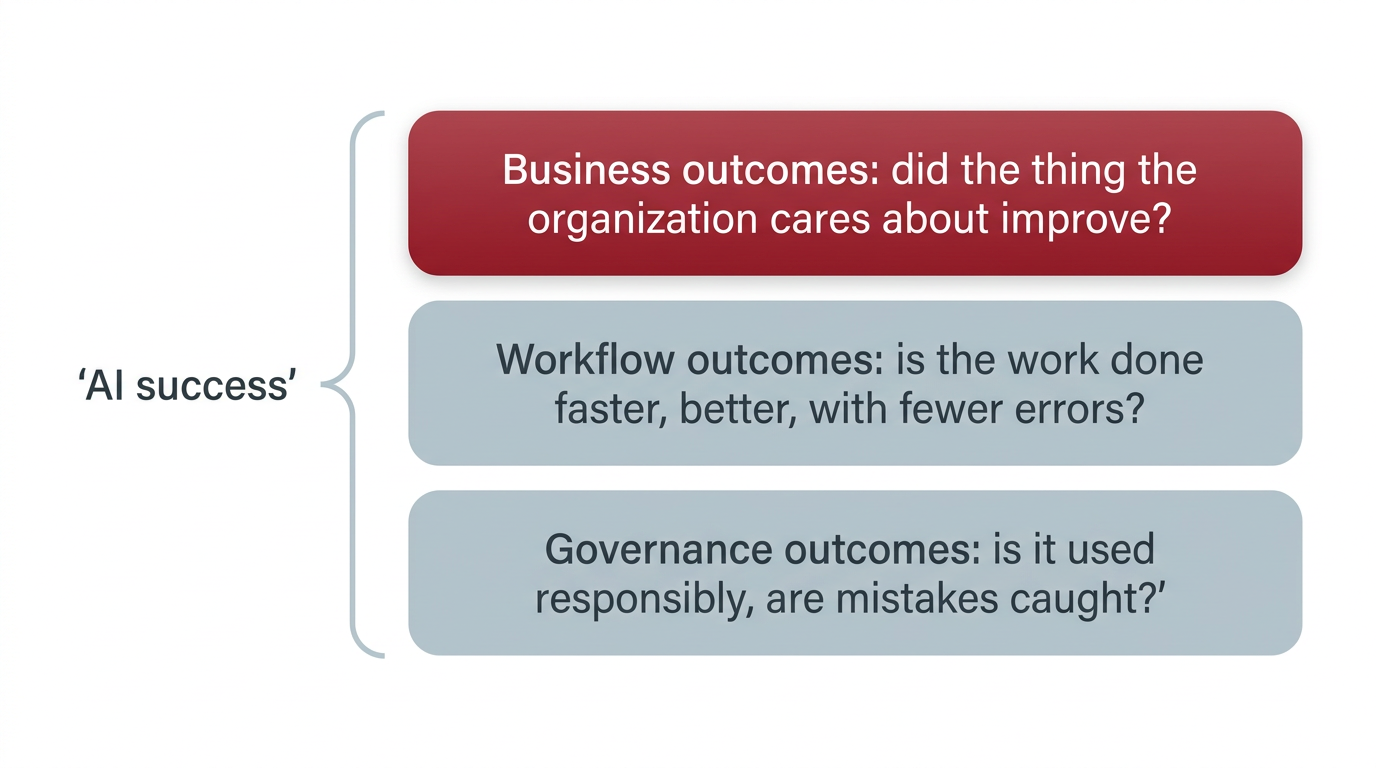
The top layer is business outcomes: the result the organization actually cares about, like faster resolution times, more proposals out the door, lower cost to serve. This is the layer leaders ask about and the one usage metrics quietly avoid. The middle layer is workflow outcomes: at the level of the work itself, is it getting done faster, to a higher standard, with fewer errors? This is where most of the genuine signal lives. The bottom layer is governance outcomes: is the tool being used responsibly, and are its mistakes being caught before they travel? A tool can look brilliant on speed and still be a problem if nobody is checking what it gets wrong.
You do not need many metrics per layer. One honest measure on each beats a dashboard of twenty that all describe activity. The discipline is in choosing measures that would actually change a decision if they moved.
Putting it to work on one workflow
The tactical version of this is narrower than it sounds, and it is better to run it properly on one workflow than loosely across ten. Pick a single workflow where the AI is meant to help. Take a baseline before you lean on the tool, so you have something to compare against later. Choose one metric per layer: a business outcome, a workflow outcome, a governance outcome. Then set a cadence to look again, because a single reading taken during the honeymoon weeks will mislead you in a predictable direction.
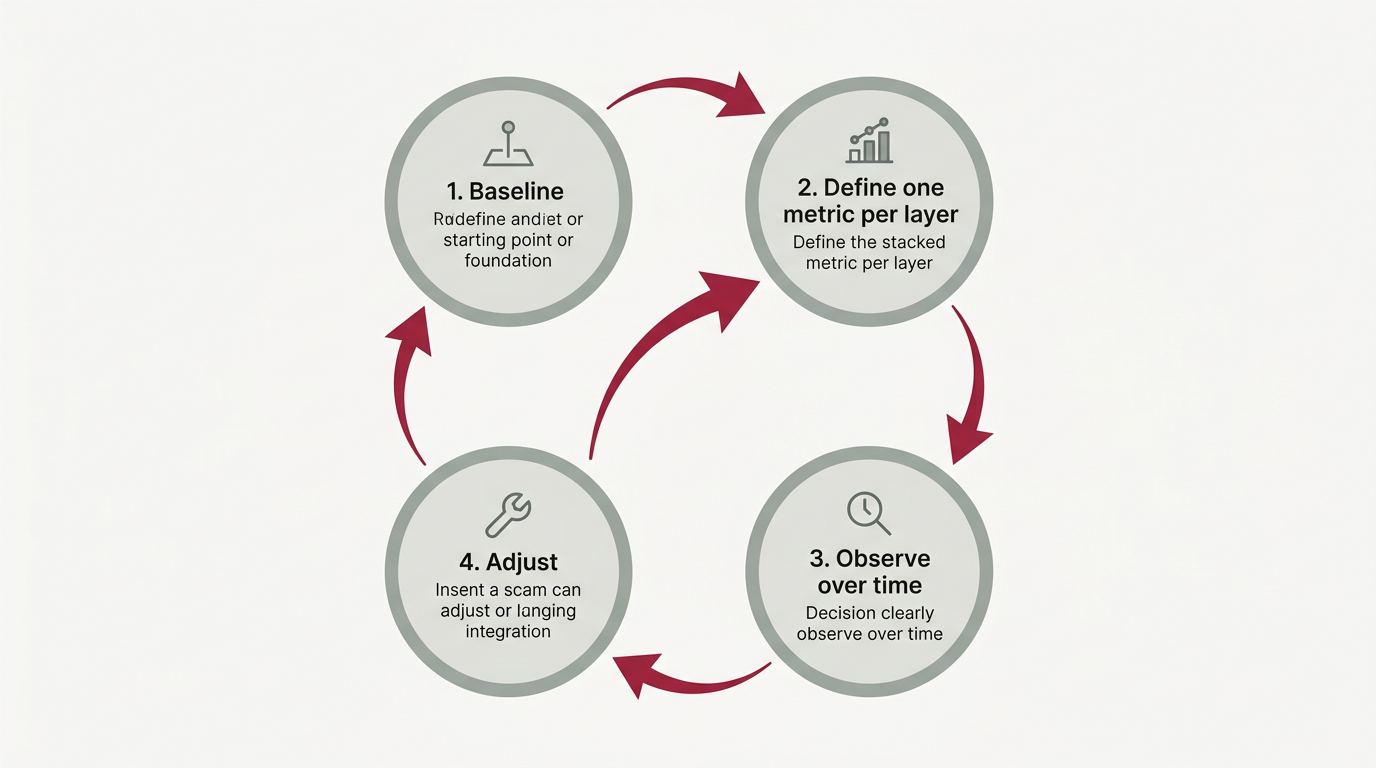
That loop is the whole method, and the return arrow matters. Measuring AI success is not a launch task you complete and file. It is something you keep doing as the tool’s role grows and the easy wins give way to the harder, more realistic picture. Treated that way, measurement becomes part of how you operate rather than a report you produce once to justify a purchase.
What this changes for the business
Measured across those three layers, on a cadence, AI success becomes something you can actually speak to. Not "everyone is using it" but "here is what improved, here is what it cost, and here is how we know it is being used responsibly." That is a far stronger position with a board, a customer, or a skeptical colleague than any usage chart. The same instinct underlies our piece on Project Risk Isn’t the Enemy – Not Seeing It Is: the goal of measurement is not to manufacture a flattering number, it is to see clearly enough to make a good decision.
Worth sitting with
If someone asked tomorrow whether our AI rollout is working, would we reach for an outcome or for a usage chart?
For our most important AI workflow, do we have a baseline from before, or only numbers from after?
Which of the three layers, business, workflow, governance, are we currently not measuring at all?
Are we set up to look again on a rhythm, or did our measurement effectively end at launch?
A practical place to begin is to pick your single most important AI workflow and define one metric for each of the three layers, even rough ones. If the governance layer turns out to be the one you have no measure for, that is a common and useful finding. Building these frameworks is easier with someone who has done it before, and the experts in Compass can help you shape a measurement approach that fits your organization rather than a generic template.


