Responsible AI Adoption Requires Ongoing Training


A company ran a genuinely good AI training day. Catered, an external facilitator, plenty of questions, and everyone left with a tidy one-page set of guidelines. Eight months later that one-pager still mentioned two tools the company had stopped using and said nothing about the three it had quietly adopted since. The training had not been wrong. It had simply aged, the way a printed map ages while the roads keep changing.
This is the part that catches careful organizations off guard. The problem with most AI training is that it is run as an event, while the thing it is training people for is a moving target.
Why a single session does not hold
Three things keep shifting underneath any guidance you write. The tools themselves change, sometimes monthly. What those tools are capable of changes, which means what is safe to do with them changes too. And the people change, as new hires arrive into a context the original training never described.
On top of that, people forget. One session, however good, does not build a habit. A guideline written in spring is partly fiction by autumn, and the gap between what the document says and what people actually do is where most of the avoidable mistakes live.
Training people once for something that changes every quarter is a way of going out of date on schedule.
A simpler way to picture it
It helps to stop thinking of adoption training as a launch and start thinking of it as a loop. The loop has four recurring moves, and the point is that it keeps turning rather than finishing.
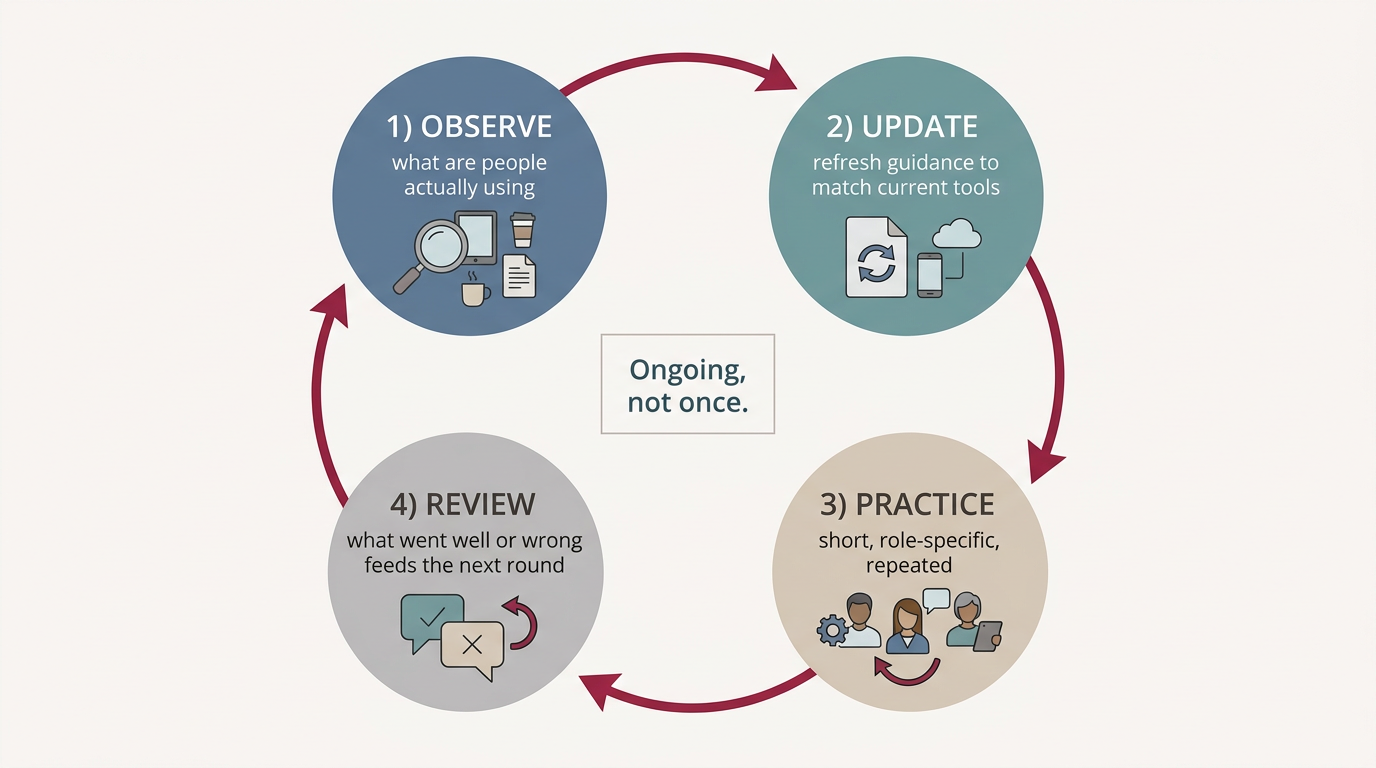
Observe what people are really doing with AI. Update the guidance so it reflects the tools currently in play. Practice in short, role-specific bursts rather than one long workshop. Review what happened, and let that feed the next turn of the loop. None of these steps is heavy on its own. The discipline is in keeping them going.
What this looks like in practice
• Keep guidance living. Put it somewhere editable with a visible “last updated” date, and actually change it when a tool changes. A document nobody maintains is worse than none, because people trust it.
• Favour short and frequent over long and rare. A twenty-minute, role-specific refresher every quarter does more than an annual workshop nobody remembers by lunchtime.
• Tie examples to real work. Anonymized cases of what went well, and what went sideways, inside your own company teach faster than abstract principles.
• Give new joiners the current version, not the founding story. The training that shaped the team a year ago may describe a world the new hire will never see.
• Close the loop without blame. When something goes wrong, fold the lesson into the next refresher rather than into a reprimand. People hide mistakes they get punished for.
Worth sitting with
When did our AI guidance last change, and does that pace match how fast our tools have actually changed?
Do people here learn how to use AI from us, or from each other in the gaps where we said nothing?
If someone joined next week, what would they genuinely know about using AI responsibly in this organization?
The aim is not a perfect curriculum. It is a rhythm the organization can actually keep, one that stays roughly in step with reality. If you want help turning this into something repeatable rather than a one-off event, the responsible-AI resources and FSC pathways in Compass are built for exactly that, and Strategies to Navigate AI’s Dual Promise of Opportunity and Risk is a useful wider frame while you set it up.


