Shadow AI Is Growing Faster Than Governance


A company that has clearly moved past the experiment stage: three different teams, over the last year and a half, each adopted a different AI tool for roughly the same kind of work. None of them coordinated, because none of them needed to in order to get started. The only governance on the books is a single policy document written for the original pilot, back when there was one tool and a handful of careful users. The pilot ended. The document didn’t get the memo.
It is tempting to read this as an AI problem. It is closer to a pacing problem. Adoption compounds: every team that succeeds gives the next team a reason to try, and tools spread sideways through an organization fast. Governance, written once and revisited rarely, moves at the speed of scheduled reviews. The two were never going to keep pace on their own.
Here is the part worth holding onto. The risk in this picture is not the AI. It is the gap between how fast it is being adopted and how slowly the organization’s shared understanding of that adoption is keeping up. The gap is the thing that eventually forces a hard, clumsy stop. Closing it is what lets you keep going.
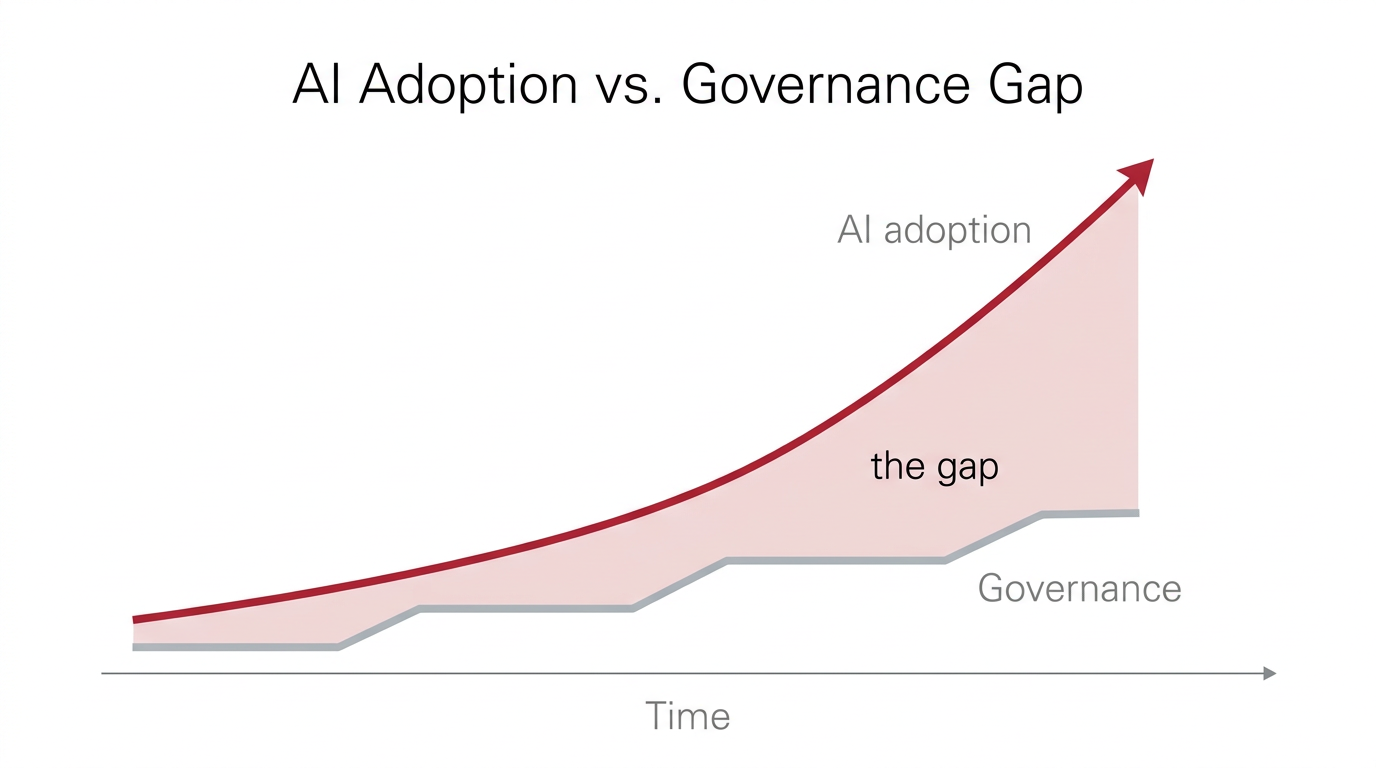
The risk isn’t how fast AI is spreading. It’s how far ahead of your understanding of it the spread has gotten.
What changes at the scaling stage
In the early days the live question was whether to allow AI at all. At the scaling stage that question is settled in practice, whatever the policy says, and a new one takes its place: is any of this coherent across teams? Three tools doing similar work means three sets of assumptions about what is safe to share, three different ways of checking output, and three places an auditor would have to look. The cost of that incoherence is rarely a single dramatic failure. It is friction, duplicated spend, and a slow erosion of anyone’s ability to say with confidence how AI is actually being used.
None of this means pulling everything back to one approved tool and one rigid rule. That tends to send usage underground, which only widens the very gap you are trying to close.
Closing the gap without slamming the brakes
The shift that helps most is treating governance as something that runs on a cadence rather than something that got decided once. A lightweight standard that someone actually owns, revisited on a regular rhythm as tools and usage change, will hold up far better than an exhaustive policy that ages out the month after it is signed. The goal is to meet adoption where it already is, not where the original document imagined it would politely stay.
Practically, that means knowing which tools are in use across teams, agreeing on a small number of things that matter everywhere (what is safe to put in, how output gets checked, who to ask when unsure), and accepting that this picture will need refreshing. Our piece on Strategies to Navigate AI’s Dual Promise of Opportunity and Risk sits alongside this one: the promise and the risk of AI tend to scale together, and governance is mostly how you keep hold of both at once.
What this buys the business
Done this way, governance stops reading as the brake on AI and starts working as the thing that lets you scale it with more confidence, more evidence, and more control. You can answer the questions a board or a customer asks. You can tell which tools are earning their place. And you spend less energy on the quiet anxiety of not quite knowing what is running where.
Worth sitting with
If three teams are solving the same problem with three different AI tools, who in our organization would even know?
When was our AI policy last written, and does it describe the organization we are now or the one we were during the pilot?
Are we revisiting governance on a rhythm, or only when something goes wrong enough to force it?
You do not need to close the whole gap this quarter. You need to start measuring it: a current list of what is actually in use, and a date in the calendar to look again. If you want more on holding opportunity and risk together as you scale, the related reads in the blog are a good next stop.


