Teams Lose Focus When Priorities Constantly Shift

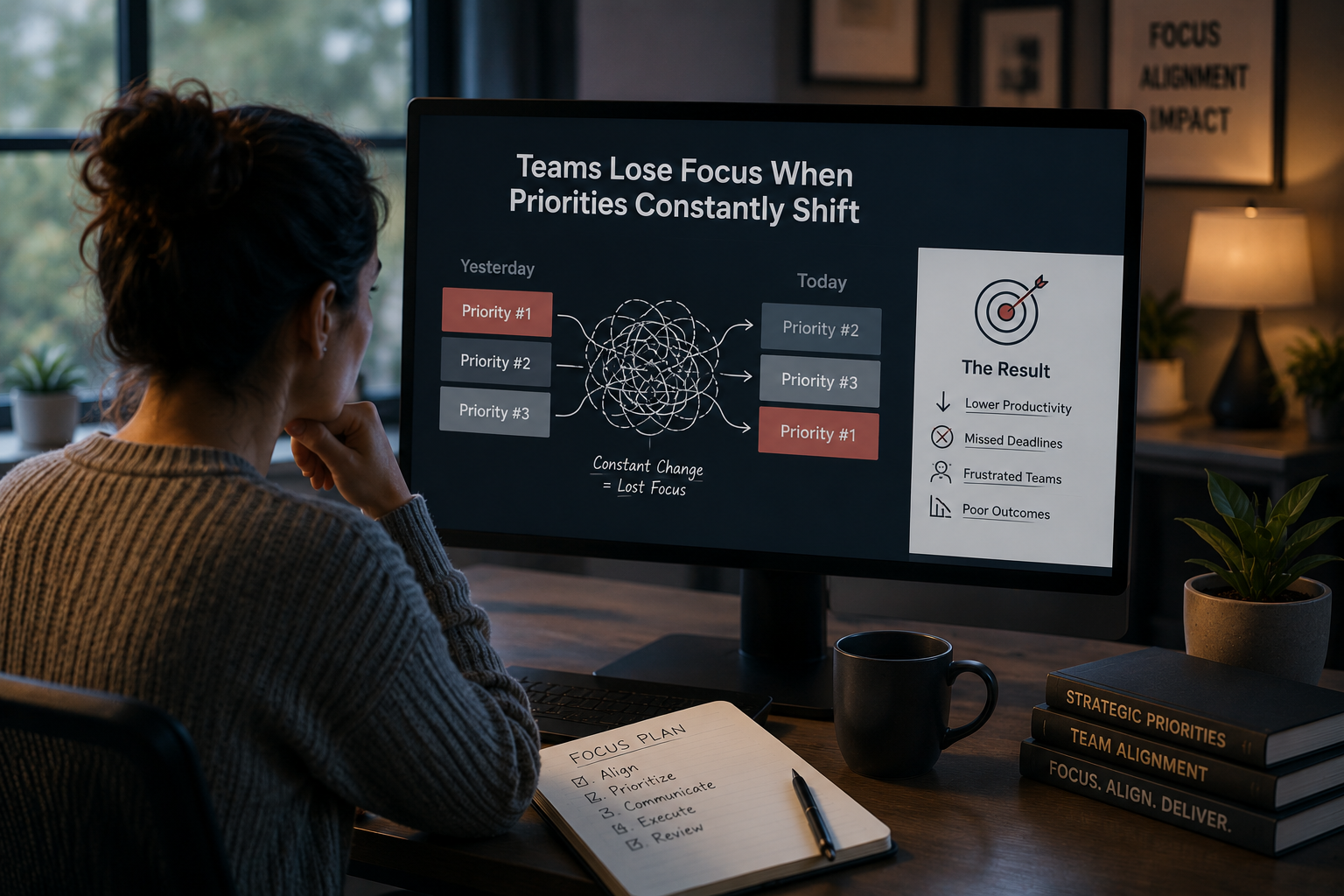
A team I worked with kept missing the mark on work they were clearly capable of doing. They attended every standup, shared updates, stayed visibly busy. But projects kept stalling halfway, and people seemed to hesitate before committing to anything. When we dug in, the cause was almost mundane: the priority had quietly changed three times in a month, and nobody was certain which version was still real.
That’s the thing about a lot of team performance problems. They look like communication problems, or motivation problems, when underneath they’re really priority problems. The team isn’t confused about how to work. They’re unsure what actually matters most this week, because the answer keeps moving.
Why constant change quietly wears teams down
Most teams can handle change. What wears them down is unstructured change, the kind that arrives often and without much context. When priorities shift faster than work can stabilize, people start spending more energy recalibrating than actually executing.
You can usually see it in the small behaviors before you see it in the results. People hesitate to fully commit, because they half-expect the plan to move again. Projects lose momentum partway through. Work gets quietly restarted. Meetings multiply because clarification becomes a constant need. The team still looks productive from the outside, which is why leaders often miss it until something visible slips.
There’s a quiet tell when it’s gone too far. You start hearing the same phrases. “I thought this was the priority.” “Didn’t we change direction on this already?” “We’re busy, but it doesn’t feel like we’re getting anywhere.”
A team can handle hard work far more easily than it can handle constant uncertainty about what the work even is.
Why good leaders cause this without meaning to
Almost no one is creating this chaos on purpose. Usually leaders are just responding to real pressure, a customer escalation, an executive request, a market shift, a staffing gap. Each individual change feels reasonable in the moment, and most of them genuinely are.
The disconnect is in how a change lands. What a leader experiences as a small adjustment, the team often experiences as a full reset, especially across hybrid and async setups where context doesn’t travel as easily as it used to. A quick “let’s pivot to this” in a leader’s head can mean a half-day of re-planning for everyone downstream. Multiply that by a few times a month and the team slowly stops anchoring to strategy and starts anchoring to whatever feels most urgent right now.
What clarity actually looks like in practice
A lot of leadership advice leans on inspiration. In practice, most teams don’t perform better because motivation suddenly spikes. They perform better because expectations got clearer. Clarity here is pretty unglamorous: people know what matters most right now, tradeoffs get said out loud, priorities hold still long enough to actually finish something, and when things do change, the team hears why.
You don’t need perfect predictability to give a team that. You need enough consistency for them to trust the direction again. A few practical shifts tend to do most of the work.
Stop inflating priorities
If everything is urgent, nothing reads as truly prioritized. Before adding new work on top, it’s worth answering three questions out loud with the team: what moves down if this moves up, what are we willing to delay, and does the team realistically have the capacity for this. Naming the tradeoff is what creates clarity. Avoiding it is what creates overload.
Explain the why, not just the what
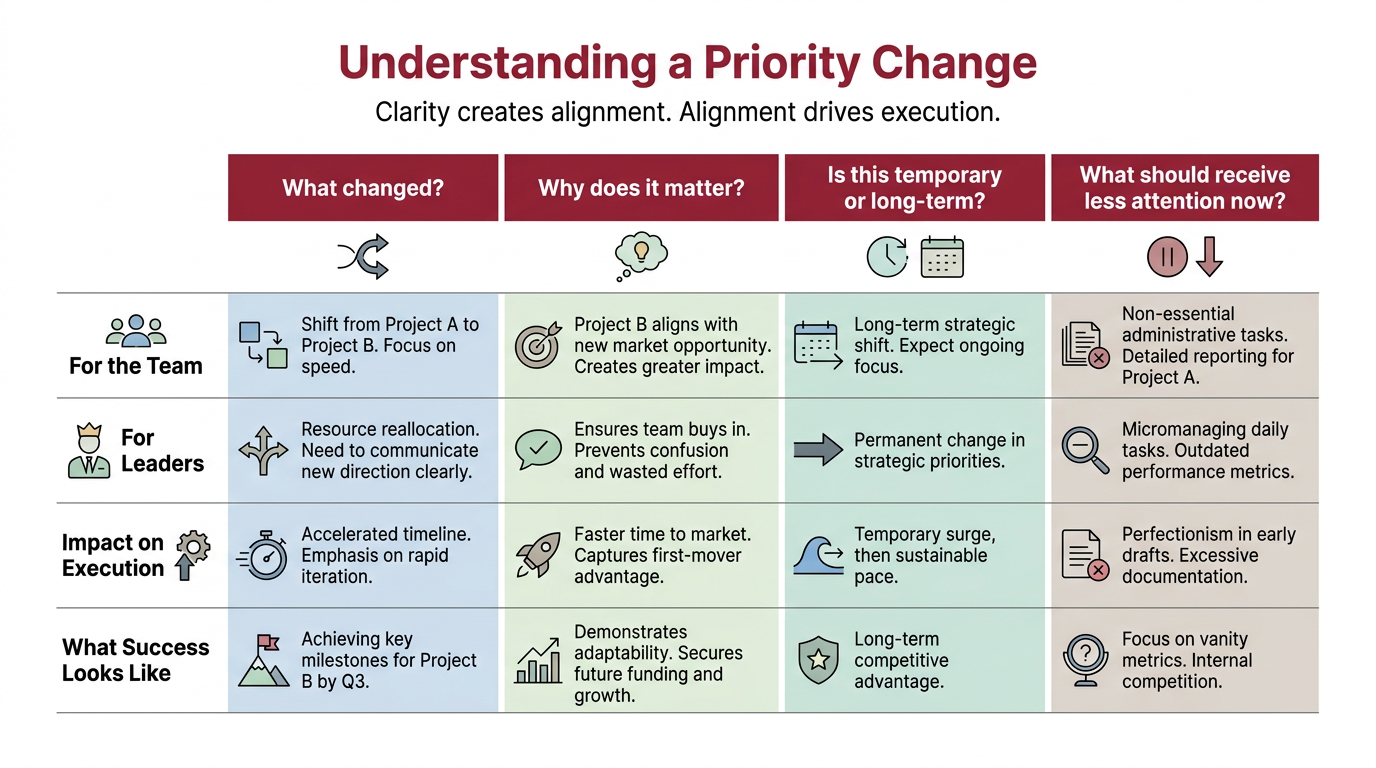
Priority changes are sometimes unavoidable. Unexplained ones are what cause the damage. A line or two of context lets people recalibrate on their own instead of guessing: what changed, why it matters, whether it’s temporary or lasting, and what should now get less attention. It takes thirty seconds and saves a week of quiet confusion.
It can help to make that explanation concrete. A simple shared view of a priority change, what it means for the team, for leaders, for execution, and what “done” looks like, removes most of the ambiguity in one place.
Protect focus windows
Many teams spend most of the week reacting to interruption. Leaders can push back on that by protecting stretches of uninterrupted execution time, limiting midweek scope changes, consolidating scattered requests into clearer channels, and reinforcing fewer priorities more consistently. Focus is much easier to hold when priorities aren’t competing with each other every hour.
Reinforce more than you think you need to
Leaders tend to state a priority once and assume it landed. It rarely sticks on the first pass, not because people aren’t listening, but because the operating environment keeps throwing competing signals at them all day. Repeating the priority, especially during busy or uncertain stretches, isn’t nagging. It’s how stability gets maintained.
Worth asking before the next change
Does the team actually know the single top priority right now?
Have priorities changed faster than the team can realistically absorb?
Are people spending more time reacting than executing?
Have we explained the tradeoffs clearly, or just announced the change?
Are we accidentally rewarding urgency over clarity?
Sometimes a team doesn’t need more pressure or more motivation. It needs fewer competing signals. The most underrated leadership skill here is protecting focus, not through tighter control or more process, but through consistency and honest tradeoffs. Teams perform better when leaders reduce ambiguity and protect focus, and that usually looks calmer from the outside than people expect.
* * *
If you want to go further on leading with clarity in distributed teams, the Leadership Effectiveness Experts inside Compass are a useful next step for pinpointing where ambiguity is quietly costing your team.


