Why Sustainable Leaders Protect Their Energy Differently


A director I knew kept a standing 7 a.m. block on her calendar that she never explained to anyone. People assumed it was a workout, or a commute buffer, or one of those vague wellness things executives put on calendars. It was none of those. She spent it doing almost nothing, reading something unrelated to work, looking at the week ahead without touching it yet, letting her own thinking catch up to her schedule. She protected that hour more fiercely than most people protect their biggest meetings.
When I asked her about it once, she said something that stuck with me. The hour wasn’t recovery from work. It was the thing that made the rest of the work worth anything.
That distinction is small and it is the whole game. Most high performers think about energy the way you think about a phone battery: you run it down during the day, you charge it at night, and as long as you don’t hit zero you’re fine. It’s a reasonable model and it quietly fails the people who rely on it most, because it treats energy as something you spend and replace rather than something you direct.
The most depleted leaders are often the busiest, not the laziest
If energy were simply about hours, the people running on empty would be the ones cutting corners. In practice it’s usually the opposite. The leaders who burn down to nothing tend to be the conscientious ones, the people who answer everything, attend everything, and carry a low hum of responsibility for things that aren’t really theirs to carry. They aren’t tired because they’re doing too little. They’re tired because almost none of what they do gets to be deliberate.
There’s a difference between being spent and being scattered, and the two feel almost identical from the inside. Spent is what happens after a hard, focused stretch of work that mattered. It has a clean quality to it. Scattered is what happens after a day of being pulled in eleven directions, none of which you chose, and it leaves a residue that sleep doesn’t fully clear. A lot of people are managing scatter and calling it tiredness, then trying to fix it with rest, which doesn’t touch the actual problem.
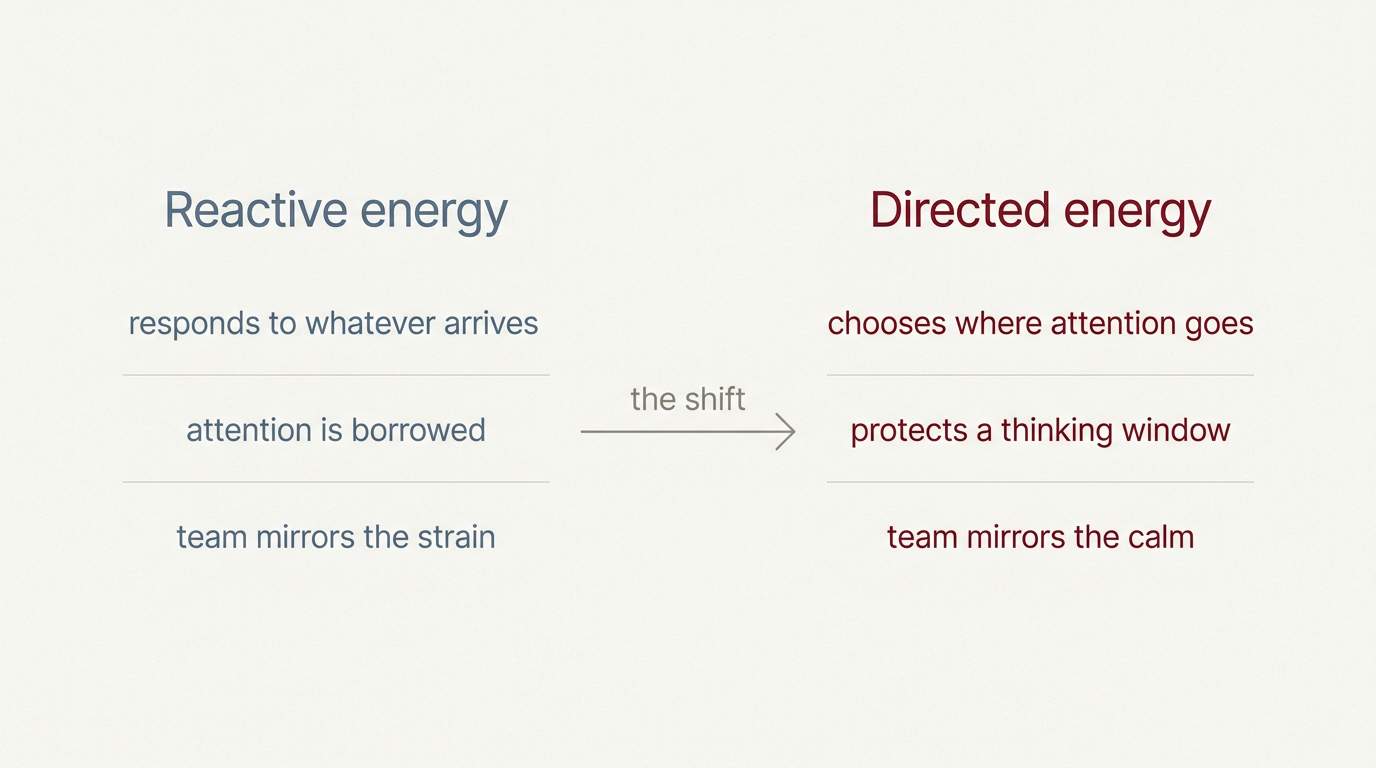
Energy isn’t mostly about how much you have. It’s about how much of it you get to point on purpose.
What changes when you start leading at this level
Early in a career, energy management is mostly personal. You learn your own rhythms, when you think well, when you fade, and you arrange your work around them as best you can. That’s enough for a while. The shift that catches people off guard is that at a certain level your energy stops being only yours.
A team reads its leader’s state more than its leader’s words. When you’re frayed, decisions slow down and everyone feels it without naming it. When you’re reactive, the people around you get reactive too, because they’re calibrating off you whether you want them to or not. So the question quietly changes. It stops being how do I get through the week and becomes what state am I bringing into the room, because that state is now part of the environment other people have to work in.
This is the part that doesn’t show up in any time-management advice. You can be perfectly efficient and still be a drain on a room. Protecting your energy at this stage isn’t self-care in the soft sense. It’s a basic condition of doing the job well.
Where strong performers usually get this wrong
The first mistake is treating energy as a reward you earn after the work is done. You’ll rest once the quarter closes, recharge once the launch ships, take the real break once things calm down. Things don’t calm down. There’s always another quarter. People who lead this way aren’t lazy or undisciplined, they’re just running a budget that never balances, and they’re usually the last to notice the slow erosion because they’re too inside it to see the trend.
The second mistake is the dramatic correction. Someone finally feels the cost, books a long holiday, swears off email, comes back genuinely restored, and then slides straight back into the same pattern within three weeks because nothing about how they actually work changed. The break treated the symptom. The structure that produced the symptom was waiting for them when they got back.
There’s a quieter trap underneath both of these, the one I see most in the people who are genuinely good at their jobs. It’s the belief that being needed is the same as being valuable. Why High Performers Burn Out Quietly gets at how that plays out, the way the buzz of constant demand reads as worth long after it’s stopped serving anything but the feeling itself. Energy spent there feels productive and mostly just disappears.
What protecting your energy actually looks like
None of this requires a lifestyle overhaul. The leaders who manage energy well rarely do anything dramatic. They make a handful of structural choices and then hold them when it’s inconvenient, which is the only part that’s hard. A few that tend to matter most:
• Protect one block for thinking, not doing. Not admin, not catching up, not a meeting in disguise. A real window where the only job is to look at what’s coming and decide what matters. The director’s 7 a.m. hour was this. It looks unproductive and it’s where the judgment comes from.
• Decide what you’re not going to be excellent at. You cannot bring full attention to everything. Choosing in advance where good-enough is genuinely fine is what frees up the energy for the few things that need your best. Leaders who refuse to choose end up giving everything the same diluted effort.
• Watch your state before a room, not just your prep. Five minutes to reset before a hard conversation does more for the outcome than another pass through the slides. The room is going to read your state regardless, so it’s worth arriving in one you chose.
• Treat recovery as part of the work, scheduled, not as what’s left over. The rest that actually restores you almost never happens by accident at the end of a depleted day. If it isn’t on the calendar with the same weight as anything else, it quietly loses every time.
What these have in common is that they’re about direction, not volume. None of them are about doing less for its own sake. They’re about making sure the energy you do spend lands on the things that move the work and the people, instead of leaking out across a hundred small reactions you never chose to have.
Why this matters beyond you
A leader who runs sustainably isn’t just protecting their own longevity, though that’s real. They’re modeling something the people watching them will absorb. Teams take their permission from the top. If the person in charge treats relentless availability as the price of seniority, everyone below learns that’s what advancement costs, and the most capable people quietly decide whether they want to pay it.
The opposite is also true, and it’s quieter and more powerful. When a leader visibly protects their thinking time, takes real breaks without apology, and brings a steady rather than frantic presence into hard moments, it gives the whole team a different model of what good work looks like over a long horizon. That’s not a soft benefit. Over a few years it’s the difference between a team that compounds and one that churns through its best people.
Worth sitting with
Where in my week is the energy actually going, and how much of it did I choose?
What am I waiting to finish before I let myself recover, and is that finish line ever actually going to arrive?
What state am I bringing into the rooms I lead, and would the people in them describe it the way I’d want?
If I protected one block of real thinking time and let something smaller slip, what would I lose, honestly?
If any of those gave you pause, you don’t need to redesign your whole approach this week. The shift starts smaller than that, with noticing that energy is something you direct and not just something you spend, and protecting even one stretch of it on purpose. The leaders who last aren’t the ones who found more hours. They’re the ones who got deliberate about where the hours they had were pointed.
If you’re rethinking how you want to lead over the long run, it can help to talk it through with someone who works on exactly this. The leadership and wellness experts in Compass are a good place to start when you want a sounding board rather than another framework to add to the pile.


