You Survived — But Are You Still Leading from Survival?

S. L. Jordan, Sr., Ph.D., Ed.D., PCC Executive Leadership Strategist | ICF‑Professional Certified Coach (PCC)Former CEO, University Dean & Academic Leader, Organizational Transformation Expert | Maxwell Leadership Certified Trainer & Coach, Dr. J Enterprises LLC
Abstract
Leadership effectiveness is often attributed to resilience forged through adversity. However, contemporary psychological and neuroscience research suggests that it is not trauma itself that constrains leadership capacity, but the survival‑based habits developed in response to it. Patterns such as avoidance, emotional suppression, hyper‑independence, and self‑doubt may preserve functioning under threat, yet silently limit leadership presence, vision, and relational impact. This article introduces a strength‑based, integrative leadership development framework that synthesizes Legacy Leadership®, the CARE Method™, and NeuroCARE™ with evidence‑based research from Shpancer, Hayes, Everly, and de Haan. Drawing on neuroscience, emotional intelligence, belief systems, and values‑driven leadership, the model reframes struggle as a catalyst for growth rather than a constraint. Leaders are invited to shift from trauma‑centered identity to resilience‑centered impact by confronting avoidance, integrating emotion, reclaiming belief, and acting with clarity, alignment, and embodied presence.
You Survived — But Are You Still Leading from Survival?
What if the real barrier to powerful leadership is not the trauma leaders experienced—but the habits they built to survive it?
Avoidance. Emotional shutdown. Hyper‑self‑reliance. Self‑doubt disguised as humility. These quiet patterns rarely announce themselves, yet they profoundly shape how leaders think, decide, relate, and lead. Over time, strategies that once protected leaders can become invisible ceilings, limiting vision, presence, and purpose‑driven action.
Psychological research consistently affirms this distinction. Shpancer argues that it is not past adversity that keeps individuals stuck, but the avoidance habits formed in its aftermath. Hayes similarly demonstrates that experiential avoidance restricts psychological flexibility, narrowing behavioral choice and reinforcing fear‑based patterns. Leadership grounded in survival mode may appear competent, but it is often constrained, reactive, and disconnected from deeper meaning.
This article offers a clear, integrative roadmap for transforming survival habits into purpose‑driven leadership by weaving together Legacy Leadership®, the CARE Method™, and NeuroCARE™—three complementary frameworks developed by Jordan—with established research in neuroscience, resilience, and coaching psychology.
Survival Was Necessary — But It Is Not the Destination
Survival strategies are intelligent responses generated by a nervous system designed to detect threat and preserve life. From an evolutionary perspective, the brain prioritizes safety, predictability, and avoidance of harm. Shpancer notes that adverse experiences disrupt internal order, compelling the brain to rely on protective habits that reduce perceived risk.
Yet leadership demands capacities that survival mode actively suppresses: presence instead of vigilance, curiosity instead of control, connection instead of emotional containment, and vision instead of threat monitoring. NeuroCARE™ emphasizes that when the amygdala remains dominant, access to the prefrontal cortex—the center of reasoning, empathy, and strategic thinking—is compromised (Jordan, 2024c).
Resilience, therefore, must evolve. What once ensured survival must be integrated, not eliminated, to support mature leadership.
From Trauma‑Centered Identity to Resilience‑Centered Impact
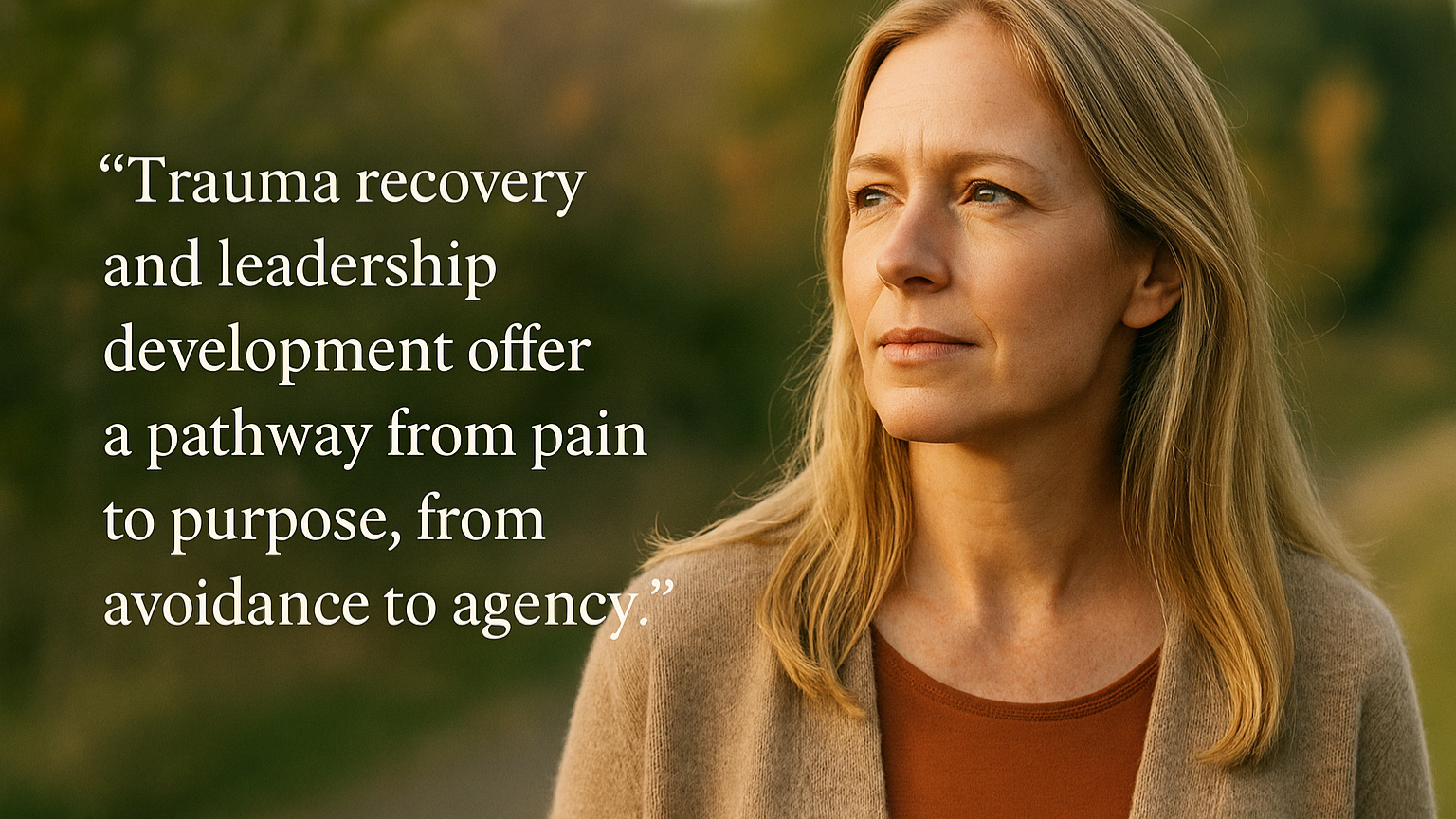
Leadership transformation does not require perpetual excavation of trauma narratives. Rather, it requires retraining the brain, body, and belief system to operate from agency rather than avoidance. This shift is achieved through an integrative application of three models:
Legacy Leadership®
Legacy Leadership® anchors leaders in meaning, values, and long‑term impact beyond immediate performance or threat response. Jordan (2024d) asserts that leaders lead most effectively when they are guided by who they are becoming and the legacy they are shaping, not merely by what they are protecting.
The CARE Method™
The CARE Method™ provides a structured, human‑centered pathway for emotional integration and relational safety. Rooted in compassion, awareness, regulation, and empowerment, CARE reframes emotional engagement as a leadership asset rather than a liability (Jordan, 2024b).
NeuroCARE™
NeuroCARE™ applies neuroscience‑informed coaching practices that calm the amygdala, restore nervous system regulation, and activate executive functioning. By integrating somatic awareness, emotional intelligence, and cognitive reframing, NeuroCARE™ supports leaders in moving from reactivity to intentional presence (Jordan, 2024c).
Together, these models form a psychologically grounded, neurologically informed, and values‑driven framework for leadership growth.
Four Transformational Shifts from Survival to Strength
Confront What Was Learned to Avoid
Avoidance is among the most powerful survival habits—and the most limiting. Hayes’s work on acceptance and commitment demonstrates that resisted emotions gain greater behavioral control over time. Leadership growth begins when leaders develop awareness of avoidance patterns without judgment and replace suppression with curiosity.
Feel What Was Taught to Be Suppressed
Many leaders were socialized to equate emotional control with strength. Neuroscience reveals the opposite: suppressed emotions remain active within the nervous system, shaping tone, decision‑making, and relationships. NeuroCARE™ reframes emotional awareness as data, enabling leaders to integrate feeling without becoming overwhelmed.
Believe in a Future Bigger Than the Past
Everly emphasizes the role of belief, meaning, and hope in resilience. Leaders anchored to past adversity often unconsciously restrict what they believe is possible. Legacy Leadership® invites leaders to reclaim authorship of their future by aligning belief with purpose rather than fear.
Act with Clarity, Alignment, and Embodied Presence
Insight alone does not transform leadership; action does. When leaders integrate neuroscience, emotional intelligence, and values‑based decision‑making, they respond rather than react. Leadership becomes embodied—grounded, intentional, and aligned.
Struggle as Catalyst — Not Cage
This integrative model reframes struggle as raw material for transformation rather than a leadership deficit. When leaders confront avoidance, integrate emotion, reclaim belief, and act from alignment, resilience evolves into agency. Survival gives way to purpose‑driven leadership characterized by presence, compassion, and sustainable impact.
As Jordan notes across his body of work—including The Sacred‑Driven Couple—healing and leadership alike require alignment between inner values and outward action. Whether in personal relationships or organizational systems, transformation emerges when individuals lead from wholeness rather than protection.
Survival helped you endure. Leadership asks you to become.
References
Everly, G. S. (2017). The resilience advantage: Master change, thrive under pressure, and bounce back from setbacks. AMACOM.
Hayes, S. C., Strosahl, K. D., & Wilson, K. G. (2012). Acceptance and commitment therapy: The process and practice of mindful change (2nd ed.). Guilford Press.
Jordan, S. L., Sr. (2014). The sacred‑driven couple. Author.
Jordan, S. L., Sr. (2024a). 31 days of divine connection. Dr J Enterprises LLC.
Jordan, S. L., Sr. (2024b). CARE Method™: Transformational coaching for every generation. Dr J Enterprises LLC.
Jordan, S. L., Sr. (2024c). NeuroCARE™: Transformational coaching for every generation. Dr J Enterprises LLC.
Jordan, S. L., Sr. (2024d). Legacy leadership®: Leading beyond survival into purpose. Dr J Enterprises LLC.
Shpancer, N. (n.d.). Confront what you learned to avoid. Psychology Today.
de Haan, E. (2016). Fearless consulting. Wiley.
DeHart, L. (2024). Light up the science of coaching with metaphors. Lyssa deHart Coaching.


