AI Adoption Requires Workflow Design, Not Just Tool Access


When a logistics team I know got access to a new AI tool, the rollout was a single email: here is the login, go ahead and try it. A few weeks later, three people were using it in three completely different ways, one had built a clever little routine around it, and the rest had opened it once and quietly gone back to how they always worked. Nobody had done anything wrong. There was just no shared idea of where the tool fit.
Access had been handed out. A workflow had not. And those are not the same thing, even though giving someone a login can feel like the whole job is done.
Here is the part that tends to surprise people. The hard part of AI adoption is almost never getting the tool into people’s hands. It is deciding, deliberately, where the tool sits in the actual work: what it is for, when it gets used, what happens to its output, and who does what around it. That design work is unglamorous and easy to skip, and skipping it is the most common reason adoption stalls.
Why access feels like enough
Granting access is concrete and quick. You can do it in an afternoon and point to it as progress. Designing a workflow is fuzzier, takes longer, and does not produce a tidy artifact you can show a leadership team. So the easier task quietly stands in for the harder one.
There is also a fair assumption underneath it: capable people will figure out the best way to use a good tool. Sometimes they do. But left to figure it out individually, ten people invent ten workflows, none of them written down, and the organization ends up with activity that is impossible to support, improve, or trust. The tool gets used. The work does not get better in any way you can repeat.
Handing someone a login is not the same as handing them a way of working. One takes an afternoon; the other is the actual job.
What workflow design actually involves
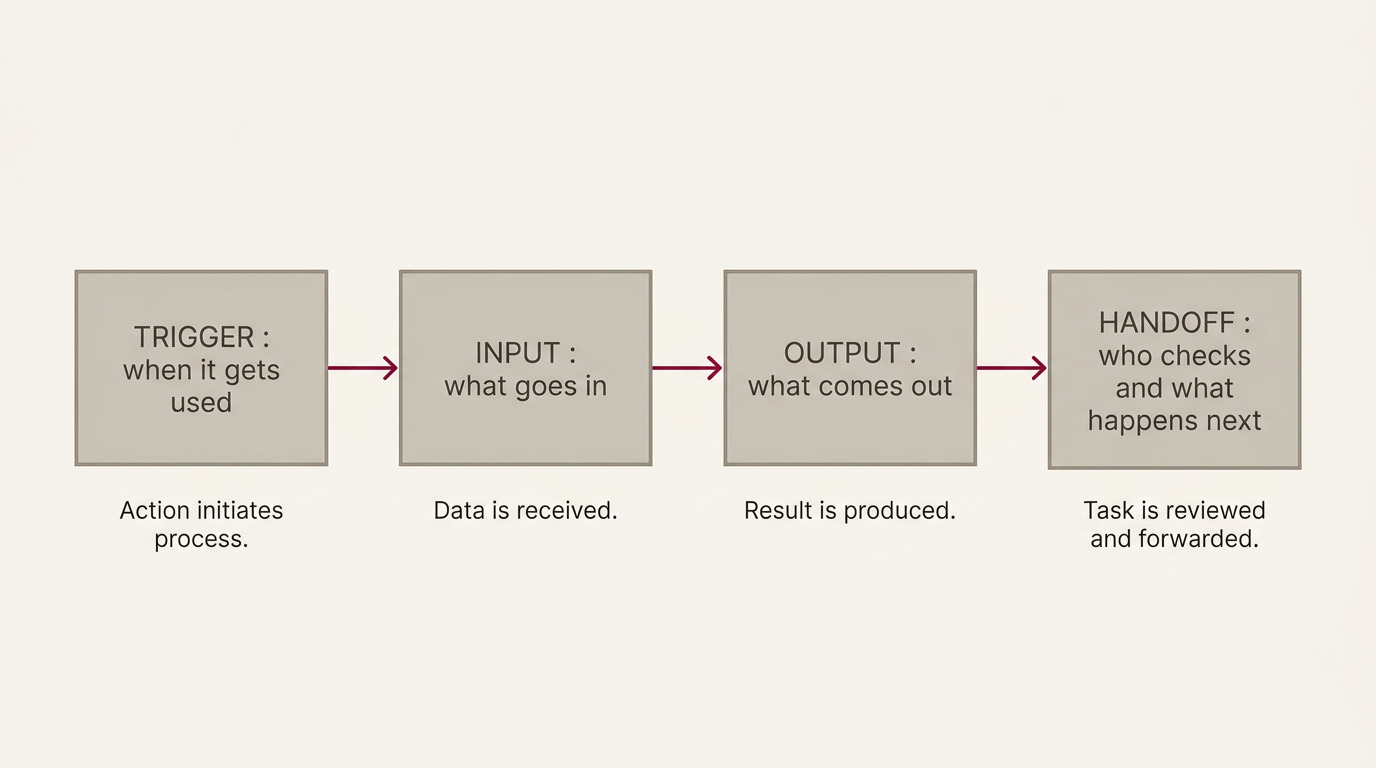
Designing a workflow around an AI tool sounds heavier than it is. At this stage it is mostly a matter of making a few decisions out loud, together, before usage spreads on its own. The diagram below sketches the shape of it.
A practical way to design one
You do not need a formal process map. Pick one task the tool is meant to help with, and walk through four plain questions with the people who actually do that task:
• When does the tool get used? Name the moment. “Whenever it seems useful” is how a tool ends up used by three people and ignored by the rest. A clear trigger turns it into a shared habit instead of a personal one.
• What goes into it, and what stays out? Decide what kind of information is fine to put in and what is not. This is where quiet governance lives, and it is far easier to agree on now than to claw back later.
• What happens to what it produces? An AI output that no one knows how to treat just creates hesitation. Decide whether it is a draft, a starting point, or something that still needs a human sign-off, and say so plainly.
• Who picks it up next? Name the handoff. The output goes to a person, or into a system, or back to the same person to finish. An undefined handoff is where good intentions stall.
Write the answers down somewhere ordinary and shared. It does not need to be polished. A short, agreed description of how the tool fits the work is worth more than the most capable tool used four different ways.
One small thing tends to happen once you do this. People stop asking whether they are using the tool correctly, because there is now a shared answer. That alone removes a surprising amount of the friction that makes early adoption feel shaky.
Where this leads
Designing workflows early does something that pays off well beyond the first tool. It builds the habit of treating AI as part of how work is done, rather than as a gadget bolted onto the side. When the next tool arrives, and it will, the question is no longer “how do we get people to use this,” but “where does this fit,” which is a much better question to be good at answering.
It also quietly keeps consistency from becoming a problem later. Teams that lose a shared sense of how work should flow tend to drift, and that drift is hard to notice until it is costly. The same care that goes into a workflow here is the kind that keeps a team aligned as things speed up.
If keeping that shared focus is something your team already wrestles with, Teams Lose Focus When Priorities Constantly Shift is a useful companion read, because designing AI workflows well is partly about not letting yet another tool fragment how people work.
Worth sitting with
For the AI tools we already use, could two people on the team describe the workflow the same way?
When we gave people access, did we also give them a shared idea of when and how to use it?
What is one task where a tool is being used in several different, undocumented ways right now?
If those land uneasily, the next step is small and concrete. Take one task, gather the people who do it, and answer the four questions out loud. The tool was the easy part. The way of working around it is what turns access into adoption, and that is well within reach.


