AI Compliance Starts With Documentation


A compliance reviewer asked one of the teams I work with to walk through how their AI screening tool had handled a batch of applications the previous spring. The lead opened a shared doc, scrolled to the right week, and had the answer in about four minutes: which version was running, who had approved the threshold, and the two cases that got sent to a person. The reviewer nodded and moved on. What stayed with me wasn’t the tidy process. It was how unremarkable the team found it. Nobody was proud of the documentation. They just had it.
Most teams don’t have that. They have the tool, a rough sense of how it works, and a quiet hope that nobody asks them to prove it. For a while, that holds.
Here is the part worth sitting with. Documentation tends to get treated as the boring tax you pay after the real work is done. In practice it is usually the cheapest thing that makes the real work defensible later. The teams that document least are rarely the busiest. They are the ones who haven’t yet had a conversation go badly.
Why documentation moved to the front
Once an organization is past writing its first AI policies, the interesting question changes. It stops being “do we have a position on AI” and becomes “can we show what actually happened.” A policy describes intent. Documentation is the evidence that intent survived contact with a real Tuesday.
This is the gap most teams fall into at this stage. The policy says outputs are reviewed. The reality is that review happens sometimes, by whoever is around, with no trace left behind. Nobody is lying. The record simply was never written down, so the only honest answer to “show me” is a shrug.
Documentation isn’t written for the auditor. It’s written for the version of your team that has completely forgotten why it made this call.
What is actually worth writing down
The instinct, when people finally take this seriously, is to over-build. A heavy template, twelve required fields, a process so thorough nobody keeps it up. A week later it is abandoned, and the team is back to the shrug. Light and consistent beats thorough and dead. A useful record for a single AI use is small:
• Which tool and which version is in use, and who owns it by name.
• What it is allowed to decide on its own, and what has to go to a person.
• A short, dated note when something meaningful changes: a setting, a threshold, a scope.
• The handful of cases that got escalated or overridden, and why.
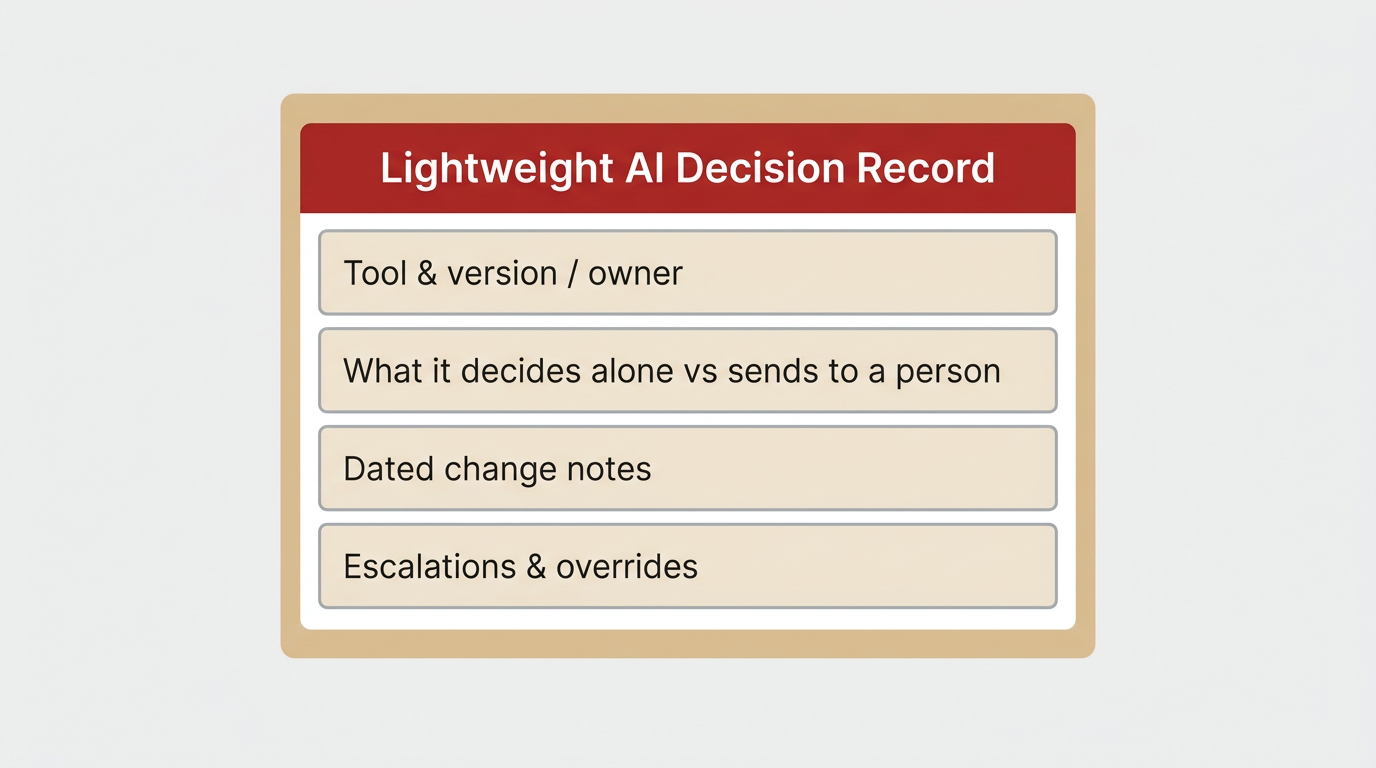
None of those fields are impressive on their own. Together they answer almost every question a reviewer, a customer, or a nervous executive actually asks, and they answer it in minutes rather than in a week of reconstruction.
Why leaders should care about the dull version
For a leader, the value of documentation shows up at the worst possible moments, which is exactly why it is easy to underfund. The quarter something goes wrong, or a large customer sends a questionnaire, or a regulator gets curious, the difference between a calm afternoon and a fire drill is whether the record already exists. You cannot build it retroactively without it looking exactly like what it is.
There is a quieter version of this pattern worth knowing, which is that rules without records tend to rot. That is the dynamic behind AI Policies Fail When Nobody Owns Enforcement: the policy is real, but nothing keeps it honest day to day.
Where to start this week
You do not need a program for this. Pick the one AI use that would be most awkward to explain if someone asked tomorrow. Start a single running log for it, keep the entries short, and add to it as decisions happen rather than saving it all for later. The goal is not a perfect archive. It is being able to answer “show me” without your stomach dropping.
Worth sitting with
If someone asked us to explain a specific AI-assisted decision from six months ago, where would we start, and how long would it take?
Which of our AI uses has a real owner who could be named, and which belong to “everyone” and therefore no one?
Are we documenting for the people who will actually ask, or building something thorough that nobody will maintain?
Compliance at this stage is less about having more rules and more about leaving a trail as you go. If you want a second set of eyes on what is worth recording for your particular setup, a short session with a governance or compliance specialist in Compass can save you from both extremes, the heavy template that dies and the shrug that costs you later.


