AI Governance Is Becoming an Operational Requirement, Not Just Legal Oversight


A product team I worked with had rolled out an AI assistant that drafted replies to customer support tickets. It worked. Response times dropped, the support leads were pleased, and for a few months nobody gave it much thought. Then a customer escalated a refund the assistant had quietly declined, and someone in the room asked a simple question: who decided that, and where is it written down? There was a short, awkward pause. The tool had made the call. Nobody had exactly approved it, and nobody could say which version of which setting had produced it.
That pause is roughly where a lot of organizations are sitting right now. Nothing had gone wrong in a dramatic way. No rule was broken, mostly because there wasn’t a rule to break.
For a long time governance has been treated as the thing legal handles near the finish line, a sign-off you collect before something goes live. The shift happening now is quieter and more practical. Governance is turning into something the work runs through rather than something it passes once on the way out the door.
What governance has quietly turned into
For most of the past few years, AI arrived in organizations from the edges. Someone tried a tool, it helped, word spread, and a few months later three teams depended on something that was never formally chosen. That is how most useful technology shows up. It is also why the question “who is accountable for this output” so often lands on nobody in particular.
Customers, regulators, and boards have started asking that question out loud. For the most part they are not demanding proof that the model is flawless. They are asking something more ordinary and more answerable: can you show how this was decided, who reviewed it, and what you would do if it went wrong.
A good deal of governance is simply being able to answer questions you could answer easily before software started making the calls.
Why this is becoming day-to-day work
Governance is moving into daily operations for a plainer reason than stricter rules. AI now sits inside decisions that used to have a person in the loop by default. When someone approved each refund, the trail existed without anyone designing it. The person was the record. Move that person to spot-checking, or remove them, and the record has to be built on purpose.
When a person made the call, the record came for free. When software makes it, someone has to build the record on purpose.
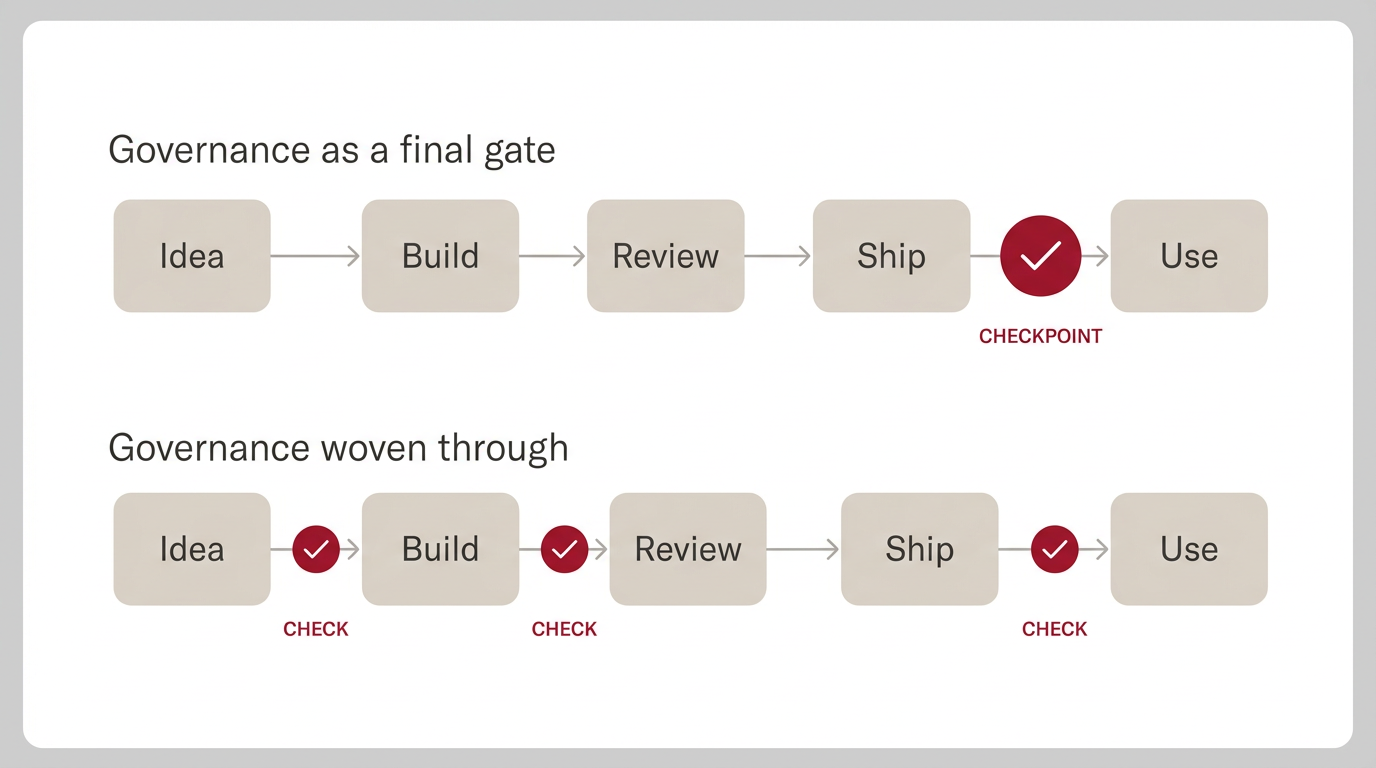
There is a knock-on effect that is easy to miss. The step that looks like it slows you down, writing down who owns what and how outputs get checked, is usually the thing that lets a team move faster later, because they stop relitigating the same question every time something new ships. The picture is less a single gate at the end and more a few light checks spread across the work, as in the comparison below.
Where this usually goes sideways
The most common mistake is treating governance as a document. A policy gets written, circulated, approved, and filed, and everyone feels covered. Six months later it describes a world that no longer exists, because new tools arrived and the policy stayed still. A policy nobody owns day to day ages quickly. It is the pattern behind AI Policies Fail When Nobody Owns Enforcement: the rule exists, but no one is responsible for keeping it true.
The second mistake is the opposite overcorrection. A governance push lands, and suddenly every small experiment needs a committee, a form, and a two-week wait. People respond to friction they did not choose the way they always do. They route around it, and the quiet adoption you were trying to prevent comes back, just harder to see.
There is a third one that slips past most teams. Organizations tend to build governance for the dramatic risks, the model that might say something it shouldn’t, and skip the dull ones, like nobody being able to say which version of a tool produced last quarter’s numbers. The dull failures are usually the ones that actually arrive.
Where to actually start
None of this calls for a transformation program. The organizations handling it well tend to start small and specific. A few moves that hold up:
• Take one AI use already in production and write down, in plain language, who owns it, who checks its outputs, and what happens when it is wrong. One real example teaches more than a framework.
• Make ownership a name, not a department. “Risk owns this” is not ownership. A person who can be asked is.
• Keep a light record of decisions as they happen, rather than assembling a heavy audit in a hurry later. A short note on what was approved and why usually answers the questions that come.
• Decide how much human review each use genuinely needs, and say it out loud, so review is a known step instead of something everyone assumes someone else is doing.
These are deliberately unglamorous, which is the point. Governance that survives a busy quarter is made of small habits, not grand frameworks.
It is worth remembering that none of this is about slowing adoption down. The organizations that get the basics in place usually end up adopting more, because the next decision does not start from nothing.
Worth sitting with
If a customer or a regulator asked tomorrow how a recent AI-assisted decision was made, could we answer it without a scramble?
Which of our AI uses has quietly lost its human owner?
Are we governing the dramatic risks while ignoring the ordinary ones that are far more likely to happen?
Where has review become something everyone assumes someone else is handling?
You do not need all of this figured out to be in reasonable shape. Most organizations are earlier than they would like to admit, and that is fine. The move worth making is a small one: treat governance as part of how AI work gets done, rather than a checkpoint it clears once. The confidence, the evidence, and the control tend to follow from that, more than from a longer policy. If you are mapping where your organization sits, Strategies to Navigate AI’s Dual Promise of Opportunity and Risk is a useful next read.


