AI Won’t Replace Leaders, But It Will Change Leadership


A team lead I know recently handed her weekly status summary over to an AI tool. It now drafts the update in a tenth of the time, pulling from the same notes she used to comb through by hand. She told me the strange part wasn’t the time she saved. It was realizing how much of her old job had been formatting, and how little of it had been the thing she was actually there to do.
That’s the shape of what’s happening to a lot of leadership work right now. The tools are quietly absorbing the mechanical parts, the summarizing, the drafting, the first-pass analysis. What’s left over is the part that was always the real job, and it turns out there’s more of it than the busywork used to let people see.
The context, without the noise
There are two loud stories about AI and leadership, and both are mostly wrong. One says the tools will replace managers. The other says they’re overblown and nothing meaningful changes. The more accurate version is less dramatic and more demanding. AI changes what a leader spends time on, which changes what makes a leader good, without changing the fact that someone still has to lead.
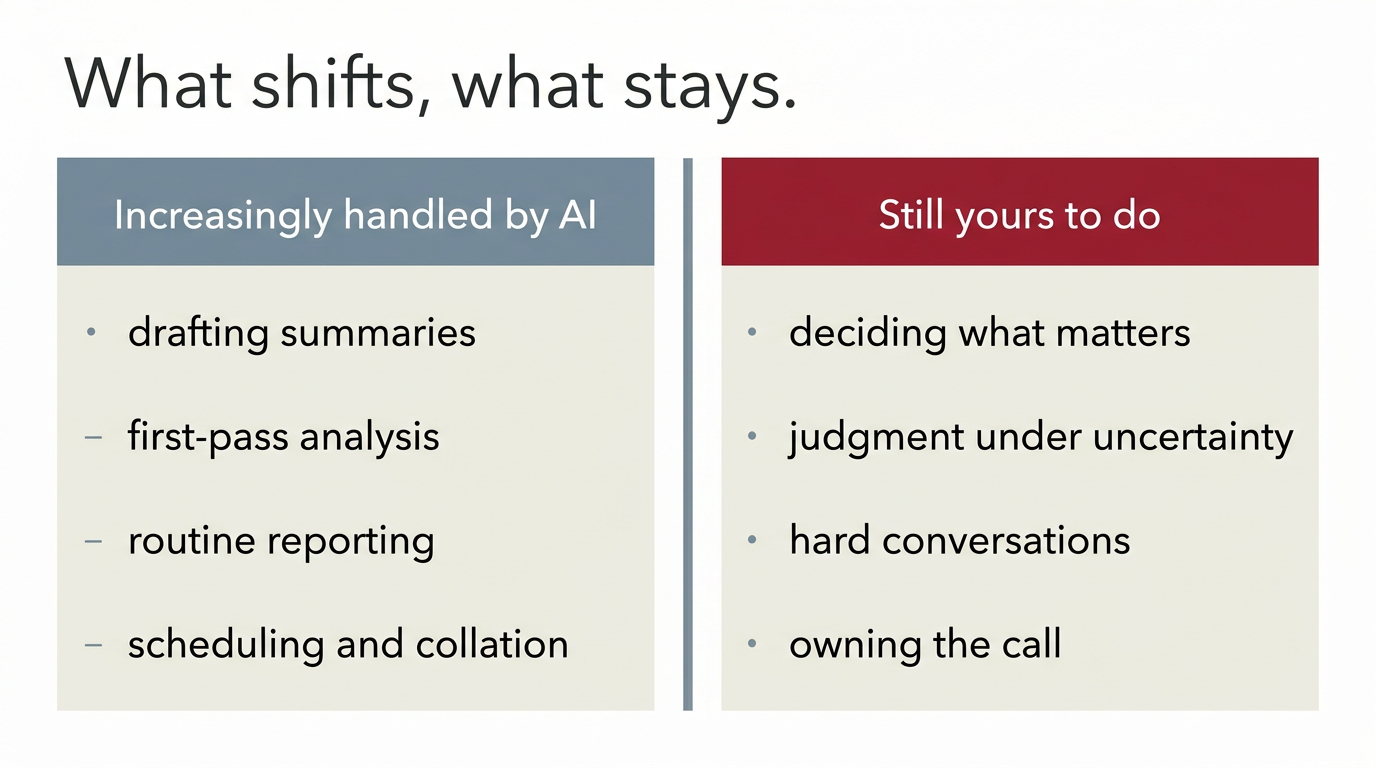
The work that’s getting automated tends to be the work you could describe as a procedure. Pull the numbers, write the recap, draft the first version. The work that isn’t going anywhere is the work that resists being proceduralized. Deciding what actually matters this quarter. Reading the room when the data and the mood disagree. Telling someone something hard in a way they can hear. Taking responsibility for a call when the information was incomplete and a decision still had to be made.
As the routine parts of the job thin out, the parts that were always the point have nowhere left to hide.
What changes when you’re leading at this level
If you lead experienced people, you’ve probably noticed the questions coming to you are getting harder, not easier. That’s not a coincidence. When a tool can handle the straightforward version of a problem, the things that reach a human are the ambiguous ones, the judgment calls, the situations where context matters more than process. Your inbox is slowly filling up with exactly the work that can’t be delegated to software.
This raises the bar in a quiet way. It used to be possible to be a decent manager mostly by being organized and responsive. Increasingly, organized and responsive is what the tools do. What distinguishes a leader now is judgment, clarity, and the ability to take responsibility, the things that were always supposed to be the core but often got crowded out by administration.
There’s also a new skill that’s genuinely worth building, which is knowing what to hand to a tool and what to keep. A leader who delegates judgment to an AI because it sounds confident is making a real mistake. So is one who refuses to use the tools out of pride and spends their week on work a machine could do better. The skill is the discernment between those, and it’s a leadership skill, not a technical one.
What this means in practice
The practical move isn’t to learn every tool. It’s to get deliberate about where you add value and protect it. A few things worth doing:
• Notice which parts of your week are procedure and which are judgment. Move the procedure toward tools where you sensibly can, and reinvest the time into the judgment, not into more procedure.
• When a tool gives you a confident answer, treat it as a strong draft, not a decision. The accountability for the call stays with you, which means understanding it stays with you too.
• Use the time you reclaim on the things that don’t scale, the conversation that builds trust, the thinking that sets direction. If automation just makes you do more shallow work faster, you’ve spent the gift badly.
• Be honest with your team about what you’re using and how. Quietly running everything through a tool you won’t name reads as evasive and erodes the trust you need.
The business stakes underneath it
The organizations that handle this well won’t be the ones that adopted the most tools. They’ll be the ones whose leaders used the time the tools freed up to lead better, to make clearer calls, to spend real attention on people and direction. The tools are roughly available to everyone now, which means they’re not the advantage. What people do with the reclaimed attention is.
There’s a failure mode worth naming. Adoption without judgment tends to produce faster, more confident, more wrong decisions, because the speed of the tool gets mistaken for the soundness of the call. The leaders who do this well stay a little skeptical of their own efficiency. They keep asking whether faster is actually better here, and sometimes decide it isn’t.
Worth sitting with
Which parts of my week are procedure I’m holding onto out of habit, and which are the judgment only I can do?
Last time a tool gave me a confident answer, did I treat it as a draft or as a decision?
If automation freed up five hours of my week, would I spend them on deeper work or just more of the shallow kind?
Where am I at risk of mistaking speed for good judgment?
The leaders who’ll matter most over the next few years aren’t the ones who feared the tools or the ones who worshipped them. They’re the ones who stayed clear about what leadership actually is, used the tools to clear away the parts that were never the point, and put their real attention where judgment still lives. That clarity is the work now. The tools just made it impossible to avoid.
If you’re thinking about how this plays out at the organizational level, AI Policies Fail When Nobody Owns Enforcement is a grounded look at the governance side, and the leadership experts in Compass can help you map where your own judgment adds the most value.


