Human Oversight Still Matters More Than Most Organizations Think


A support team set up an AI tool to draft replies to customers. It was good, so before long they let it send the straightforward ones automatically, with a human reviewing anything unusual. Within a few weeks, reviewing the unusual ones had quietly turned into skimming them, and then into approving them, because the drafts were almost always fine. The oversight step was still there on the process diagram. It had simply stopped happening in any real sense.
This is the pattern worth naming, because it is so easy to miss while it is happening to you.
Oversight rarely fails loudly
It is tempting to assume oversight fails when someone removes it. Far more often it fails while staying exactly where it was, quietly emptying out from the inside. And here is the uncomfortable turn. The better the AI gets, the faster human review tends to erode, because nothing in the day rewards catching the rare mistake while everything rewards moving quickly through the queue.
A few forces push in the same direction. People defer to a confident system, especially one that is usually right, which is a well-documented habit and not a sign of carelessness. Review framed as a gate to clear becomes a rubber stamp. And oversight applied evenly to everything ends up applied meaningfully to nothing, because attention spread that thin cannot land anywhere.
Oversight rarely gets removed. It just keeps its place on the chart while quietly emptying out.
A more honest way to structure it
The useful frame is not a human reviews everything, which is impossible at any real volume, and not a human reviews nothing, which is reckless. It is matching the depth of oversight to what a mistake would actually cost. Tier it by consequence.
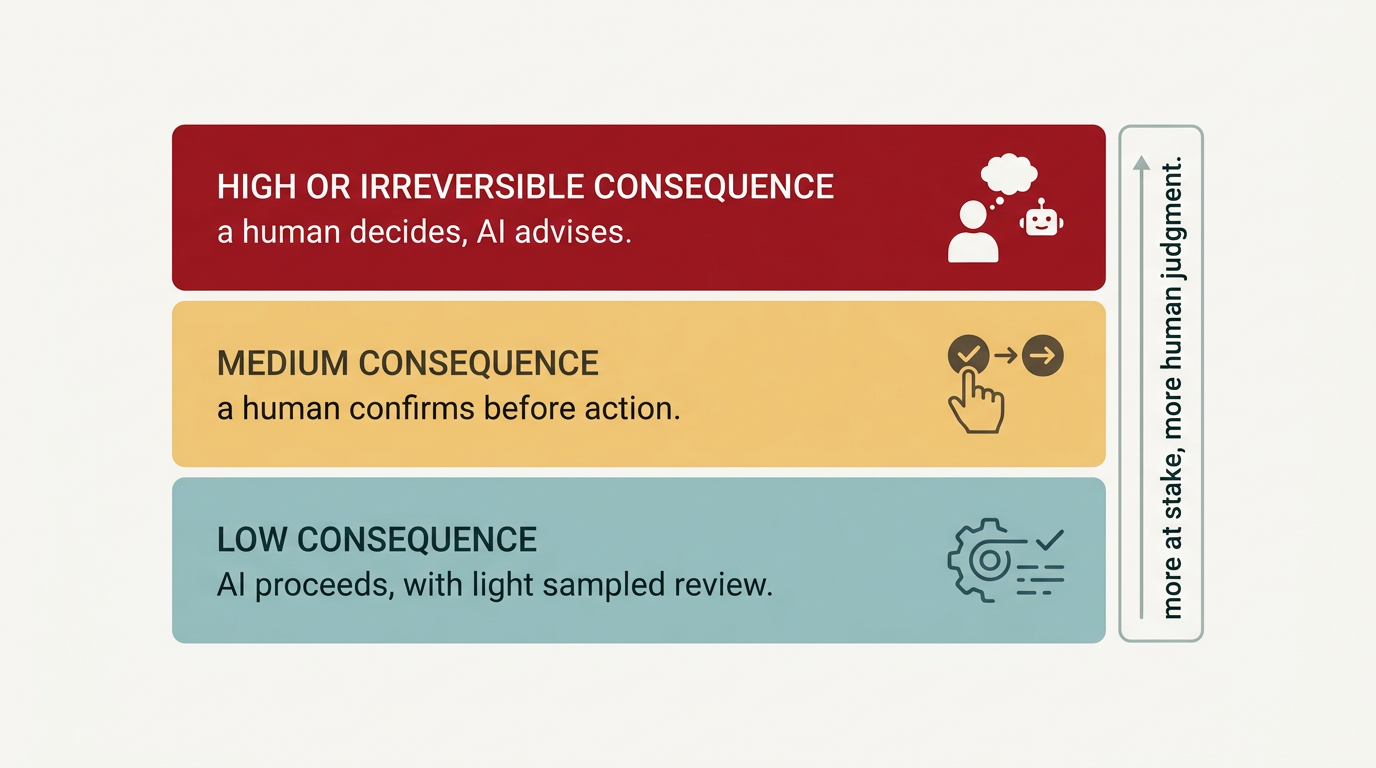
The principle underneath the tiers is simple. Spend your scarce, real attention where a mistake genuinely costs something, and let the low-stakes work flow with lighter, sampled checks. Reviewing the trivial and the high-stakes with the same thin attention is how the high-stakes ones slip through.
What this looks like in practice
• Match oversight to stakes, not to volume. The loudest, highest-volume work is rarely where the costly mistakes hide.
• Make review a real decision. If a reviewer cannot say what they are checking for, they are not reviewing, they are forwarding.
• Sample the automated lane. Even the “safe to automate” tier needs periodic spot-checks, or you will not notice the day its quality quietly drifts.
• Watch for the slide from review to rubber stamp. It is gradual, it feels like efficiency, and it is the failure mode you are most likely to live inside without noticing.
• Keep a person clearly accountable for outcomes, not merely present in the workflow. Being on the diagram is not the same as having the time, the information, and the mandate to step in.
Worth sitting with
Where have we kept a human “in the loop” who no longer has the time, information, or authority to actually intervene?
Are our review steps catching anything, or have they become a formality we would be embarrassed to measure?
If our AI made a costly mistake tomorrow, who would be accountable, and would they have had a real chance to catch it?
Human judgment and review remain essential to responsible AI decisions, but only if the oversight is real rather than nominal. It is a practice you maintain, not a box you keep ticked. If you want help designing review that holds up as your AI use scales, the FSC pathways and responsible-AI resources in Compass are built for it, and AI Policies Fail When Nobody Owns Enforcement is a natural companion, since oversight without ownership is usually where this quietly comes undone.


