Most Employees Don’t Need More Meetings. They Need Better Coaching.


A manager I worked with ran four standing meetings a week with his team of six. Monday planning, a midweek check-in, a Thursday blockers call, and a Friday wrap. He was proud of the cadence. He told me his team always knew what was going on. What he hadn’t noticed was that the same three problems kept showing up in those meetings, week after week, slightly reworded, never actually resolved.
The meetings weren’t fixing anything. They were just the place where the team confirmed, together, that things were still stuck.
When work feels chaotic, adding a meeting feels like taking control. It rarely is. Most teams that feel under-managed aren’t short on touchpoints. They’re short on the kind of conversation where someone actually gets better at the thing they’re struggling with, and that conversation is coaching, not coordination.
Why meetings get used as a substitute for coaching
A status meeting is comfortable in a way coaching isn’t. It’s scheduled, it’s group-sized, and it lets you stay in the realm of updates instead of getting into anyone’s actual work. You hear that something is behind, you ask when it’ll be done, you move on. Everyone leaves having reported, and nobody leaves having changed how they work.
Coaching is the opposite shape. It’s one person, it’s specific, and it usually means slowing down on a single real problem instead of skating across ten. It asks more of you in the moment, which is exactly why the meeting feels safer. So teams quietly drift toward more coordination and less development, and the recurring problems stay recurring because nobody ever stopped to work on the capability underneath them.
A status meeting tells you what’s stuck. Coaching is where it gets unstuck.
What coaching actually looks like in the flow of work
The word coaching makes a lot of managers picture a formal sit-down with a worksheet. In practice the useful version is much smaller and fits inside work you’re already doing. The shift is from giving answers and tracking output to helping someone think their way to a better approach. The diagram below lays out the move, from the meeting reflex to the coaching habit that replaces it.
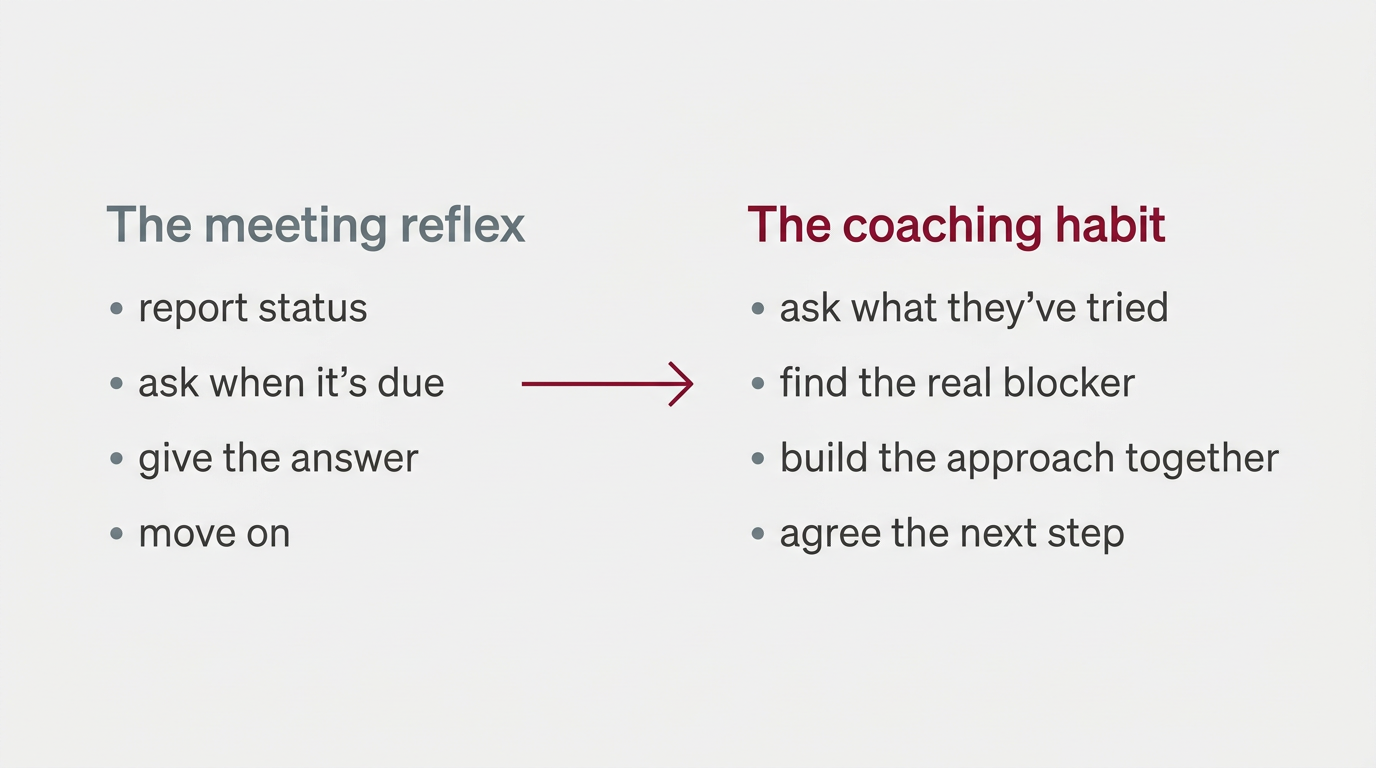
Notice that none of the right-hand column needs a calendar invite. Most of it happens in the same conversations you’re already having, just steered differently.
Four coaching moves you can use this week
If you want to trade some coordination for development without blowing up your schedule, these are concrete enough to try in your next one-on-one or even a hallway exchange:
• Replace “When will it be done?” with “What’s making this harder than it should be?” The first question manages the task. The second one surfaces the thing that’ll still be there next week if you don’t address it.
• When someone brings you a problem, ask what they’ve already tried before you offer a fix. You’ll either learn they’ve thought it through further than you assumed, or you’ll spot exactly where their thinking stalls, which is the part worth coaching.
• Let them leave with the next step in their own words. If you name it for them, you’ve taken the work back. If they name it, they own it, and they’re more likely to actually do it.
• Cut one recurring status meeting and convert that time into two short individual conversations. You’ll cover less ground and resolve more.
You won’t get all four right at once, and you don’t need to. Picking one and using it consistently for a couple of weeks does more than adopting all of them badly.
Where managers tend to overcorrect
There’s a failure mode worth flagging, because eager managers fall into it fast. Coaching does not mean never giving an answer. If someone is genuinely stuck on something you know cold, withholding it to make them “grow” is just a slower way to be unhelpful. The judgment call is whether the gap is information or capability. Information you can simply hand over. Capability is the thing coaching is for, and that’s where the questions earn their keep.
Worth sitting with
Which of my recurring meetings exist to coordinate work, and which actually help anyone get better at it?
When someone brings me a problem, is my first instinct to solve it or to understand how they got stuck?
If I cut one standing meeting tomorrow, what would genuinely break, and what would just feel uncomfortable?
Where to start
You don’t need to redesign your team’s whole rhythm to begin. Take your next one-on-one and swap a single status question for a coaching one, then stay quiet long enough to hear the real answer. If you want a sharper sense of where coaching ends and doing-it-for-them begins, Pair Programming vs Coaching: The Difference Is Ownership draws that line well.
More meetings will always feel like the responsible move when things are messy. Usually the responsible move is quieter, and it happens one conversation at a time.


