Organizations Need AI Standards Before AI Scale


A company I advised had genuinely figured out AI in pockets. One team had a polished way of using it for research, with clear rules about what they would and would not trust it to do. Another had quietly built something just as good for drafting. The trouble was that neither team knew the other existed in any detail, and a third team, newer to it, was making early mistakes the first two had already learned their way past a year earlier.
Each pocket worked. The organization, as a whole, was relearning the same lessons in parallel and carrying risks it could not see across team lines. They were ready to scale AI much more widely. What they did not have was any shared sense of how it should be done, and that absence was about to get expensive.
This is the moment that catches mature organizations off guard. The instinct, once AI is clearly working, is to push for more scale. But scaling inconsistent practice does not multiply the wins. It multiplies the variation, and variation is exactly what becomes unmanageable at size. The thing that needs to come before more scale is not more tools. It is a set of shared standards, and putting them slightly ahead of the growth is what keeps the growth from turning brittle.
Why standards feel premature exactly when they are needed
There is a natural resistance here. Standards sound like bureaucracy, and an organization that has gotten this far on the initiative of capable teams is rightly wary of smothering what worked. Why impose rules now, when the freedom to experiment is what got you here.
The answer is that the thing which made early success possible is the same thing that makes scale risky. In a few hands, varied practice is healthy experimentation. Across the whole organization, that same variation means inconsistent quality, duplicated learning, uneven handling of sensitive information, and risks that live in the gaps between teams where no one is looking. Standards at this stage are not about constraining the good teams. They are about making what the good teams already know into something the whole organization can rely on.
In a few hands, varied practice is healthy experimentation. Across an organization, the same variation is what becomes unmanageable at scale.
The aim is not to freeze practice. Good standards capture the current best understanding, leave room to improve, and get revised as the organization learns. They are a floor and a shared language, not a ceiling.
What “standards” should and should not mean here
It helps to be precise, because the word carries baggage. At this stage, useful AI standards are mostly about consistency in a few things that matter, not control over every choice.
They cover what kinds of information can go into which kinds of tools, so that sensitive data is handled the same way regardless of which team is doing the handling. They establish a shared way of treating AI output, when it is a draft, when it needs review, when it can be acted on directly. They define who owns AI use in each area, so that questions have somewhere to go. And they create a light, common record of what is being used where, so the organization can see itself.
Notice what is not on that list: dictating which tools people may use, or how creatively they may apply them within safe bounds. The standards set the guardrails and the shared vocabulary. Within them, teams keep the latitude that made them good in the first place.
Reading where you are before you scale
Most organizations at this point are not starting from zero, nor are they fully mature. They are somewhere in between, and it helps to locate that honestly before pushing for more scale. The stages below are a rough map, not a grade.
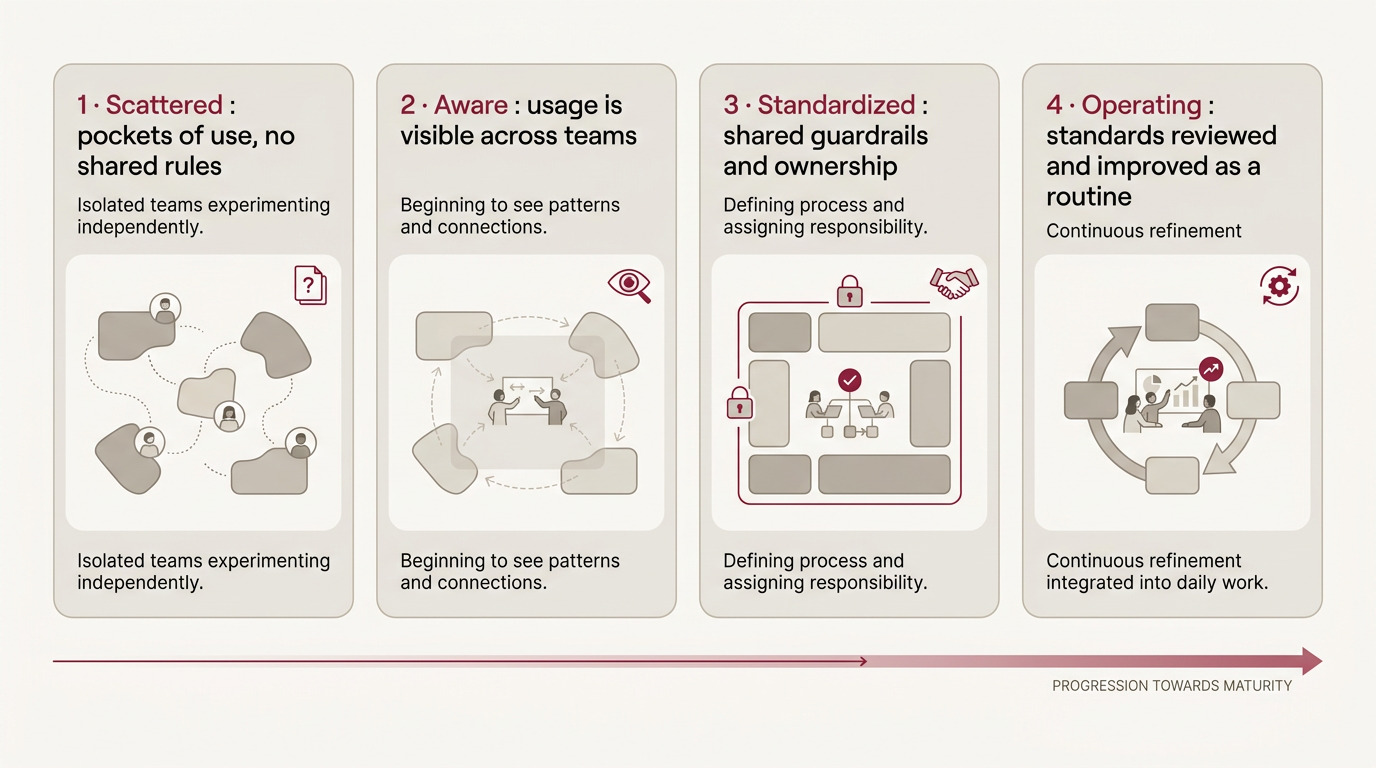
Most organizations that feel ready to scale are sitting around the second stage: usage is visible, a few teams are genuinely good at it, but there is no shared way of working across them. The temptation is to jump straight to broad scale from there. The steadier move is to pass through standardization first, turning what the strong teams know into shared guardrails, before adding much more volume on top.
How to set standards without killing momentum
The way this goes wrong is predictable: a central group, often well-intentioned, writes a comprehensive policy in isolation and hands it down, and the teams who were actually good at AI quietly route around it. The standards that hold are built differently.
They start from what already works. The teams who have figured out good practice are the best source of the standard, not its opponents. Asking them to help codify what they already do turns your strongest practitioners into authors rather than obstacles, and the result is something grounded in real use.
They stay deliberately light at first. A short set of standards that people actually follow beats a thorough one that gets ignored. You can always add specificity where real problems show up. Starting heavy almost guarantees the routing-around that undermines the whole effort.
They name owners, not just rules. A standard without someone responsible for it ages badly and quietly stops being followed.
This is the same lesson that shows up wherever AI governance is tried: rules need an owner or they fade. AI Policies Fail When Nobody Owns Enforcement makes that case directly, and it pairs naturally with this, because standards and enforcement are two halves of the same idea. One says what good looks like; the other makes sure it holds.
And they are treated as living. The first version will be imperfect. What matters is that it gets revised as the organization learns, rather than being written once and left to rot. Standards that improve become an operating practice. Standards that ossify become the bureaucracy everyone feared.
The longer view for leaders
It is tempting to see standards as a tax on scale, the slow part that delays the exciting part. The organizations that handle AI well over time tend to see it the other way around. Standards are what make scale safe enough to be worth pursuing. Without them, more scale just means more exposure, and the eventual reckoning is far more expensive than the standards would have been.
There is a quieter payoff too. An organization with shared AI standards stops relearning the same lessons in every team, and starts compounding what it knows. That is the difference between a company that has AI in pockets and one that operates with AI as a capability. The first is common. The second is rare, and it usually got there by being willing to standardize before it scaled.
Worth sitting with
If two of our strong teams described how they use AI, how much of it would actually match?
Are we about to scale AI more widely on top of practice we have never made consistent?
Do our best AI practitioners feel like authors of our standards, or like people who will need to route around them?
Is there anything in how we use AI today that we would be uncomfortable seeing every team do the same way?
If those questions surface more variation than you expected, that is the signal to standardize before you scale, not after. Bring your strongest teams together, capture what they already know as a light shared standard, name the owners, and treat it as something you will keep improving. Done this way, standards are not the thing that slows AI down. They are what lets you scale it without it quietly getting away from you.


