Responsible AI Requires Better Decision-Making Habits


An organization I worked with had done everything you are supposed to do. There was an AI policy. There was a governance committee. There was a risk register, and somewhere a tidy slide deck from the launch. Then one of their tools drifted out of its intended use over a few quiet months, and none of the artifacts caught it, because every one of them described a decision made a year and a half earlier. The governance existed. It just was not a habit. It had become a monument.
This is the failure mode that catches mature organizations, and it is almost the opposite of the one that catches beginners. Early on, the problem is having nothing. Later, the problem is having everything, beautifully documented, and treating that documentation as the finish line.
The reframe worth holding is that responsible AI is not a thing you complete. It is a thing you keep doing. The maturity does not live in the policy or the committee or the register. It lives in the cadence, in whether anyone is still looking.
What “mature” actually means here
Past a certain point, adding more frameworks stops helping. A second risk taxonomy does not make you safer than the first one nobody reads. The organizations that handle AI well at this stage are not the ones with the most controls. They are the ones whose decisions get revisited, where someone notices that a tool is now doing something slightly different from what it was approved to do, and treats that as normal maintenance rather than a crisis.
That sounds obvious written down. It is rare in practice, because revisiting a decision feels like admitting the first one was incomplete, and because nothing on a busy calendar ever reserves time for checking whether last quarter’s judgment still holds.
Mature governance isn’t a thing you finish. It’s a cadence you keep.
What changes when the basics are already in place
When the policies and the committee already exist, the useful work shifts. It stops being about building artifacts and starts being about maintaining judgment over time. The questions change from “do we have a position” to “is our position still true,” and from “who approved this” to “has anyone looked at it since.” That shift is unglamorous and it is most of the job.
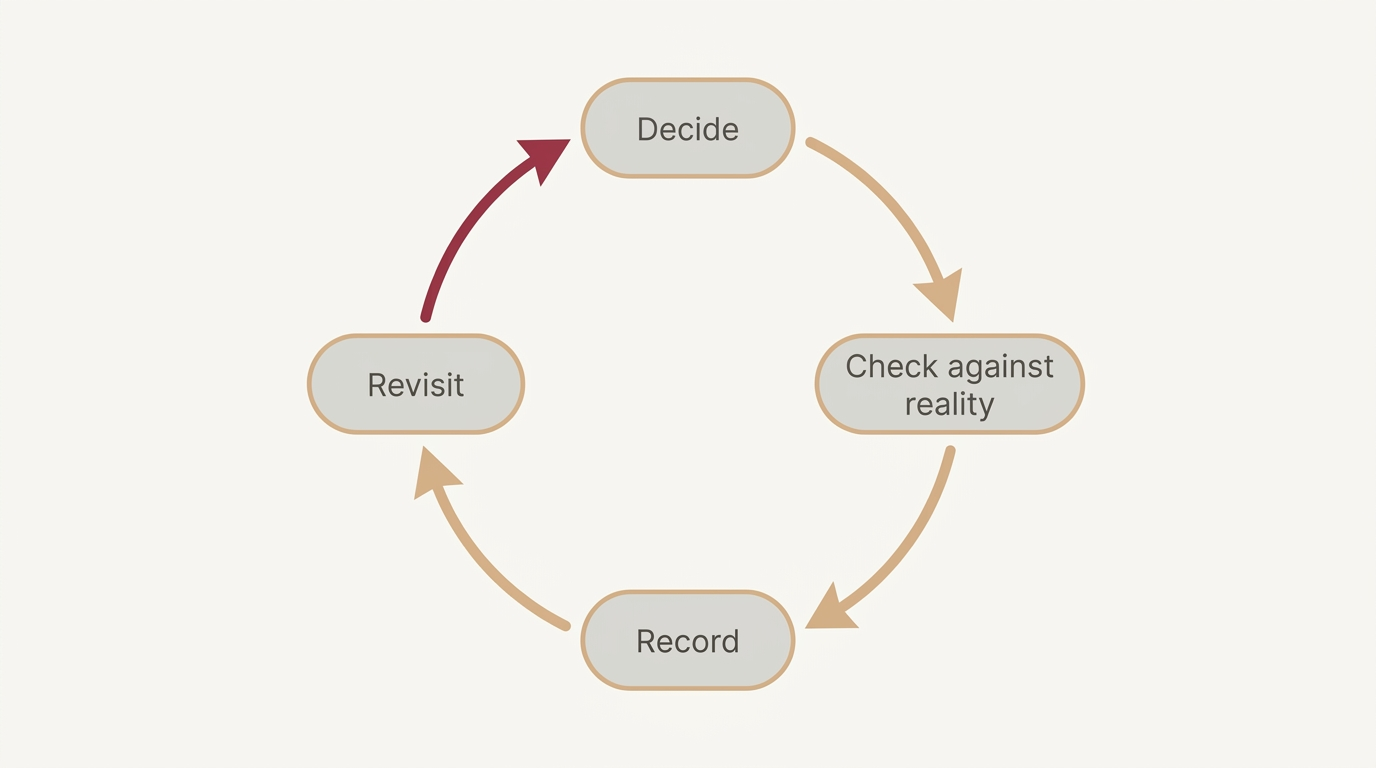
The practical version of this is a loop rather than a launch. A decision gets made, it gets checked against reality after some time, the result gets recorded, and that record feeds the next decision. Nothing about it is dramatic. It just keeps turning.
The habits that hold it together
If the loop is the idea, these are the habits that keep it turning when the quarter gets busy:
• Schedule revisits, not just launches. A decision with no review date is a decision nobody will ever look at again.
• Make drift visible. Build a small, regular moment where someone asks whether each significant AI use is still doing what it was approved to do.
• Keep decisions reversible where you can. The willingness to walk something back is what makes ongoing governance honest rather than defensive.
• Give each significant use a standing owner, not a one-time approver. Approval is a moment; ownership is a relationship over time.
These are deliberately modest. The aim is not heroic oversight, which never survives a real quarter. It is a light cadence that keeps running in the background, the way good maintenance does.
Why this is a leadership question
For leaders, the temptation is to read governance maturity as a state you reach and then bank. The organizations that scale AI well treat it as an operating practice instead, something with a rhythm and an owner and a place on the calendar. Counterintuitively, that ongoing discipline is what lets them say yes to new uses more readily, because each new decision starts from a living understanding of what is already running rather than from a year-old snapshot and a hope.
This connects to a broader point about ownership keeping rules alive, which is the dynamic behind AI Policies Fail When Nobody Owns Enforcement: a policy with no standing owner ages into the same kind of monument as an unmaintained committee.
And because the underlying goal is to keep adopting AI without losing the thread, Strategies to Navigate AI’s Dual Promise of Opportunity and Risk is a useful companion read on holding opportunity and caution together.
Where to start
If your organization already has the artifacts, the next move is not another framework. It is to put one revisit on the calendar, give one significant AI use a named standing owner, and treat the first review as routine rather than an audit. The maturity you are after is built from that small, repeating motion, not from a bigger binder. The AI governance experts in Compass can help you design a cadence that fits how your organization actually works, rather than one that looks impressive and quietly stops turning.
Worth sitting with
Which of our AI governance artifacts describe decisions we have not revisited since they were made?
Where would we first notice if an AI tool quietly drifted out of its intended use, and who would notice it?
Do our significant AI uses have standing owners, or only original approvers?
Are we treating governance as something we finished, or something we keep doing?
What would it take to make one honest revisit feel like routine maintenance rather than a crisis?


