Teams Need Clarity More Than Constant Availability


A director I worked with ran a team split across three time zones, and she was proud, reasonably, of how reachable she was. Green dot almost always on. Replies within minutes. If you pinged her at the edge of her day she’d still answer, usually with a thoughtful paragraph. Her team described her as incredibly responsive. They also, when I talked to them one by one, couldn’t quite agree on what the team was trying to achieve that quarter.
Those two facts were connected, though it took her a while to see it. Her availability was real and generous. It was also doing a quiet kind of harm, because every fast answer she gave was a decision the team didn’t have to make for itself, and every decision she absorbed was one more thing that lived in her head instead of in the shared understanding of the group.
There’s a belief, especially among conscientious leaders of distributed teams, that being constantly reachable is the thing that holds everything together. It feels like leadership. It feels like care. But when work is spread across hours and locations, the leader who is always available often becomes the bottleneck nobody names, and the clarity that would actually let people move without her never gets built, precisely because she keeps being there to fill the gap in real time.
Why availability stops scaling
In a co-located team, constant availability is cheap and mostly invisible. People overhear answers, catch context in passing, calibrate off the room. A quick question and a quick reply barely register. The whole arrangement runs on a steady background hum of presence that nobody has to deliberately produce.
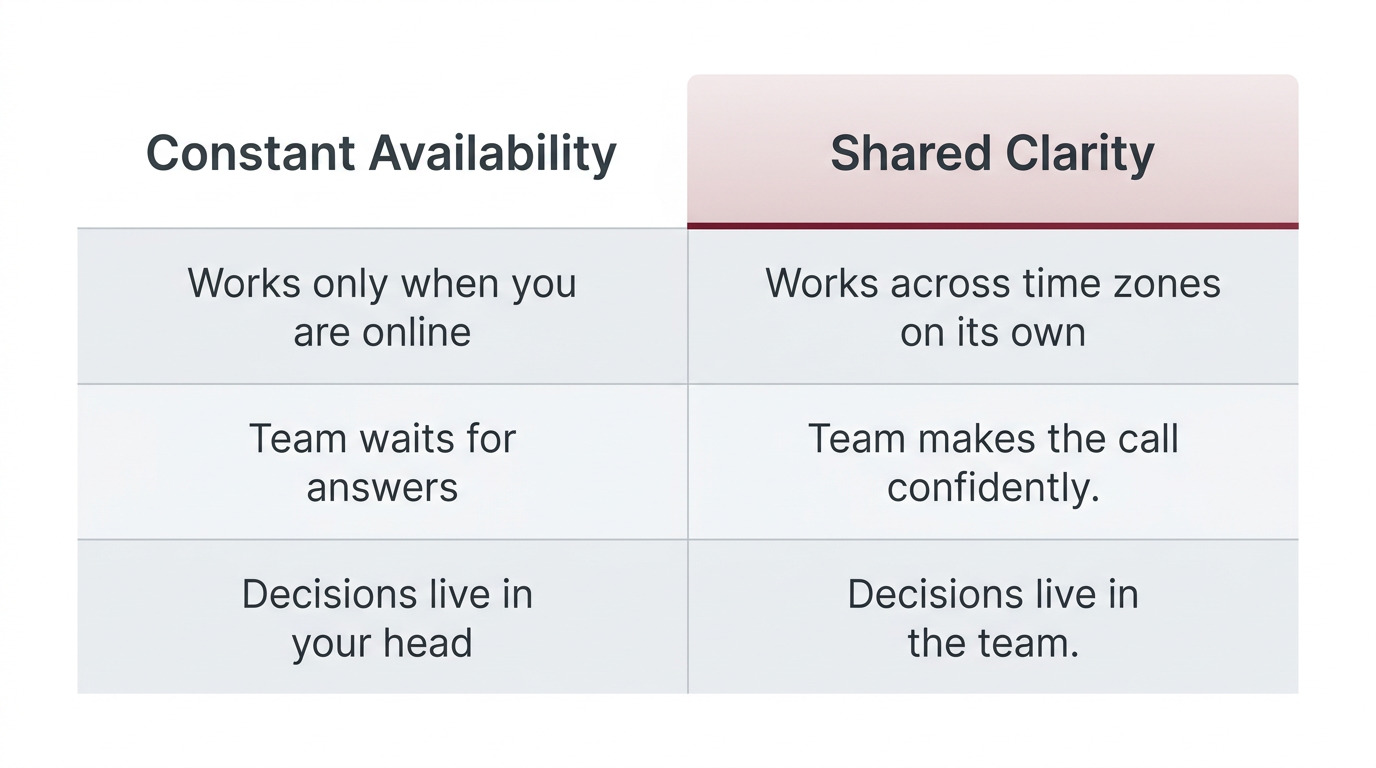
Spread that same team across time zones and the hum disappears. Now every answer has to be requested, and the person who could give it might be asleep. If the team has been trained to wait for the leader, work stalls in the hours she’s offline and floods her inbox in the hours she’s on. Her responsiveness, the thing everyone praised, has quietly become the rate limit on the entire team. The more available she is, the more the team learns to depend on her being available, which is a loop that tightens rather than loosens over time.
In a distributed team, every answer you give in real time is a decision the team didn’t learn to make without you.
Clarity works the opposite way. A team that genuinely understands the priority, the constraints, and what “good” looks like can keep moving while the leader sleeps. It can make the small judgment calls without checking. Clarity is the thing that travels across time zones on its own. Availability has to be present to be useful. Clarity keeps working when you’re not in the room, which is the entire point of building it.
What changes when the team is senior
For an experienced leader running a capable team, this is where the real shift sits. The instinct that served you earlier, be present, be responsive, unblock people fast, starts to work against you at this level. Your team doesn’t need you to answer faster. It needs to need you less, and that only happens if you stop being the fastest path to an answer.
That reframe is uncomfortable because availability is so easy to feel good about. Answering quickly is satisfying. It produces visible gratitude. Building clarity, by contrast, is slow and mostly invisible, and it occasionally looks like you’re being less helpful in the moment. A leader who replies “what does your read tell you?” instead of just solving it can feel, briefly, like they’re withholding. Over a quarter, it’s the difference between a team that can run without you and one that can’t.
What this looks like in practice
Trading availability for clarity is mostly a set of deliberate choices about where your effort goes. A few that tend to hold up on distributed teams:
• Write the decision down where the team can find it, not just the answer to the question. When someone asks, answer in the shared space and explain the reasoning, so the next person doesn’t have to ask at all.
• Make the priority and the guardrails explicit enough that most calls don’t need you. People escalate less when they know the boundaries they’re allowed to operate inside.
• Be reliably available in a narrow window rather than vaguely available all the time. A predictable “I respond to async questions by end of my morning” builds more confidence than a green dot that might or might not answer.
• When someone brings you a decision they could have made, hand it back with the context they need to make it next time. Resist the small pleasure of just solving it.
None of this means going quiet or unreachable. It means being less of a live oracle and more of a source of durable understanding. The director I mentioned didn’t become harder to reach. She just started spending the energy she’d been pouring into instant replies on making the shared picture clearer, and within a couple of months the late-night pings dropped on their own, because fewer of them needed her at all. If the underlying issue is that priorities themselves keep moving, that’s a related and worth-reading problem, covered in Teams Lose Focus When Priorities Constantly Shift.
The wider payoff
There’s a business case underneath all of this, and it’s worth saying plainly. A team that depends on the leader’s presence has a single point of failure built into its operating model. It slows when she’s on leave, stalls across time zones, and quietly caps how large or how senior it can grow, because everything still routes through one person’s attention. A team that runs on clarity doesn’t have that ceiling. It’s more resilient, easier to scale, and frankly easier to lead, since the leader gets back the hours she was spending as a human switchboard.
For leaders building the muscle of running distributed work well, the practical side of async and remote norms is its own skill set, and it’s well covered in Mastering Remote Work: Tools and Strategies for Tech Pros.
* * *
Worth asking yourself
If I were offline for a full week, where would my team stall, and what does that tell me about where clarity is missing?
How many of the questions I answered this week were decisions the team could have made if the context lived somewhere shared?
Am I reaching for fast replies partly because they feel good and visible, rather than because they’re what the team most needs?
What would it take for my team to trust a slower, more reliable rhythm from me over an always-on one?
You don’t have to change how you lead overnight, and you don’t have to disappear to prove a point. Pick one recurring question your team keeps bringing you, and instead of answering it again, spend that time making the answer findable without you. Watch what happens over the next few weeks. If you want to pressure-test this shift against your own situation, the leadership experts in Compass are a good place to work through it.


