The Hidden Cost of Constant Prioritization

Published on
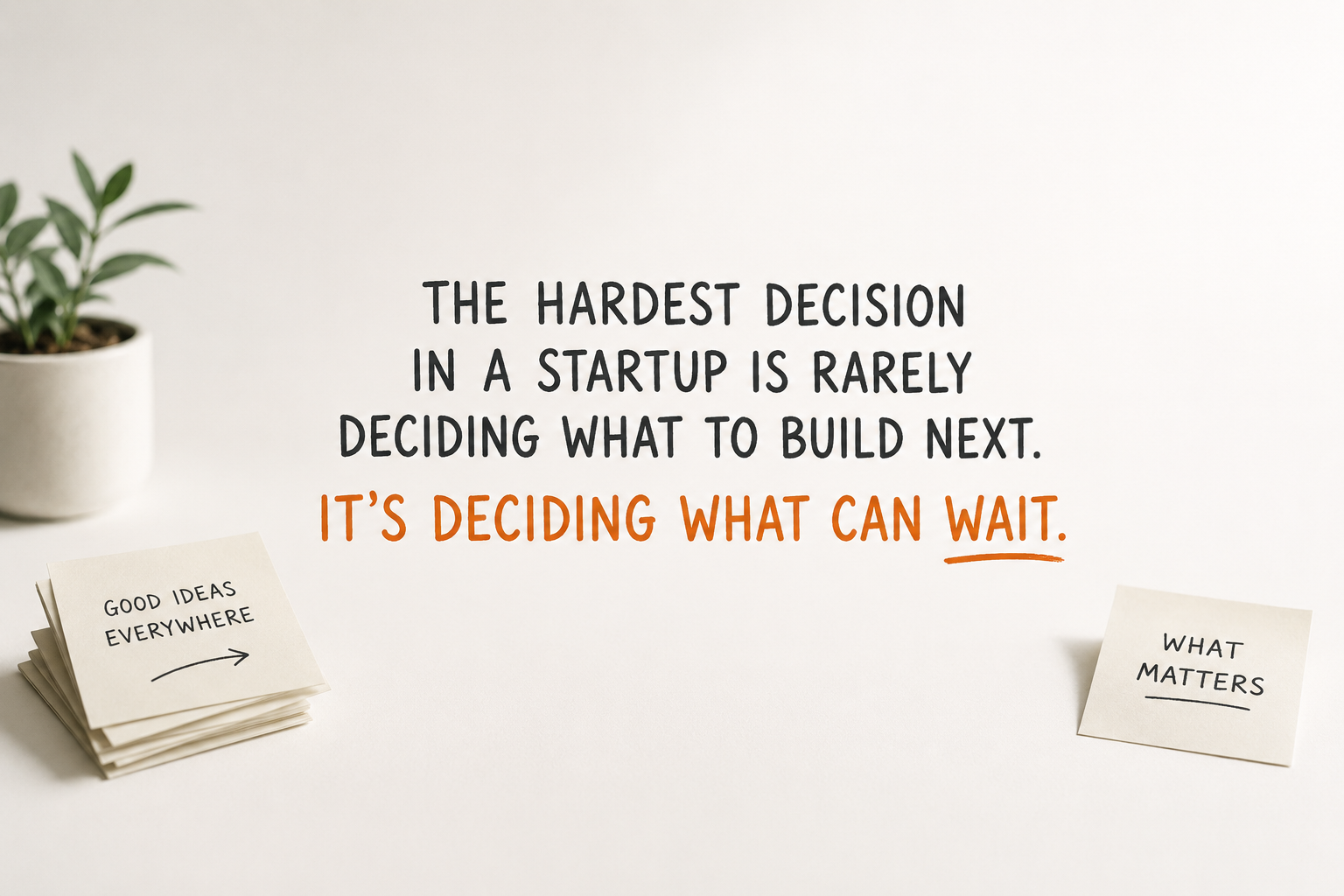
The Illusion of Good Prioritization
One of the most common complaints in startups is that there is never enough time.
Not enough time to build. Not enough time to improve existing features. Not enough time to fix technical debt. Not enough time to think strategically.
The usual assumption is that the problem is a lack of resources. Not enough people. Not enough money. Not enough hours in the day.
Sometimes that's true.
But often the problem is something much simpler.
Too many priorities. Most startups do not suffer from a lack of ideas. They suffer from an abundance of them.
- A customer requests a feature.
- Sales identifies a new opportunity.
- Marketing wants support for a campaign.
- Engineering raises concerns about technical debt.
- A competitor launches something interesting.
- An investor suggests a new direction.
Individually, each request seems reasonable. Each one can be justified. Each one feels important. And that is precisely what makes prioritization so difficult.
The challenge is rarely identifying good opportunities. The challenge is deciding which opportunities deserve attention right now.
As startups grow, roadmaps become longer. Initiatives multiply. New requests arrive faster than old ones are completed. Eventually, the organization reaches a point where everything appears to be a priority. And when everything is a priority, nothing truly is. This creates a dangerous illusion. Teams feel productive because they are constantly busy. Roadmaps are full. Meetings are scheduled. Projects are launched. Work is happening everywhere.
Yet progress often slows.
Not because people are working too little. But because the organization is trying to move in too many directions at once.
The irony is that many companies believe they have a prioritization system. What they actually have is an accumulation system.
New priorities are added.
Very few are removed.
And over time, the weight of those decisions begins to affect everything else.
Because the true cost of prioritization is rarely visible at the moment a decision is made, it appears later. In unfinished work. In context switching. In delayed decisions.
And in the growing belief that everything is urgent.
Why Everything Feels Important
If prioritization were simply a matter of identifying important work, most startups would not struggle with it.
The reality is far more complicated. Most priorities are important. That is exactly why prioritization becomes difficult.
- A customer requests a feature that could improve retention.
- Sales identifies an opportunity that could unlock a significant deal.
- Engineering raises concerns about technical debt that may slow future development.
- Marketing proposes a campaign that could generate new leads.
- Investors ask questions about growth.
- A competitor launches a feature that suddenly becomes the topic of discussion across the industry.
None of these concerns are unreasonable. None of them should be ignored. And that is where the challenge begins. The problem is not that startups cannot identify important work. The problem is that they struggle to distinguish between what is important and what is important right now. Those are not the same thing.
A customer request may be valuable. That does not automatically make it the highest priority. Technical debt may eventually become a serious problem. That does not mean it deserves immediate attention over an urgent customer issue. A competitor's new feature may create pressure. That does not mean copying it will improve your business.
Yet many organizations react as if every new piece of information requires a new priority.
- A customer complains. The roadmap changes.
- A competitor launches something new. The roadmap changes again.
- A large prospect requests a custom feature. The roadmap changes once more.
Over time, the roadmap stops representing a strategy. It starts representing a collection of reactions.
The irony is that most of these decisions are made with good intentions. Nobody is trying to create chaos. People are trying to be responsive. Helpful. Customer-focused. Competitive.
The problem is that responsiveness without discipline creates instability.
Every new priority consumes attention.
Every new priority requires decisions.
Every new priority competes with work that is already in progress.
And because the cost is distributed across the organization, it is rarely visible when the decision is made. The founder sees an opportunity. Sales sees potential revenue. The customer sees their request being acknowledged.
What nobody immediately sees is everything that must now slow down, pause, or wait.
This is why prioritization is not simply about deciding what to do. It is about protecting the organization from the constant pressure of everything that appears important.
Because if every opportunity becomes a priority, priorities lose their meaning. And when that happens, the organization begins paying a cost that few leaders measure.
The cost of constantly switching attention from one thing to another.
One famous example comes from Microsoft's early years.
Examples:
For a long time, Microsoft was known for pursuing multiple initiatives simultaneously. Internal teams often competed for resources and attention, while leaders faced constant pressure to respond to competitors, emerging technologies, and new market opportunities.
When Satya Nadella became CEO, one of his major challenges was not a lack of opportunities but a lack of focus. Microsoft began simplifying priorities, aligning teams around a smaller number of strategic goals, and reducing internal competition for attention.
The result was not fewer opportunities. The result was greater clarity about which opportunities mattered most.
A similar lesson can be found in the history of Apple.
When Steve Jobs returned to Apple in 1997, the company had dozens of products, overlapping initiatives, and competing priorities. Rather than introducing more projects, Jobs famously reduced the company's focus to a small number of core products.
The challenge was not identifying good ideas. The challenge was deciding which good ideas deserved resources and attention. Many opportunities were abandoned.
But that discipline allowed the company to concentrate its efforts where they mattered most. In retrospect, Apple's turnaround is often explained through innovation. Less attention is given to the fact that it was also an exercise in ruthless prioritization.
*https://sebastiaanvanderlans.com/steve-jobs-wwdc-1997/?utm_source=chatgpt.com
The Cost Nobody Measures: Context Switching
At this point, a founder might be thinking:
"Okay, I understand that not everything should be a priority. But if something important comes up, shouldn't we adjust?"
Of course. The problem is not changing priorities. The problem is changing them too often. Most leaders look at a priority change and see only the visible work. A customer requests a feature. A large prospect asks for a customization. A bug appears in production. A competitor launches something new. A roadmap gets updated. The team changes direction. Everything seems reasonable.
What most people don't see is the invisible work that comes with that decision.
Imagine a developer who has spent three days working on a feature. They understand the requirements. They know the edge cases. They have a mental map of the code. Then a new priority appears.
Work stops.
The developer switches to something else. Two weeks later, they come back to the original feature. At first glance, it looks like they are simply continuing where they left off. But that's not what actually happens.
- They need to remember why certain decisions were made.
- They need to review old conversations.
- They need to understand unfinished code.
- They need to reconstruct the mental model they had before the interruption.
- In many ways, they are doing the work twice.
And this is not just a feeling.
Research on task switching has consistently shown that moving attention between complex tasks creates a measurable performance cost. The American Psychological Association points out that people are generally less efficient when they attempt to handle multiple demanding tasks at the same time. The brain does not truly multitask. It switches attention back and forth, and every switch carries a cost.
That cost becomes especially expensive in knowledge work.
- Developers.
- Designers.
- Product Managers.
- Engineers.
- Writers.
- Analysts.
Their value does not come from moving quickly between tasks. It comes from building deep understanding. And deep understanding takes time.
Researcher Gloria Mark, who has spent years studying interruptions at work, found something fascinating. After an interruption, it can take people more than twenty minutes on average to fully return to the original task. Not because they are distracted. Because rebuilding context takes effort.
Most organizations never measure this. They measure completed projects.
- Delivered features.
- Velocity.
- Revenue.
But they rarely measure the hours spent recovering from interruptions. The result is a hidden productivity tax. Every priority change creates invisible work. A developer stops coding and starts rebuilding context. A designer stops designing and starts remembering. A Product Manager stops planning and starts reconnecting pieces of information spread across dozens of conversations and documents.
None of this work appears on a roadmap.
Yet it consumes enormous amounts of time.
This is one reason many startups feel busy while making less progress than expected.
- Everyone is working.
- Everyone is moving.
- Everyone is solving problems.
But attention is constantly fragmented. And fragmented attention produces fragmented results.
I've seen teams spend weeks jumping between initiatives because each new opportunity felt too important to ignore.
A customer request appears.
Then a sales opportunity.
Then a production issue.
Then a feature request from another customer.
Then a competitor launches something new.
Individually, every decision makes sense. Collectively, they create a cycle where nothing receives enough sustained attention to be completed properly. The organization becomes responsive. But responsiveness is not the same thing as progress.
Progress requires focus.
Progress requires time.
Progress requires staying with a problem long enough to actually solve it.
When priorities change too often, projects don't move faster. They simply move less efficiently. And over time, that creates another problem.
The organization accumulates a growing collection of initiatives that have been started, partially completed, and then abandoned in favor of something else.
Which leads to one of the most common sights inside growing startups: a graveyard of half-finished initiatives.
The Graveyard of Half-Finished Initiatives
One of the easiest ways to understand a company's priorities is not to look at what it has completed. Look at what it has started. Most startups have no shortage of initiatives. There is always something new being built, improved, redesigned, tested, or discussed. The problem is that starting work is much easier than finishing it.
Starting creates excitement.
Finishing requires commitment.
A new idea appears and everyone immediately sees its potential. People imagine how it could help customers.
Generate revenue.
Improve growth.
Differentiate the product.
The energy is real.
The opportunity may be real as well.
But opportunities do not create value. Execution does. And execution requires staying with an initiative long enough to complete it. This is where many organizations struggle. After enough priority changes, projects stop moving toward completion and start competing for attention. The result is a growing collection of partially completed work. A feature reaches version one but never receives the improvements users actually need. A process is introduced, but nobody follows it consistently. A reporting dashboard is launched, but nobody trusts the data. A documentation effort begins but is abandoned after a few weeks. Nothing has technically failed. Yet nothing has fully succeeded either. This creates an illusion of progress. From the outside, the company looks active. The roadmap is full. Teams are busy.
New work is constantly being announced. But activity and completion are not the same thing. Customers rarely benefit from initiatives that are 80% complete. The market does not reward effort that never reaches the finish line. Value is created when work is completed, adopted, improved, and maintained over time.
One example can be found in product development itself.
Many software teams measure "work in progress" because unfinished work creates risk. The more initiatives that remain open simultaneously, the harder it becomes to move any individual initiative to completion.
The same principle applies at the organizational level.
Every unfinished project competes for attention.
Every unfinished feature creates future decisions.
Every unfinished process generates uncertainty.
Over time, these loose ends begin to accumulate.
And eventually, leaders find themselves spending more time managing unfinished commitments than creating new value. That is why most startups do not have a shortage of ideas. They have a surplus of unfinished work. And the larger that surplus becomes, the more difficult leadership becomes. Because every unfinished initiative eventually demands a decision:
- Should we continue?
- Should we improve it?
- Should we restart it?
- Or should we finally let it go?
And when dozens of those decisions accumulate, leaders begin experiencing another hidden cost of poor prioritization: decision fatigue.
Decision Fatigue at the Leadership Level
By this point, the consequences of poor prioritization are no longer limited to projects and roadmaps. They start showing up in leadership itself. Most founders do not wake up in the morning planning to make bad decisions. In fact, the opposite is usually true. They care deeply about the business. They want to help customers. They want to support the team. They want to capture opportunities before competitors do.
The challenge is that every one of those goals requires decisions. And decisions consume attention.
A founder's day is often a constant stream of competing demands. A customer requests a feature. A candidate needs to be interviewed. A partnership opportunity appears. A bug reaches production. A salesperson needs support to close a deal. An investor asks questions about growth. A team member needs guidance. Individually, none of these decisions seem overwhelming. Collectively, they create a continuous demand on a founder's attention.
The problem is not simply the number of decisions. The problem is that many of them remain unresolved.
Questions stay open. Priorities remain unclear. Trade-offs are postponed. Instead of reducing uncertainty, the organization accumulates it. And uncertainty has a cost. Every unresolved decision continues occupying mental space. Founders carry these decisions into meetings. Into customer conversations. Into product discussions.
Sometimes even into evenings and weekends. Not because they are actively working on them. But because the brain keeps trying to find closure. Over time, this creates decision fatigue. Not exhaustion from working hard. Exhaustion from constantly evaluating competing priorities.
- Should we build this feature?
- Should we delay that release?
- Should we hire now or wait?
- Should we focus on retention or growth?
- Should we solve the current problem or invest in the future?
Eventually, the quality of decision-making begins to decline. Not because leaders become less intelligent. Because their attention becomes fragmented.
Research in psychology has repeatedly shown that decision quality tends to deteriorate when people are forced to make large numbers of choices without sufficient recovery time. The issue is not knowledge. The issue is cognitive load.
Founders experience this every day. The irony is that many postponed decisions feel harmless. It is easy to believe that waiting preserves flexibility. Sometimes it does. But more often, it creates uncertainty for everyone else. Teams wait. Projects slow down. Priorities become ambiguous. People start making assumptions. And assumptions rarely improve alignment. This is why delayed decisions often become expensive decisions. The longer uncertainty remains unresolved, the more people are affected by it. The more work is delayed. The more context is lost. The more difficult the eventual decision becomes.
The best leaders are not necessarily those who make perfect decisions. They are the ones who create CLARITY quickly enough for the organization to keep moving. Because prioritization is not just a roadmap exercise.
It is a decision-making discipline.
And understanding that distinction changes how we think about priorities altogether. Which brings us to the most common misunderstanding in startups: what prioritization actually means.
What Prioritization Actually Means
At this point, many founders come to the same conclusion:
"We need better prioritization."
The problem is that most people misunderstand what prioritization actually means. When teams talk about priorities, the conversation usually focuses on choosing what to do next.
- Which feature should we build?
- Which customer request should we address?
- Which market opportunity should we pursue?
- Which initiative should move to the top of the roadmap?
These are important questions. But they are not really questions about prioritization. They are questions about selection.
True prioritization starts earlier. Before an organization decides what to do, it must decide what it is willing not to do. That is the part most people avoid. Saying yes feels productive. Saying no feels uncomfortable. A new feature could help customers. A partnership could create growth. A prospect might become a major client. An investor may suggest a promising opportunity. Every option comes with a reasonable argument. Every option has potential.
That is exactly what makes prioritization difficult. The challenge is rarely identifying good opportunities. The challenge is accepting that the organization cannot pursue all of them at the same time. Every company operates under constraints.
Limited time.
Limited resources.
Limited attention.
The moment leaders forget those constraints, priorities begin to multiply. Roadmaps grow longer. Projects accumulate. Teams become overloaded. And eventually the organization finds itself trying to move in ten directions at once.
This is why prioritization is fundamentally a trade-off. Every time a company commits to one initiative, it is choosing not to invest those same resources somewhere else. Every time a team says yes, it is also saying no. Whether that trade-off is acknowledged or not, it still exists.
One of the most famous examples comes from Apple.
When Steve Jobs returned in 1997, Apple had dozens of products and numerous competing initiatives. Instead of adding more priorities, he dramatically reduced the number of products the company would focus on.
Years later, Jobs explained that focus is not about saying yes to the thing you decide to pursue. It is about saying no to the many other good ideas competing for attention.
That distinction matters. Most opportunities are not obviously bad. Many are genuinely promising. The difficulty lies in deciding which opportunities deserve attention now and which ones must wait. Strong organizations understand this. Weak organizations try to avoid the trade-off. They continue adding priorities without removing existing ones. The result is predictable. Teams become busy. Projects move more slowly. Attention becomes fragmented. And execution suffers.
The irony is that saying no often creates more progress than saying yes. Every initiative that is removed gives more attention to the initiatives that remain. Every distraction that disappears creates more capacity for meaningful work. Every postponed opportunity allows the organization to finish what it has already started.
In that sense, prioritization is not really about choosing work. It is about protecting focus.
Because focus is what allows ideas to become products. Products to become businesses. And businesses need to become sustainable. The companies that understand this do not move faster because they do more. They move faster because they have the discipline to do less.
And that discipline creates a competitive advantage that many organizations underestimate.
Conclusion
The longer I work with startups, the less I believe that success is primarily a function of ideas. Ideas matter. They create opportunities. They open doors. But most startups do not struggle because they lack opportunities. They struggle because opportunities are endless. There is always another feature that could be built. Another market that could be explored. Another customer request that could be addressed. Another initiative that might create growth.
The challenge is not finding things to do. The challenge is deciding what deserves attention now and what can wait. That sounds simple. In reality, it is one of the hardest disciplines in business. Because every opportunity comes with a cost. Every new initiative competes for resources. Every priority demands attention. And every decision to pursue one path means leaving another path unexplored.
When organizations lose sight of those trade-offs, priorities begin to multiply. Attention becomes fragmented. Work slows down. Teams become busy but progress becomes harder to see.
Not because people stop caring.
Not because they stop working hard.
But because focus is gradually replaced by motion.
And motion can be deceptive. A full roadmap feels productive. A busy calendar feels productive. A growing list of initiatives feels productive.
But activity is not the same thing as progress. Progress requires commitment. Progress requires sustained attention. Progress requires the discipline to stay focused long enough for good ideas to become meaningful results.
The companies that execute well understand something that many organizations learn only through experience:
Focus is not created by adding priorities.
Focus is created by removing them.
And sometimes the most important strategic decision is not choosing what to build next.
It is having the courage to decide what can wait.
Sources:
- American Psychological Association — multitasking and switching costs https://www.apa.org/topics/research/multitasking
- PubMed — Rubinstein, Meyer & Evans study on task switching https://pubmed.ncbi.nlm.nih.gov/11518143/
- UC Irvine / Gloria Mark — interrupted work study PDF https://ics.uci.edu/~gmark/chi08-mark.pdf
- Gallup interview with Gloria Mark — 23 minutes 15 seconds to resume interrupted work https://news.gallup.com/businessjournal/23146/too-many-interruptions-work.aspx
- Atlassian — context switching explanation https://www.atlassian.com/blog/productivity/context-switching


