Why Performance Ratings Fail - And What to Do Instead

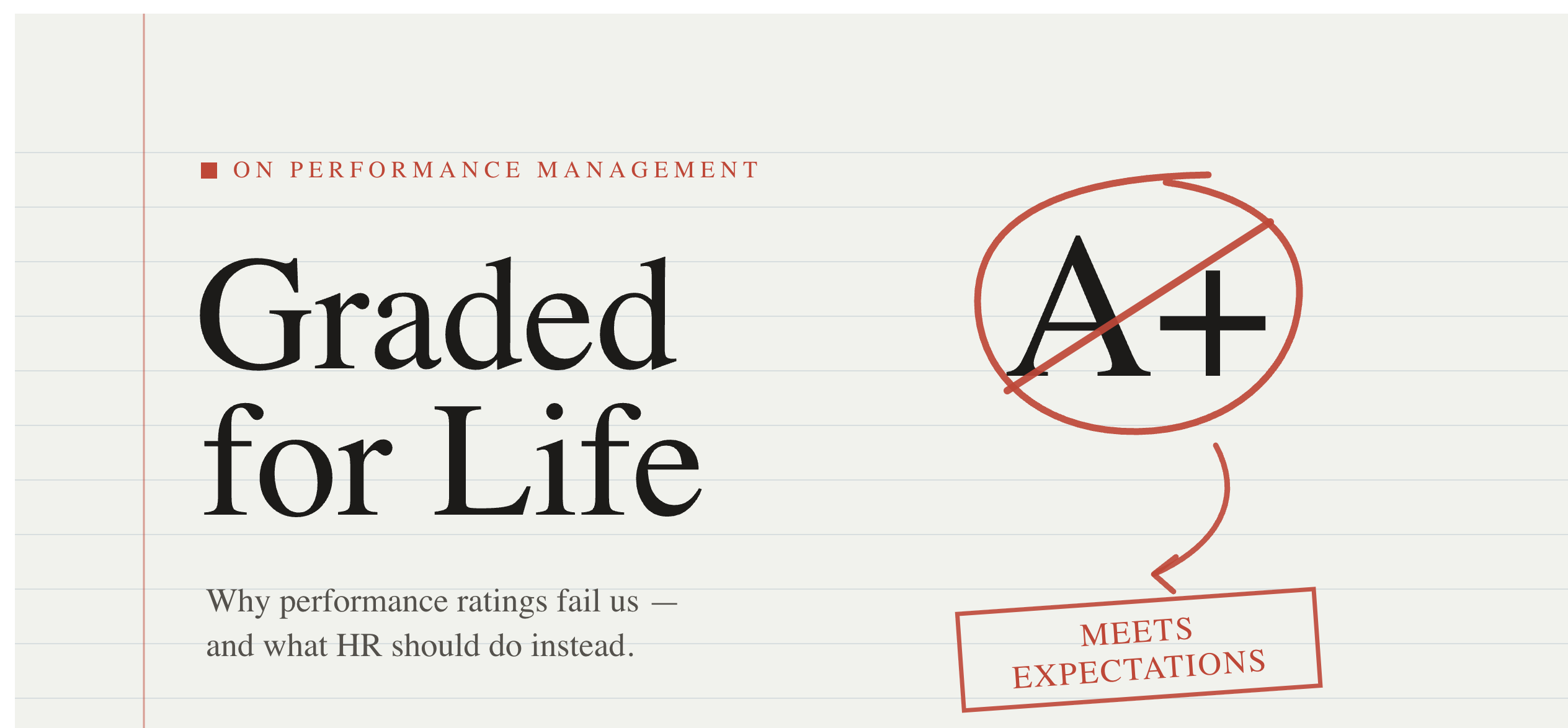
The first time I ever heard someone seriously argue for getting rid of performance ratings, I was an HR manager at WebMD and had just turned 30.
An HR column writer (and I genuinely wish I could remember her name) referred to people who defended performance ratings as “weenies.”
I remember thinking she was being provocative for the sake of it. I’d been conditioned by ratings my entire career. They were just how the work world worked. It wasn’t until much, much later that I realized she had a point. Wherever she is, I hope she’s still out there moving the needle.
Then, about twelve years ago at Electronic Arts (EA), we actually did it. We moved away from performance ratings. At the time, it still felt strange to me. Then I watched it work, and I finally understood what that writer was getting at.
We Spend Two Decades Learning the Opposite Lesson
Think about the arc of a person’s life before they ever enter the workforce. From kindergarten through a bachelor’s degree, maybe a master’s or a PhD, we are graded constantly. And in nearly all of those systems, everyone can get the A. There’s rarely a forced curve. If the teacher can justify the grade, the entire class can earn it. A 95 means you did excellent work: full stop, regardless of how your classmates did.
Then we hand that same person a job, and we flip the rules entirely. Now there’s a fixed, limited number of top ratings, usually tied directly to the biggest pay increases. We take people who spent twenty-plus years internalizing that a B is disappointing and a C is alarming, and we tell them that “meets expectations” (the corporate equivalent of a 75) should feel “just fine”.
It doesn’t feel fine.
It feels like failure. The employee didn’t do anything wrong and isn’t a poor performer, but how do you expect to remove 20+ years of conditioning in performance?
The Parts That Break Trust
If the psychology were the only problem, maybe we could train our way out of it. But the mechanics of forced ratings are just as flawed, and employees can see it.
Politics beats performance. Even with genuine calibration, the system isn’t clean. A manager who’s skilled at internal politics, who’s built the right relationships with the right leaders, can get a solid-but-unremarkable performer rated higher than someone on another team who moved the needle on something that actually mattered. All because one manager knew how to play the room and the other didn’t.
Quiet managers penalize their people. The flip side is just as damaging. An employee can do exceptional work and still lose out simply because their manager doesn’t know how to champion them in a calibration session. The employee never sees that conversation. They just see the ratings and are left to draw conclusions about their own worth.
The compensation math doesn’t even pay off. The entire justification for forced ratings is usually that we need them to differentiate pay. But look at how merit budgets are actually funded. When the merit pool is 3% and change, the difference between your top rating and your middle rating is often a rounding error on a paycheck. We put employees through an emotionally loaded, politically distorted grading exercise so we can pay our very best performers 18 cents more than everyone else. That’s a lot of trust destroyed for very little differentiation delivered.
It’s high risk, low value, and (ironically) low effort. For all the process weight, an annual forced rating is one of the laziest forms of performance management there is. It compresses a year of human effort into a single label, once a year, built more for compensation math than for actually developing anyone.
None of This Means Performance Management Is the Problem
Here’s where I want to be very clear, because this is where the conversation usually goes off the rails: the failure of ratings is not the failure of performance management.
Coaching. Feedback. Motivation. Real relationship-building between a manager and their people. That work isn’t just worth keeping — it’s essential to a business running well. What’s broken is the annual, forced-rating system we bolted on top of it. The grading system none of us asked to be re-enrolled in as adults.
This Is Where HR Business Partners Earn Their Impact
And this, to me, is the real opportunity - because the most meaningful work an HR business partner can do lives exactly in this space. Not administering the rating cycle. Coaching managers into behaving like leaders.
That looks like:
- Teaching managers how to give feedback and why it matters. Not once a year in a form, but on the spot, in the moment, when it can actually change something and at least once a month if not quarter on how things are going.
- Role-playing the hard conversations. Sitting with a manager before a difficult discussion and practicing it, so they walk in prepared instead of avoidant.
- Coaching managers to motivate and innovate. Helping them understand what actually drives each person on their team, and how to create room for people to grow and ensuring they have the tools to do this essential part of their job.
- Building platforms for two-way dialogue. The best managers don’t just deliver feedback, they create an environment where employees can bring tough conversations back to them.
- Working through the manager’s leader when needed. Sometimes the most effective coaching an HRBP does is indirect - by equipping leaders to develop the managers underneath them.
If you’re an HR business partner, ask yourself honestly how your time splits between running the performance process and coaching your leaders to be coaches. Because one of those activities is administration. The other one changes how the business actually performs.
Good performance management is a critical component of a business running well.
We don’t need to abandon it. We need to finally separate it from a grading system that was built for compensation math — and give our energy back to the work that develops people.
What do all of you think?
Has your organization moved away from ratings - and if so, what changed?

This subscription is no longer available
Daniel Space is not currently accepting new subscribers.
You can still enjoy any free blogs they share, but premium content is now unavailable for new subscriptions.


