Why Startups With Good Ideas Still Fail

Published on
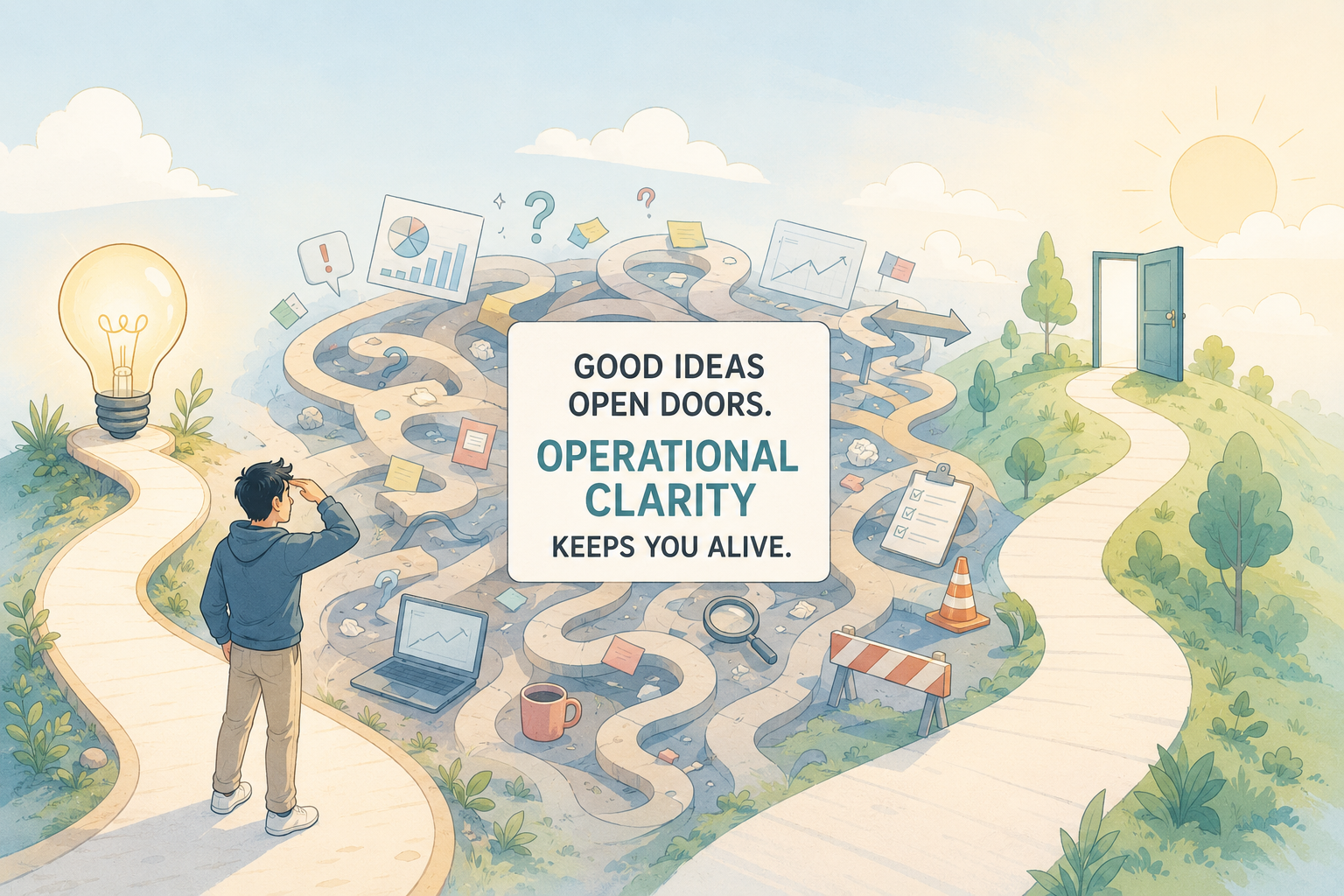
The Myth of the Great Idea
Every startup begins with an idea. A founder sees a problem that others overlook. A new opportunity emerges. A different way of doing things becomes possible. The idea attracts attention. Investors ask about it. Teams rally around it. Customers become curious about it.
And for a while, the idea feels like the most important part of the company.
This creates one of the most common misconceptions in the startup world: that great companies are built primarily on great ideas.
But if that were true, far fewer startups would fail. The reality is that good ideas are everywhere. Every day, founders imagine products that could improve industries, simplify processes, solve frustrations, or create entirely new markets. Many of these ideas are genuinely valuable.
Yet most never become successful businesses. Not because the idea was wrong. Not because the founders lacked passion. And often not because the market was too small.
The gap between a promising idea and a sustainable company is much larger than most people realize.
Ideas create opportunities. Execution creates results.
And between those two sits something that receives far less attention than it deserves: operational clarity.
Operational clarity is what helps teams understand priorities, make decisions, allocate resources, learn from mistakes, and move in the same direction when uncertainty appears.
Without it, even the most promising idea can slowly dissolve into confusion, misalignment, and wasted effort.
A good idea can open the door, but only operational clarity can keep the company alive. The challenge is that startups rarely lose their way all at once.
Most begin with something far more subtle.
They start falling in love with the idea itself.
Every founder needs a certain amount of belief.
Starting a company requires conviction. Long before customers arrive, before revenue appears, and before anyone else understands the vision, founders have to believe that what they are building matters.
Without that belief, most startups would never get off the ground. The problem begins when belief slowly turns into attachment. At first, the idea is a hypothesis. A possible solution. Something to be tested. But as time, energy, and money are invested, the idea can start to feel less like a hypothesis and more like a fact.
Questions become assumptions. Assumptions become certainty. And certainty becomes dangerous.
Founders stop asking:
"Is this the right solution?"
And start asking:
"How do we make people understand this solution?"
The difference seems small, but it changes everything. When a startup is still learning, feedback is valuable. When a startup becomes attached to an idea, feedback becomes inconvenient. Customer objections are explained away. Weak adoption is blamed on marketing. Requests for different features are dismissed as misunderstandings.
The team continues building because everyone assumes success is just one more feature, one more release, or one more marketing campaign away.
Sometimes it is. Often it isn't.
The market does not reward effort. It does not reward passion. It does not reward how long a founder has believed in an idea.
The market rewards companies that solve real problems in ways customers actually value.
That requires something many founders struggle with: letting reality challenge the original vision.
The strongest startups are not the ones that defend their ideas the longest.
They are the ones that learn the fastest.
And that learning becomes much harder when nobody inside the company can clearly see what is actually happening. This is where the next problem begins: operational blindness.
Operational Blindness
Once founders become attached to an idea, a dangerous shift often begins. They stop looking for evidence. And start looking for confirmation. This is where operational blindness emerges.
Operational blindness is not the absence of data. Most startups have plenty of data.
- Dashboards.
- Analytics.
- Customer feedback.
- Revenue reports.
- Feature requests.
The problem is that information and understanding are not the same thing.
A startup can be surrounded by information and still have very little clarity about what is actually happening.
This often starts earlier than founders realize.
Research from McKinsey https://www.mckinsey.com/capabilities/people-and-organizational-performance/our-insights/successful-transformations#/
found that a significant portion of organizational value is lost before implementation even begins. Before projects are launched, before teams start executing, and before customers ever experience the result, companies are already making assumptions that limit their future success.
Startups face the same risk. A founder believes they understand the problem. The team believes they understand the priorities. Everyone believes they understand the customer. But few people stop to verify those assumptions.
As a result, the company begins making decisions based on interpretations instead of facts.
Features are built because they seem important. Roadmaps expand because opportunities appear exciting. Resources are allocated based on confidence rather than evidence. The startup becomes busy. But busy is not the same as effective.
One of the most dangerous aspects of operational blindness is that it often looks like progress. The team is working hard. Meetings are happening. New features are being released. Investors are receiving updates. Customers are signing up. Everything appears to be moving forward.
Yet beneath the surface, fundamental questions remain unanswered.
- Which customer problem matters most?
- What creates the most value
- What should the team stop doing?
- What assumptions have been proven wrong?
- What have we actually learned in the last thirty days?
When these questions are unclear, activity begins replacing understanding.
The company keeps moving, but nobody can confidently explain whether it is moving in the right direction.
And when different people begin forming different answers to those questions, operational blindness evolves into an even bigger problem: misalignment.
The Alignment Problem
Operational blindness rarely stays contained. Once people lose clarity about what is happening, they begin creating their own interpretations of reality. And that is where misalignment begins.
At first, it is almost invisible.
- The founder believes the company is solving one problem.
- Product believes the priority is something slightly different.
- Engineering interprets requirements through a technical lens.
- Sales hears customer frustrations and starts making promises based on those conversations.
- Marketing develops messaging based on what it believes customers care about most.
Everyone is acting with good intentions. Everyone is working hard. And everyone is moving in a slightly different direction.
This is one of the most dangerous challenges a growing startup faces.
Not because people disagree. But because they often believe they agree. The language sounds aligned. The mission statement sounds aligned. The roadmap sounds aligned.
Yet when you look closely, different teams are optimizing for different outcomes.
- The founder wants growth.
- Product wants adoption.
- Engineering wants stability.
- Sales wants faster delivery.
- Customer Success wants fewer complaints.
None of these goals are wrong.
The problem appears when nobody has established clear priorities between them.
Research on organizational transformations repeatedly shows that successful organizations do more than communicate goals. They make those goals tangible. People at every level understand how their daily work connects to the company's broader objectives. When that connection is missing, performance suffers because individuals begin making decisions based on their own assumptions rather than shared understanding.
Startups experience this problem constantly. A founder explains the vision. The team nods. Everyone leaves the meeting believing they understand the direction.
Weeks later, different teams have interpreted the same vision in completely different ways.
The result is not conflict.
The result is friction.
Small misunderstandings begin accumulating.
Projects take longer than expected.
Features miss customer expectations.
Priorities change repeatedly.
Meetings multiply.
Decisions are revisited.
Energy is spent coordinating instead of creating value.
The company remains busy, but progress becomes increasingly difficult.
The irony is that most startups try to solve misalignment by adding more communication.
More meetings.
More documents.
More updates.
But misalignment is rarely caused by a lack of communication. It is usually caused by a lack of clarity.
People do not need more information. They need a shared understanding of what matters most. Without that clarity, every team creates its own version of success.
And once that happens, the organization starts developing another dangerous habit.
Everything becomes urgent.
The Culture of Urgency
Without alignment, priorities begin to compete. And when priorities compete, everything starts feeling urgent. A customer requests a feature. Sales wants a faster release. Engineering discovers technical debt. Product identifies an opportunity. Marketing needs support for a campaign.
Investors ask for updates.
Each request is reasonable. Each request has a valid explanation. Each request feels important.
The problem is that importance and urgency are not the same thing.
In healthy organizations, priorities are clear enough that teams can distinguish between the two.
In struggling organizations, everything becomes urgent because nobody has agreed on what matters most. At first, urgency feels productive.
People move quickly. Messages are answered immediately. Meetings appear on calendars with little notice. Roadmaps change to accommodate new opportunities. Teams work longer hours. The company feels energetic. From the outside, it can even look like momentum. But over time, urgency creates a hidden cost.
People stop thinking strategically.
Decisions become reactive.
Teams focus on solving today's problem without understanding whether it should have been a priority in the first place.
The organization becomes trapped in a cycle of constant response.
Research on successful transformations suggests that organizations perform better when people understand how their daily work connects to larger goals and when communication reinforces those priorities consistently.
The opposite is also true.
When priorities are unclear, urgency fills the vacuum.
Teams begin making decisions based on whoever is speaking the loudest, whichever customer complained most recently, or whichever issue feels most painful in the moment.
- The result is not speed.
- The result is volatility.
- Priorities change.
- Context shifts.
- Focus disappears.
People become exhausted not because they are working hard, but because they are constantly changing direction. One week, the company is focused on growth. The next week is focused on retention. Then revenue. Then, a competitor's new feature. Then, an unexpected customer request.
The startup keeps moving, but its energy becomes fragmented. And fragmented energy rarely produces exceptional results.
The irony is that most founders believe urgency helps startups move faster.
In reality, urgency often slows them down.
When everything is urgent, teams spend more time reacting than improving. More time switching than finishing. More time responding than learning. Eventually, the organization develops a habit of solving symptoms instead of causes.
And that is where the next stage begins.
Reactive execution.
Reactive Execution
Once urgency becomes part of the culture, the organization begins to change in subtle ways. Teams stop driving the business. The business starts driving the teams.
Instead of executing according to a clear strategy, people spend their days responding to whatever demands attention first.
- A customer complains.
- A competitor launches a feature.
- A bug appears in production.
- A prospect requests a custom solution.
- An investor asks a difficult question.
- A team member raises a concern.
Each event creates a reaction. Individually, these reactions seem reasonable. Collectively, they create chaos. This is the trap of reactive execution. The company appears busy. People are solving problems. Work is getting done.
But the organization is no longer operating according to priorities. It is operating according to interruptions. The difference is enormous.
In a proactive organization, teams decide what matters most and allocate their attention accordingly.
In a reactive organization, attention is constantly pulled away from important work by whatever feels urgent at the moment.
As a result, long-term initiatives begin to suffer.
- Strategic projects move slowly.
- Technical debt accumulates.
- Processes remain broken.
- Customer insights go unexamined.
- The team spends so much energy responding to today's problems that it never creates time to prevent tomorrow's problems.
This is one reason many startups feel trapped in an endless cycle of firefighting. The same issues keep returning. The same conversations keep happening. The same bottlenecks keep appearing. Not because people are incapable. But because nobody has enough space to address the underlying causes.
Every solution becomes temporary.
Every fix becomes another item on tomorrow's to-do list.
The organization starts optimizing for immediate relief instead of long-term improvement.
Ironically, reactive execution often creates the illusion of responsiveness. Customers receive quick answers. Teams move quickly. Problems are addressed immediately.
Yet beneath the surface, the company becomes less adaptable, not more.
Because adaptability is not the ability to react. Adaptability is the ability to learn, adjust, and improve before problems become crises.
The most successful organizations understand this distinction.
- They do not spend all their energy fighting fires.
- They build systems that reduce the number of fires in the first place.
- They create feedback loops.
- They identify root causes.
- They improve processes.
- They make decisions that strengthen the organization over time rather than simply reducing today's pain.
And this leads to the most important difference between startups that survive and startups that fail.
The ability to learn faster than their competitors.
The Ability to Learn Faster Than Competitors
By this point, the pattern becomes clear. Startups rarely fail because of a single catastrophic mistake. More often, they fail because small problems compound over time. A founder becomes attached to an idea. The organization loses visibility. Teams become misaligned. Everything becomes urgent. Execution becomes reactive. And slowly, the company drifts further away from reality.
The startups that survive are not immune to these challenges. They experience the same uncertainty. The same pressure. The same resource constraints. The same mistakes.
What separates them is how quickly they learn.
Many founders assume their biggest competitors are other companies in the market.
Often, their biggest competitor is their own ability to recognize reality. The market is constantly providing feedback. Customers reveal what they value. Prospects reveal what they ignore. Employees reveal where processes are breaking down. Data reveals which assumptions were wrong. The question is not whether feedback exists. The question is whether the organization is capable of hearing it.
Learning sounds simple. In practice, it is difficult.
- Learning requires admitting that previous decisions may have been wrong.
- Learning requires challenging assumptions.
- Learning requires changing direction when evidence demands it.
- Learning requires replacing certainty with curiosity.
And curiosity becomes increasingly difficult as organizations grow. The strongest startups deliberately create systems that support learning.
- They talk to customers continuously.
- They measure outcomes instead of activity.
- They challenge assumptions regularly.
- They review failures openly.
- They encourage uncomfortable questions.
Most importantly, they treat every decision as a hypothesis rather than a conclusion. This creates a very different type of organization. Instead of defending existing beliefs, the company actively searches for better ones. Instead of protecting plans, it improves them. Instead of assuming it knows the answer, it continually asks better questions.
Over time, this creates a powerful advantage. A competitor may have more funding. A larger team. A stronger brand. More experience.
But if they learn more slowly, they eventually begin making decisions based on an outdated understanding of reality.
The company that learns faster gains something far more valuable than certainty.
It gains adaptability.
And adaptability is often what determines survival. Markets change. Customer expectations change. Technology changes. Competition changes.
The companies that thrive are not necessarily those that predicted every change.
They are the ones who adjusted to change faster than everyone else. In the end, startup success is rarely about having the perfect idea. It is about building an organization capable of discovering what works before resources, time, and opportunities run out. And that is why learning is not simply another business activity. It is the foundation that makes everything else possible.
Conclusion
When people talk about startup success, they often focus on ideas. The breakthrough concept. The disruptive technology. The unique insight that nobody else saw. Those stories are compelling because they are easy to understand.
A great idea appears.
A company is built.
Success follows.
Reality is rarely that simple.
A good idea may be the reason a startup begins. But it is rarely the reason a startup survives.
The journey from idea to sustainable business is filled with opportunities to lose direction.
- Founders become attached to assumptions.
- Organizations lose visibility.
- Teams drift out of alignment.
- Urgency replaces focus.
- Execution becomes reactive.
- Learning slows down.
And when learning slows down, reality eventually catches up.
The startups that endure are not necessarily the ones with the smartest founders. They are not always the ones with the most funding.They are not always the ones with the best technology.
More often, they are the ones that maintain clarity while everything around them becomes uncertain.
- They continue questioning assumptions.
- They stay aligned around priorities.
- They resist the temptation to make everything urgent.
- They solve root causes instead of chasing symptoms.
Most importantly, they build organizations capable of learning faster than the challenges they face. Because every market changes. Every product evolves. Every customer expectation shifts. No strategy survives forever. No roadmap remains perfect. No founder sees every answer in advance. The companies that survive are not those that avoid uncertainty. They are those that navigate uncertainty better than others.
In the end, startup success is not a story about ideas. It is a story about decisions, about learning, about clarity.
A good idea can open the door. But only operational clarity can keep the company alive.


