Teams Break Down When Ownership Is Fuzzy


On a distributed team I advised, three different people each thought someone else was handling the weekly client recap. Not because anyone was avoiding it. Each of them had quietly assumed, from the way it came up in a call, that it belonged to one of the others. The recap went out late twice, then not at all, and when it finally surfaced in a retro, the reaction was not guilt. It was surprise. Wait, that was mine?
That moment, the genuine surprise, is the tell. These were not people dodging work. They were people operating on three slightly different maps of who owned what, and the gaps between those maps were invisible until something fell into one.
On a co-located team, fuzzy ownership gets caught by accident. Someone overhears, someone swivels their chair and asks, the ambiguity gets resolved in a hallway without anyone noticing they resolved it. Remote teams lose all of those accidental corrections. The fuzziness just sits there, unspoken, until a deadline finds it.
How fuzzy ownership actually forms
Ownership rarely goes fuzzy through one big mistake. It erodes through small, reasonable-sounding moments. A task gets mentioned in a thread but assigned to no one. Two people are looped in for visibility and each reads the other as the actual owner. A piece of work changes hands during a busy week and the handoff happens in a passing message that one person treats as confirmed and the other treats as tentative.
None of these feel like errors when they happen. They feel like normal collaboration. That is what makes the pattern hard to catch. The damage is not in any single moment, it is in the accumulation of unowned edges across a dozen of them.
It gets noticeably worse when priorities are in motion, a dynamic I dug into separately in Teams Lose Focus When Priorities Constantly Shift. Every reprioritization quietly reshuffles who should own what, and almost nobody stops to re-state ownership when the work itself shifts under them.
Fuzzy ownership is not a sign people stopped caring. It is a sign three people are working from three different maps.
A simple way to make ownership visible
The fix is not a heavier tool. It is making the implicit map explicit, and keeping it that way. The pattern below is deliberately plain. For any meaningful piece of work, four things should be sayable in one breath by anyone on the team:
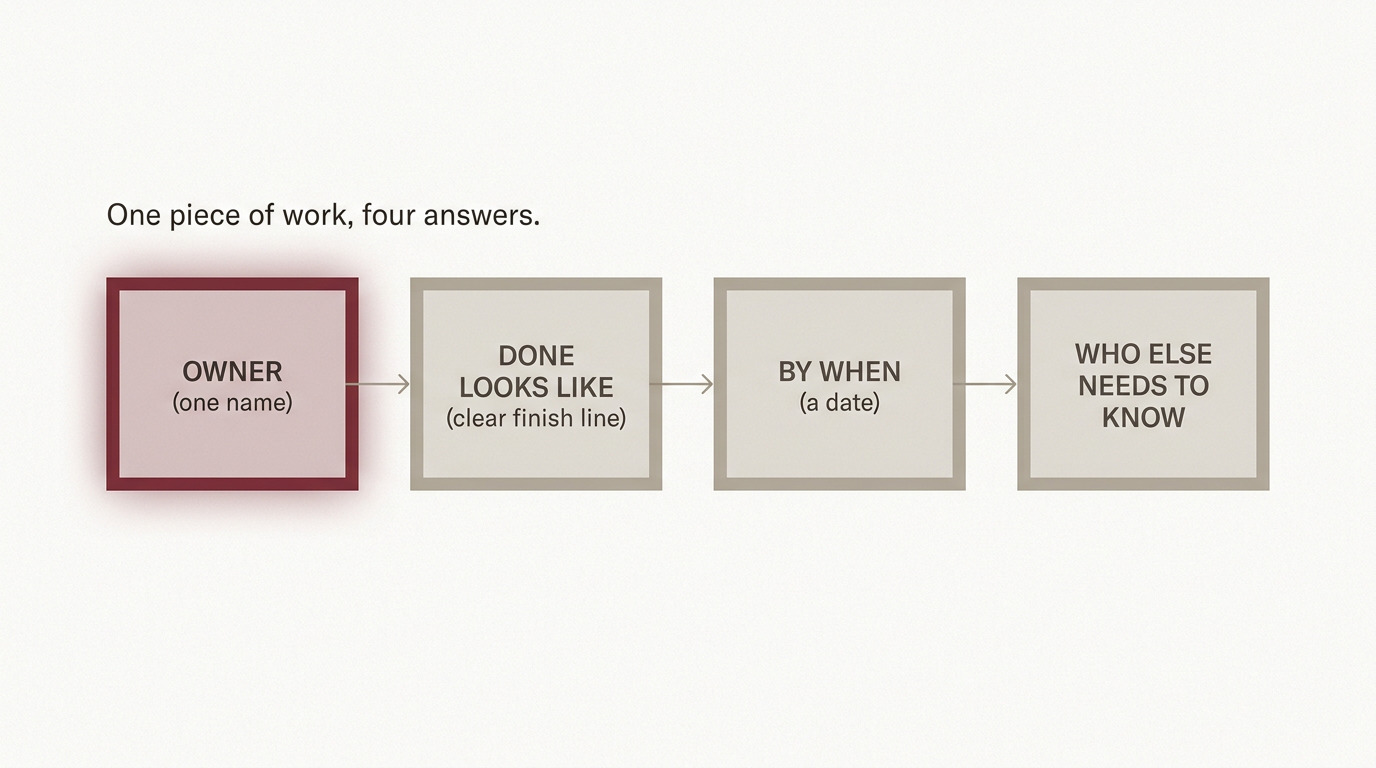
Owner is one name, not a team. Done looks like is a sentence, not a vibe. By when is a real date. And who else needs to know is the part most teams skip, which is exactly why the recap kept surprising people. If a piece of work cannot answer all four, it is not assigned yet, no matter how much it got discussed.
The discipline is not writing this down once. It is re-stating it whenever the work changes hands or the priorities move. A thirty-second so you are owning this now, done by Thursday, and looping in Maya does more than a polished tracker that nobody trusts.
Where teams get the fix wrong
The first overcorrection is tooling. A team feels the pain and reaches for a new system with owner fields and automated nudges. The system is not the problem. The unspoken assumption was the problem, and a tool full of unspoken assumptions just renders them in a nicer font.
The second is confusing ownership with doing it alone. Naming one owner does not mean that person does all the work, it means one person is accountable for it moving and for flagging when it is stuck. That distinction between owning an outcome and doing every task echoes the line drawn in Pair Programming vs Coaching: The Difference Is Ownership, and it is what keeps a single owner from quietly becoming a single bottleneck.
Worth trying this week
If your team has been having more should-have-been-obvious slips lately, a few concrete moves:
• Pick one thing that slipped recently and ask, without blame, who actually thought they owned it. The answer is usually more than one person, or no one, and that tells you it was a clarity gap, not a discipline gap.
• End your next planning call by reading ownership back out loud, one line per item: name, done, date. Watch for the items where someone goes wait, I thought that was yours.
• When work changes hands, make the handoff explicit in writing and ask for a one-word confirmation. The friction of waiting for that confirmation is the whole safeguard.
• Add who else needs to know to every owned item. Most distributed-team surprises are not missed work, they are missed visibility.
None of this needs a rollout. It is mostly the habit of saying ownership out loud at the moment everyone would otherwise have assumed it. On a remote team, that small spoken step replaces all the accidental corrections you used to get for free in a shared room.
Worth sitting with
On my team right now, which pieces of work could three people answer differently if I asked who owns this?
When work changes hands here, does the handoff get confirmed, or just assumed?
Am I treating a recent slip as a follow-through problem when it was really an ownership-clarity problem?
Where have I named a team as the owner when I should have named a person?
If those raised something, the next step is small and specific: take the one piece of work that feels fuzziest and make its four answers sayable in one breath. Clear ownership feels like over-explaining in the moment. A few weeks later it feels like the reason nothing fell through.


